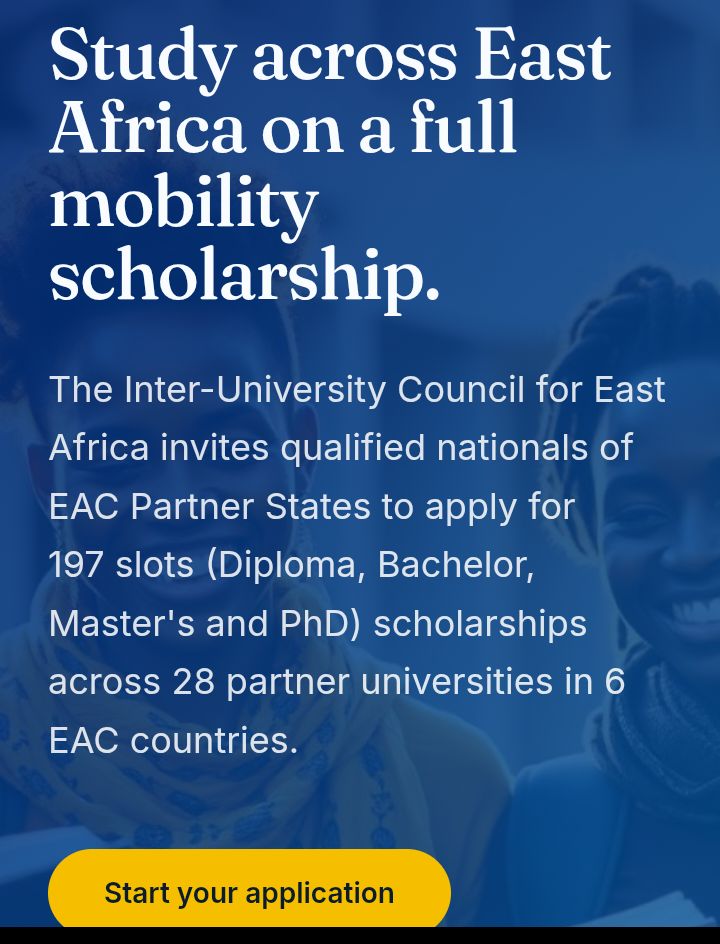
When I submitted my application for the IUCEA EAC Student Mobility Scholarship, I wasn’t thinking about how much my life would change. I simply wanted the chance to study at one of East Africa’s top universities without paying international tuition fees.
A year later, I found myself standing in a country I had only ever visited in books and documentaries, carrying a suitcase, a backpack full of research notes, and a mixture of excitement and anxiety.
Looking back now, I realise the scholarship gave me much more than an opportunity to study abroad. It introduced me to a completely different academic culture, expanded my professional network across East Africa, and challenged me in ways I never expected.
If you’re considering applying for the IUCEA EAC Student Mobility Scheme, here’s what the experience was really like from someone who has lived it.
The Acceptance Email Changed Everything
I’ll never forget opening the email.
I had refreshed my inbox so many times that day that I almost ignored the notification when it finally appeared.
The message confirmed that I had been selected for the 2026/2027 IUCEA EAC Student Mobility Scholarship.
For a few seconds I simply stared at the screen.
Then came excitement.
Then panic.
Because getting accepted was only the beginning.
There were documents to prepare, travel plans to make, accommodation to arrange, and an entirely new country waiting for me.
Studying in Another East African Country Felt Surprisingly Different
Before travelling, I assumed universities across East Africa would feel almost identical.
I couldn’t have been more wrong.
Every campus has its own rhythm.
Teaching styles differ.
Lecturers ask different kinds of questions.
Students approach assignments differently.
Even classroom discussions have their own personality depending on the country you’re studying in.
Those differences became one of the biggest strengths of the programme.
Instead of staying inside my academic comfort zone, I learned to adapt quickly.
That adaptability has become one of the most valuable skills I’ve gained.
Living Outside My Home Country Was the Real Education
People often ask about the lectures.
Ironically, some of the biggest lessons happened after classes ended.
Learning how public transport worked.
Shopping in local markets.
Trying unfamiliar foods.
Understanding local customs.
Finding affordable accommodation.
Building friendships with students from countries I had previously only read about.
These everyday experiences taught me as much about East Africa as my coursework did.
By the end of my first semester, I no longer felt like an international student.
I simply felt like another East African student trying to meet assignment deadlines.
The Scholarship Covered More Than I Expected
One thing many people misunderstand is how the EAC Student Mobility Scheme works.
It isn’t a fully funded scholarship where one organisation pays every expense.
Instead, it’s a cost-sharing programme, and understanding that before travelling saved me from several surprises.
Here’s how my funding worked:
The Host University
My university waived my tuition and examination fees.
Considering the cost of higher education, that was already a significant financial relief.
IUCEA Support
IUCEA covered:
Travel expenses
Health insurance
Research support for postgraduate students through a research lump sum
Knowing those essentials were taken care of allowed me to focus on settling into university life.
My Personal Expenses
Like every other mobility scholar, I was responsible for:
Accommodation
Food
Daily transportation
Personal expenses
Some university-related charges outside tuition
Planning my monthly budget became just as important as planning my coursework.
That lesson alone improved my financial discipline.
Meeting Students From Across East Africa Was Incredible
One of the highlights of the scholarship was the diversity.
My classmates came from nearly every corner of the East African Community.
Group discussions became opportunities to
compare educational systems.
Assignments often turned into conversations about different cultures.
Even simple lunch breaks became informal lessons about life across the region.
Before joining the programme, I understood regional integration mainly as a political idea.
After living it every day, I understood it as something much more personal.
It happens through friendships.
Shared classrooms.
Joint research.
Late-night study sessions.
And countless conversations.
Research Became More Interesting
One unexpected advantage of studying outside my home country was gaining access to new perspectives.
Issues I had previously viewed from a national perspective suddenly became regional questions.
Different lecturers challenged my assumptions.
Classmates questioned ideas I had always accepted.
Access to different libraries, supervisors, and research environments strengthened my academic work considerably.
By graduation, my research had become broader and far more practical because it reflected experiences from multiple East African countries.
The Application Process Was More Detailed Than Difficult
Preparing the application took time, but none of the requirements were unreasonable.
I submitted:
A motivation letter
My updated CV
Academic certificates and transcripts
University application documents
Passport-sized photograph
Proof of nationality
Proof of residence
Supporting evidence of leadership and community service
I also ensured every document was properly certified before uploading it.
One mistake many applicants make is rushing this stage.
Taking extra time to organise everything carefully makes the process much smoother.
One Thing I Nearly Missed
Initially, I almost applied directly to the university.
Thankfully, I read the instructions again.
For this scholarship, applicants submit everything through IUCEA, not directly to the host university.
That small detail could easily have delayed my application.
Reading every instruction carefully turned out to be just as important as meeting the academic requirements.
Adjusting to a New Academic System Took Time
The first few weeks were challenging.
Different lecturers had different expectations.
Referencing styles weren’t always identical.
Assessment methods varied.
Even classroom participation worked differently from what I had been used to.
At first, I worried I was falling behind.
Eventually, I realised every international student goes through the same adjustment period.
Once I accepted that learning the system was part of the experience, everything became easier.
The Scholarship Opened Doors Beyond the Classroom
During the programme, I attended conferences, workshops, networking events, and research seminars that I probably would never have discovered otherwise.
Those experiences introduced me to researchers, lecturers, development professionals, and policymakers working across East Africa.
Some of those contacts have since become research collaborators.
Others have introduced me to graduate opportunities and professional projects.
Years from now, those relationships may prove even more valuable than the degree itself.
Who Can Apply for the IUCEA EAC Student Mobility Scholarship?
From my experience, the scholarship is designed for nationals of East African Community (EAC) Partner States who want to study in another EAC country.
Applicants generally need to:
Be a national and resident of an EAC Partner State.
Apply to an eligible programme in another EAC country.
Meet the host university’s admission requirements.
Demonstrate strong academic performance.
Hold an Upper Second-Class Honours, Distinction, or equivalent for postgraduate study.
Meet the programme’s age requirements for Master’s or PhD applications.
Doctoral applicants with relevant work experience may have an added advantage.
What Makes This Scholarship Different?
Unlike many international scholarships that take students far away from home, this programme strengthens education within East Africa.
That creates a very different experience.
Instead of feeling disconnected from the region, you become even more connected to it.
You learn how neighbouring countries approach similar challenges.
You discover shared opportunities.
You build friendships that cross national borders.
For me, that regional perspective became one of the scholarship’s greatest gifts.
My Biggest Lesson
If I had to summarise everything in one sentence, it would be this:
The scholarship didn’t just change where I studied.
It changed how I see East Africa.
Before joining the programme, I identified primarily with my own country.
After living and studying alongside students from across the region, I started seeing opportunities, challenges, and solutions through a much wider lens.
That shift in perspective continues to influence every professional decision I make today.
My Summary
Winning the IUCEA EAC Student Mobility Scholarship was one of the defining moments of my academic journey.
Yes, the tuition waiver made higher education more affordable.
Yes, the travel support made studying abroad possible.
But the greatest benefit wasn’t financial.
It was the chance to experience East Africa from the inside—to study, collaborate, and grow alongside talented students from across the region.
The programme challenged me academically, stretched me personally, and gave me friendships and professional connections that continue long after graduation.
If you’re eligible and dreaming of studying beyond your home country’s borders while remaining within East Africa, this scholarship offers far more than financial support. It offers a genuinely life-changing regional experience.
IUCEA EAC Student Mobility Scholarship 2026/2027 at a Glance
Programme: IUCEA EAC Student Mobility Scholarship Scheme
Cohort: 2026/2027
Scholarships Available: 197
Levels: Diploma, Bachelor’s, Master’s, and PhD
Host Countries: Burundi, Kenya, Rwanda, South Sudan, Tanzania, and Uganda
Funding: Tuition waiver by host university, travel support, health insurance, and research support for eligible postgraduate students
Student Contribution: Accommodation, daily living expenses, and other applicable university fees
Application Deadline: 20 August 2026Application Process: Submit online through IUCEA (not directly to host universities)
If you wish to apply for this scholarship you can visit the official applications portal to apply
See more opportunities to apply for on this website
CDU Scholarships 2026 in Australia | Eligibility, Application Process and Key Dates
Discover more from Scholars Africa
Subscribe to get the latest posts sent to your email.
About Scholars Africa Editorial Team
Scholars Africa Editorial Team is dedicated to researching and publishing verified scholarships, jobs, and global opportunities. Our content is built on extensive analysis of application trends, eligibility criteria, and selection patterns to help applicants succeed at every stage. Our team has reviewed hundreds of scholarship programs and application processes across multiple countries.