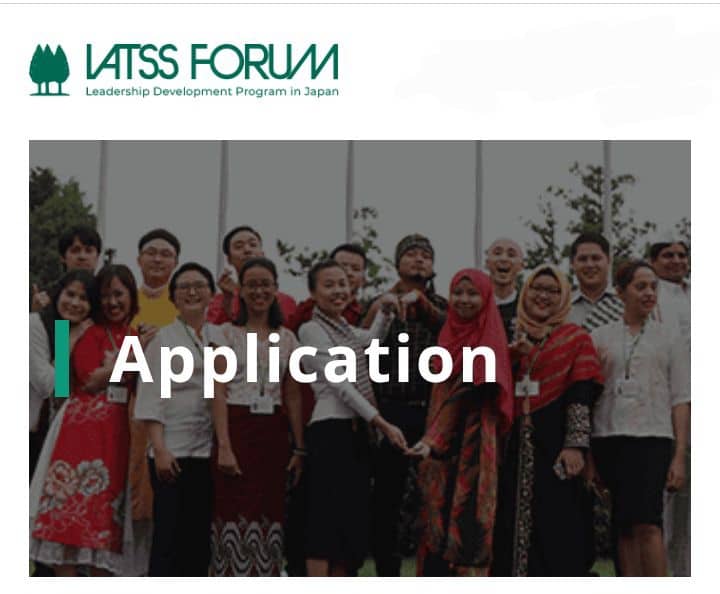
Meta description: Learn how I would approach the IATSS Forum 2027 in Japan, including eligibility, application requirements, selection interviews, funding, leadership training and life during the 8-week program.
When I first discovered the IATSS Forum, I assumed it was probably another short leadership programme where participants attend seminars, take a few group photos, collect a certificate and go home.
After looking through the application booklet properly, I realised that assumption was completely wrong. The IATSS Forum 2027 is much more immersive than that.
The programme brings young professionals from ten Asian countries to Japan for an intensive eight-week leadership development programme built around sustainable development, group learning, field studies, seminars and international exchange.
And there is something else I would pay attention to immediately: this is not a student programme. I would need to be working full-time in a professional field, have at least two years of full-time professional experience, and still be employed when I apply.
That changes the kind of person the programme is looking for. I wouldn’t be applying simply as someone who wants to learn about leadership.
I’d be applying as a working professional who already has experience, opinions, strengths and weaknesses—and who is expected to bring those experiences into a group of professionals from other Asian countries. That is what makes the IATSS Forum interesting to me.
What Is the IATSS Forum?
The IATSS Forum, organised by the International Association of Traffic and Safety Sciences, is a leadership development programme for young professionals from Asian countries.
The 2027 programme will have two sessions:
71st IATSS Forum: May–July 2027, for approximately 8 weeks
72nd IATSS Forum: September–November 2027, for approximately 8 weeks
The schedule is subject to change, and applicants are not guaranteed their preferred season. A total of 40 participants are expected in 2027, with 20 participants in each programme.
Approximately one to three participants from each participating country will be selected for each programme, although the allocation can change from year to year.
That small number is one reason I would take the application seriously. This isn’t a programme where hundreds of participants are sitting in a huge auditorium. The structure is deliberately small enough for people to work closely together.
Which Countries Can Apply for IATSS Forum 2027?
The 2027 IATSS Forum is open to nationals of these ten participating countries:
- Cambodia
- India
- Indonesia
- Laos
- Malaysia
- Myanmar
- Philippines
- Singapore
- Thailand
- Vietnam
If I were from one of these countries, this would be one of the first things I’d verify before doing anything else.
The nationality requirement is strict because participants are selected as representatives of their respective countries. The booklet even gives a useful example.
If I were Malaysian but temporarily living and working in Singapore, I would apply through the Malaysian Country Committee, not Singapore’s. That tells me that the country committee is connected to my nationality rather than simply where I happen to be living.
I Have to Be 35 or Younger
The age requirement is straightforward: I must be 35 years old or younger as of the application deadline.
That makes the programme particularly relevant to early- and mid-career professionals. It isn’t aimed at recent school leavers. And it isn’t designed primarily for senior executives who already have decades of professional experience.
The sweet spot is someone who has gained meaningful professional experience but is still relatively early in their career and has room to develop into a broader leadership role.
I Cannot Apply as a Student
This is probably one of the easiest requirements to misunderstand. If I were currently a full-time student and not working full-time, I would not be eligible.
Even having two years of previous professional experience would not solve the problem if I were currently unemployed or studying full-time. The IATSS Forum specifically requires applicants to be currently working full-time in a professional field.
That includes:
employees,
self-employed professionals, and
freelancers.
Interestingly, I could still attend school part-time and remain eligible as long as I am working full-time professionally. So the important distinction is not simply whether I am studying. It’s whether I am currently working full-time.
I Need at Least Two Years of Professional Experience
The programme also requires at least two years of full-time professional work experience at the time of application.
For me, this changes how I would present my professional background. I wouldn’t simply list job titles. I would think about what those two or more years have actually taught me.
What problems have I worked on?
Have I led a project?
Have I managed people?
Have I worked across departments?
Have I had to negotiate with people who disagreed with me?
Have I made decisions without having all the information?
Have I seen a problem in my organisation or country that I genuinely want to help solve?
Those experiences would be far more useful when answering the leadership questions.
The IATSS Forum Isn’t Only for Transport Professionals
This was another detail I would want to understand before applying. Because the organisation behind the programme is the International Association of Traffic and Safety Sciences, I might initially assume that applicants need to work in transport or road safety.
They don’t. The overarching theme of the programme is sustainable development. Mobility and transport are included, but the programme goes beyond those areas.
Sustainable development can include areas such as:
the environment,
the economy,
politics,
education,
social development,
public policy, and
other areas affecting the future of Asian countries.
That means I wouldn’t rule myself out simply because my professional field isn’t transportation.
What the IATSS xForum Actually Means by Leadership
This is one of the most interesting parts of the application booklet. The IATSS Forum doesn’t define leadership simply as having authority over other people.
Its concept of leadership is connected to bringing out the strengths of a group and using those strengths effectively to achieve a goal. That immediately changes how I would answer the application questions.
I wouldn’t write: “A leader is someone who inspires people and achieves great things.”
That is too generic. I would like to talk about an actual situation. Maybe I was part of a team where people had different strengths. Maybe a project was failing because everyone was working separately.
Maybe I had to convince people to cooperate. Maybe I wasn’t the official leader, but I helped the team move forward. Those situations would give me something concrete to discuss.
The Five Basic Questions That Are More Important Than They Look
The application requires answers to five basic questions. Each answer must be within 100 words. That word limit is extremely tight. The questions are:
Q1. What is my concept of ideal leadership based on my experience?
Q2. How far am I from that ideal leadership?
This includes my strengths and weaknesses.
Q3. What do I expect to gain from the IATSS Forum?
Q4. If selected, how would I contribute to the Forum or the learning of other participants?
Q5. What is my ultimate career goal?
These aren’t five unrelated questions. If I were preparing my application, I’d make sure my answers connect. My definition of leadership should relate to my experience.
My weaknesses should be believable rather than disguised strengths. What I want to gain should connect to those weaknesses. What I can contribute should come from my existing experience. And my career goal should explain why all of this matters.
The 100-Word Limit Would Force Me to Be Specific
This is where I think the application gets interesting. One hundred words isn’t enough space for a long biography. So I would choose one strong example instead of trying to mention everything I’ve ever accomplished.
If I were describing leadership, I’d rather write about one situation where I had to bring people together than list ten leadership positions. And for the weaknesses question, I’d avoid the classic:
“My biggest weakness is that I work too hard.” That doesn’t tell the selection committee anything useful. A more honest weakness might be something I have genuinely struggled with and have taken concrete steps to improve. The important thing is showing self-awareness.
The Essay Is Only 500 Words
The main essay has a maximum of 500 words. The theme is: How can I contribute to the sustainable development of my country?
Again, that’s not a huge amount of space. And the application booklet tells me exactly what the essay needs to address. I would need to explain:
- What challenge or problem I want to solve.
- Why I believe it is a challenge or problem.
- Why do I want to solve it?
- My plan for achieving it, including specific details.
That last part is important. The essay isn’t asking me simply to identify a problem. It wants to know what I intend to do about it.
I Would Choose One Problem, Not Save My Entire Country
If I were writing an essay, I’d resist the temptation to discuss every major problem in my country. That is almost impossible in 500 words.
I would choose one issue that I actually understand through my education or professional experience. Then I would explain it clearly. For example:
Problem → why it matters → why I care → what I will do → expected contribution.
That gives the essay a logical structure. I wouldn’t need to pretend that I could personally solve the problem nationwide. I would focus on a realistic contribution.
The Essay Does Not Have to Be About the Environment
The booklet makes this very clear. “Sustainable development” is broader than environmental issues. It can include:
economic development,
politics,
education,
environmental issues,
social challenges,
and other areas.
So if my professional background is in education, I could develop an education-related development goal. If I am working in technology, I could explore a technology related development challenge.
If I’m working in public policy, I could focus on governance. The key is showing how my proposed contribution supports sustainable development in my country.
There Is One Rule I Would Take Extremely Seriously
This is probably the most important application warning in the entire booklet. The IATSS Forum states that submitting AI-generated text for the Basic Question Form or Essay will result in immediate disqualification.
That means I would not use ChatGPT or another AI system to write those responses and submit them as my own. This is particularly important because the application specifically requires personal reflection.
The questions are about my own leadership experience, weaknesses, expectations and career goals. So I would write those answers myself.
I could still use ordinary tools to check spelling or formatting where permitted, but I would make sure the actual responses represent my own thinking and writing. This is one application where trying to shortcut the writing could cost me the entire opportunity.
All Application Documents Must Be in English
The application documents must be written in English. Handwritten forms aren’t accepted. The required formats also matter. The essay must be:
typed in Microsoft Office Word;
A4 size;
single-spaced;
Times New Roman;
font size 11;
written in English; and
no more than 500 words.
The essay must also include the word count at the top. These details may look administrative, but I would follow them exactly. When a programme gives precise formatting instructions, I wouldn’t assume they are suggestions.
I Would Be Careful With Acronyms
The application booklet specifically says that if I use an acronym, I need to write out the full name the first time it appears.
For example: International Association of Traffic and Safety Sciences (IATSS) After that, I can use IATSS. It’s a tiny detail, but it’s exactly the kind of thing that is easy to overlook when rushing an application.
The Recommendation Letter Comes From My Employer
This is another unusual part of the application. The IATSS Forum requires one recommendation letter from my employer.
More specifically, it should come from my direct supervisor at my current job. That means I wouldn’t simply ask a former university professor because they know me academically.
The programme wants someone who has actually seen me work. That makes sense.
If the programme is selecting working professionals for leadership development, a current supervisor can comment on how I behave professionally, how I work with colleagues and what kind of potential I show at work.
What If My Supervisor Doesn’t Speak English?
The booklet provides for that situation. If my referee cannot write the recommendation in English, I would need to arrange an English translation. The translator must include:
their name;
their relationship to me;
the date of translation; and
their signature.
Both the original recommendation and English translation must be submitted. That’s another administrative detail I’d sort out early rather than during the final days before submission.
Do I Need an English Test?
The application allows applicants to submit a copy of an English proficiency certificate if they have one. Examples listed include:
TOEFL;
TOEIC; and
other certificates showing English proficiency.
The wording is important. The booklet lists the English certificate as applicable rather than presenting one specific test as universally mandatory.
I would therefore check the current application requirements and my country committee’s instructions before assuming I need to sit a new English exam.
IATSS Forum 2027 Application Timeline
The application is accepted once a year. For the 2027 programme, the application period is: 1 June – 30 September 2026 The deadline is therefore: 30 September 2026
After applications close, the process moves into two stages.
Stage 1: Document Screening
October – mid-November 2026
The IATSS Forum Country Committee examines the application documents. This is where the application form, basic questions, essay, recommendation and other supporting material are assessed.
Stage 2: Final Interview
Late November – late December 2026
Shortlisted applicants proceed to an interview involving members of the IATSS Forum Japan Steering Committee and the IATSS Forum Country Committee. The final interview takes place in the applicant’s home country.
The Interview Would Be Very Different From a Normal Job Interview
This is something I would prepare for carefully. According to the booklet, the interview looks at whether I can:
express my opinions clearly;
remain open-minded toward other points of view;
contribute individually; and
contribute as part of a group.
That last part is important. They aren’t simply looking for someone who can dominate a conversation. The programme is built around cooperation.
So if I strongly disagree with someone, I would need to show that I can explain my position without shutting down their perspective. That’s a real leadership skill.
I Would Expect Them to Challenge My Thinking
If I were shortlisted, I wouldn’t prepare only polished answers. I would prepare to explain why I think what I think.
Suppose I say my ideal leader listens before making decisions. I would expect someone to ask: “Can you give us an example?” Or: “What happens when the group is divided?” Or: “What if listening to everyone prevents a decision from being made?”
Those questions would test whether my leadership philosophy comes from actual experience or whether I simply memorised a definition. I would rather understand my own answers deeply than rehearse perfect sentences.
The Programme Wants Diverse Participants
One detail I particularly like is that the Forum deliberately tries to avoid creating homogeneous groups. It wants participants from a variety of backgrounds and fields.
That makes sense. If everyone studied the same subject, worked in the same industry and approached problems in the same way, the group would have fewer opportunities to challenge one another.
So I wouldn’t worry about whether my background is completely different from the other applicants. That difference may actually be part of the value.
What I Would Expect From the Eight Weeks in Japan
The programme is built around learning through experience. The booklet specifically mentions:
Group Study;
Seminars;
Field Study; and
International Exchange Activities.
That tells me the programme isn’t simply classroom-based. I would expect to spend a lot of time discussing issues with other participants.
I would also expect to encounter situations where there isn’t one obvious answer. That can be uncomfortable. But it is probably intentional.
The Forum’s motto is: “Thinking and Learning Together.” The objective isn’t simply to fill participants with information. It’s to give us situations where we can think, discuss, observe and learn from one another.
There Are No Exams or Participant Rankings
This was one of the most interesting details for me. The IATSS Forum says there are no tests to complete the programme and no ranking of participants.
That doesn’t mean nobody is learning or reflecting on their performance. Instead, participants are expected to evaluate themselves through the discussions, seminars and group work.
That changes the atmosphere. I’m not competing against another participant for the highest score.
I’m trying to understand an issue better. Someone else might have a completely different perspective. Instead of treating that as competition, the programme wants us to learn from it.
The Group Study Could Be the Most Challenging Part
If I were selected, I think Group Study could be one of the places where the real leadership lessons happen.
Imagine putting professionals from ten different countries and different career backgrounds into one group and asking them to work through a complex development issue.
Everyone comes with their own assumptions. Everyone has a different communication style. Everyone thinks their own approach makes sense.
The easy option would be for one or two confident people to dominate. But the IATSS definition of leadership is about bringing out the strengths of the whole group.
So I would need to learn how to contribute without taking over. I would also need to speak up when I had something valuable to add. That balance is harder than it sounds.
I Would Expect My Evenings to Be Busy
This is perhaps the most important practical detail for someone with a demanding job. The booklet explicitly warns participants not to expect free time every day.
There can be evening programmes, practice and collaboration work on most evenings. Participants are also expected to use their free time to build relationships and trust with the other participants.
That means I would not approach the programme as an eight-week holiday in Japan. If I have a business or job that requires me to remain actively involved every evening, this could become a problem.
The Forum expects participants to engage fully in the programme and not busy themselves with outside work.
Even CEOs Are Expected to Put the Programme First
The FAQ specifically addresses a CEO who wants to continue working during the programme. The answer is essentially: don’t expect to. The programme requires full participation.
That is useful because it tells me the expectations aren’t only for junior professionals. Even someone with significant responsibilities at home is expected to temporarily prioritise the Forum.
If I were applying, I would discuss the timing with my employer well in advance. Eight weeks away from normal work is not a minor commitment.
What Happens to My Job?
The programme expects participants to return to their home countries after completion and be reinstated into their current employment so they can apply what they learned.
That is a major part of the programme’s philosophy. The objective isn’t: Work → go to Japan → permanently relocate somewhere else.
It is: Work → learn in Japan → return home → apply what I learned. That makes the programme especially relevant to professionals who already have a career they intend to continue developing.
I Wouldn’t Plan a Post-Forum Vacation
This was another rule I would definitely note before travelling. Participants cannot simply finish the programme and then extend their stay in Japan for personal travel.
The FAQ states that participants must return to their home country by the designated date and on the designated airline. The training visa permits the stay only during the programme period.
Participants are expected to return directly home after the programme. So if I had always dreamed of spending another month travelling around Japan after the Forum, I’d need to separate that dream from this particular programme.
The IATSS Forum’s priority is the training itself and returning participants to their professional lives at home.
What Does the IATSS Forum Pay For?
This is one of the biggest financial advantages. The IATSS Forum pays for:
round-trip airfare;
programme participation fees;
accommodation;
almost all food expenses; and
other programme-related costs as specified.
Participants are responsible for their personal expenses and part of their food expenses. The exact financial responsibilities are detailed in the Letter of Agreement provided to successful candidates after the final interview.
That means I wouldn’t assume “fully funded” means literally every expense I might incur. It is more accurate to say that the programme covers the major costs of participating, while I still need personal spending money.
Accommodation Is Covered
Having accommodation arranged is a major practical advantage. Moving to Japan for eight weeks would otherwise mean dealing with short-term housing, deposits, contracts and other logistical problems.
The Forum handles accommodation as part of the programme. That lets me concentrate much more on the actual experience.
The Flight Is Also Covered
Round-trip airfare is covered by the IATSS Forum. But there is a catch I would pay attention to.
The programme specifies the return arrangements, including the designated airline and date. So I wouldn’t assume I could book my own flight home for a later date because I found a cheaper option or wanted to travel. The programme’s travel arrangements are part of its conditions.
The Alumni Network Doesn’t End After Japan
Another feature I would value is the alumni association. After completing the programme, participants join the IATSS Forum alumni association in their home country.
This means the relationship with the Forum isn’t necessarily finished when the eight weeks end. The alumni organisations provide opportunities to continue sharing experiences and information with people from different age groups and professional fields.
Some alumni activities also include:
information sessions for prospective applicants;
community service;
English lessons; and
traffic safety education for disadvantaged children.
That gives the programme a longer life beyond the Japan experience.
The Alumni Network Could Become a Professional Resource
This is where I would think long term. During the Forum, I might meet professionals from nine other countries.
After returning home, those relationships could become useful in ways I cannot predict immediately. Perhaps someone becomes a partner on a regional project.
Perhaps we collaborate on research. Perhaps I need expertise from another country. Perhaps an alumnus knows someone working in a field I’m entering.
The network becomes more valuable when participants continue interacting after the programme.
What I Would Actually Try to Learn
I wouldn’t arrive in Japan with the goal of becoming a “perfect leader.” That’s unrealistic. I would identify a few specific things I genuinely want to improve.
For example:
Listening: Can I understand an opposing view before trying to respond?
Collaboration: Can I bring quieter people into a discussion?
Decision-making: Can I move a group forward when there is disagreement?
Communication: Can I explain a complicated idea clearly?
Self-awareness: Can I recognise where my own assumptions are affecting my decisions? Those are measurable enough to reflect on.
I Would Expect Japan to Challenge Some of My Assumptions
The Forum isn’t only about meeting other Asian professionals. It also exposes participants to Japan’s current situation and encourages them to examine Asian issues from a global perspective.
That matters. I might arrive with assumptions about Japan based on what I’ve seen online or learned from books.
Then I would encounter actual people, institutions and situations. Some of those assumptions might turn out to be wrong. That’s a useful experience.
Good international leadership requires the ability to update your understanding when reality doesn’t match your expectations.
The Most Valuable Conversations May Happen Outside Formal Sessions
Because participants live together and spend so much time together, some of the best learning may happen during ordinary conversations.
Someone might explain how their country approaches a problem I’ve been trying to solve. Another participant might disagree with an assumption I didn’t even realise I was making.
Someone might describe a professional challenge that sounds strangely familiar. Those conversations can reveal similarities between Asian countries that aren’t obvious from the outside. They can also highlight important differences.
I Wouldn’t Try to Be the Loudest Participant
The Forum’s selection criteria make it clear that they care about open-mindedness and group contribution. So if I were participating, I’d focus on being useful rather than constantly visible. Sometimes leadership means speaking.
Sometimes it means asking the question that allows another person to explain an idea. Sometimes it means noticing that someone hasn’t contributed and bringing them into the discussion.
Sometimes it means changing my mind. That last one is difficult. But it may be one of the most valuable forms of leadership in a programme built around diversity.
Why the IATSS Forum Could Be Valuable for My Career
I would see the programme as a bridge between my existing professional experience and the kind of leadership role I want to take on later.
I’m not arriving as an empty vessel.
I’ve already spent at least two years working.
I have seen real workplace problems.
I have probably made mistakes.
I have dealt with colleagues and supervisors.
I have experienced deadlines and professional pressure. The Forum gives me a chance to step back from that routine and examine how I work with people.
Then I return to my job with a different perspective. That practical connection is one of the strongest parts of the programme.
I Would Think Carefully About My Career Goal
The application asks for my ultimate career goal. That doesn’t mean I need to predict exactly where I will be in 20 years. But I should have a direction. I would ask myself:
What kind of problem do I want my career to address?
What role do I want to play?
What kind of impact do I want to have?
What expertise do I need to develop?
How does the IATSS Forum fit into that journey?
If my career goal is simply “to become successful,” I’d need to think harder. The programme is asking for something more meaningful.
My Application Would Need to Show What I Can Give, Not Only What I Want
Question 4 asks what I would contribute to the IATSS Forum or the learning of other participants. That’s an important distinction. I can’t make the application entirely about what I want to receive.
I also need to explain what I bring. Maybe I have professional experience in education. Maybe I have worked on climate-related projects.
Maybe I understand a particular industry. Maybe I’ve worked with communities that other participants haven’t encountered. Maybe I have experience solving a specific type of problem. Whatever it is, I’d explain it concretely.
The Strongest Applicant Probably Isn’t the One With the Most Impressive Title
Because the Forum is designed around group learning, I wouldn’t assume a senior job title automatically makes someone a stronger candidate.
A person with an ordinary job title might have spent years solving difficult problems and working with diverse teams. Another person might have an impressive title but struggle to listen to people who disagree with them.
The Forum’s definition of leadership makes the distinction important. It’s about maximising the potential of a group. That’s a skill, not a job title.
My Practical IATSS Forum 2027 Application Checklist
Before submitting, I’d make sure I had all five core pieces ready.
1. IATSS Forum Application Form
Completed using Microsoft Word or PDF as instructed.
2. Basic Question Form
Five questions, each within 100 words.
3. Essay Form
A maximum of 500 words, including the required development points and word count.
4. Recommendation Form
One recommendation from my direct supervisor at my current job.
5. English Proficiency Certificate
If applicable, I’d include a copy of my certificate. I would also check that everything is written in English and properly formatted.
I Would Start the Recommendation Early
The recommendation is one part of the application I wouldn’t leave until the final week. My direct supervisor has their own responsibilities.
They may need time to understand the programme and complete the form. And if they don’t write in English, there is an additional translation requirement.
I would therefore approach my supervisor well ahead of the 30 September 2026 deadline.
I Would Also Save My Own Copies of Everything
This is a small practical habit, but I’d keep a complete folder containing:
final application form;
basic questions;
essay;
recommendation;
English certificate;
CV or supporting documents;
submission confirmation; and
any communication from the country committee.
If I’m shortlisted for the interview months later, I want to be able to reopen exactly what I submitted. I don’t want to read my application again and think: “What on earth was I talking about here?”
What Happens After I Submit?
The first stage is document screening. The country committee reviews applications between October and mid-November 2026.
Only shortlisted applicants who are invited to the final interview are informed. The final interview is scheduled between late November and late December 2026.
It involves members of the IATSS Forum Japan Steering Committee and country committee members. If I reach this stage, I’d expect the interview to go beyond my application form.
They would want to see whether I can communicate clearly and engage with different perspectives.
I Would Prepare for Discussion, Not Memorisation
For the interview, I’d reread everything I submitted. But I wouldn’t memorise paragraphs.
Instead, I would identify the important ideas behind each answer. If I say my leadership strength is bringing people together, I need to have an example ready.
If I say my weakness is impatience during slow decision-making, I need to explain what I’m doing about it. If I say my career goal involves sustainable development, I need to explain what that actually means in practice. That kind of preparation is much more useful than memorising speeches.
What I Would Expect From the Eight-Week Experience
If selected for either the 71st or 72nd Forum, I would expect the eight weeks to be intense. There would be formal sessions.
There would be group work. There would be field activities. There would be international exchange.
There would be evenings when the programme continued. And there would be a lot of interaction with other participants. So I would arrive prepared for a schedule that requires energy and participation. I would not plan major outside commitments during those eight weeks.
My Biggest Takeaway From the IATSS Forum
The more I look at the programme, the more I think its most valuable lesson is actually hidden in its approach to leadership. The Forum isn’t trying to teach me how to become the person who always has the answer.
It’s trying to teach me how to work with people who have different answers. That is much closer to real leadership. In a workplace, I will rarely have complete control.
I will have colleagues with different priorities. I will have people who disagree with me. I will have incomplete information.
I will have cultural differences. And I’ll still need to get something done. Learning how to bring different strengths together is therefore much more useful than simply learning leadership terminology.
Frequently Asked Questions About IATSS Forum 2027
What is the IATSS Forum?
The IATSS Forum is an intensive leadership development programme for young professionals from selected Asian countries. The 2027 programme consists of two approximately eight-week sessions held in Japan.
Which countries are eligible for IATSS Forum 2027?
The participating countries are Cambodia, India, Indonesia, Laos, Malaysia, Myanmar, the Philippines, Singapore, Thailand and Vietnam.
What is the age limit?
Applicants must be 35 years old or younger as of the application deadline.
Can students apply?
No, not if they are students who are not currently working full-time. Applicants must currently be full-time professionals.
How much work experience is required?
Applicants need at least two years of full-time professional work experience at the time of application.
Can freelancers or self-employed professionals apply?
Yes. The eligibility requirements explicitly include self-employed and freelance professionals, provided they are working full-time in a professional field.
Can someone working full-time while studying part-time apply?
Yes. The FAQ states that applicants who study part-time can apply as long as they are working full-time professionally.
Is the IATSS Forum only for transport professionals?
No. Although IATSS is the organisation behind the programme, the Forum’s overarching theme is sustainable development, covering areas beyond transport and mobility.
What is the IATSS Forum 2027 application deadline?
The application period runs from 1 June to 30 September 2026. The closing date is 30 September 2026.
How does the selection process work?
There are two stages: document screening from October to mid-November 2026, followed by final interviews from late November to late December 2026 for shortlisted applicants.
Is an English certificate required?
The application allows applicants to provide an English proficiency certificate if they have one. Examples include TOEFL and TOEIC. Applicants should check the current instructions applicable to their country.
Can I use AI to write my IATSS Forum essay?
No. The application booklet explicitly states that submitting AI-generated text for the Basic Question Form or Essay results in immediate disqualification. Applicants should write these responses themselves.
How long is the IATSS Forum programme?
Each programme lasts approximately eight weeks. The 71st Forum is scheduled for May–July 2027 and the 72nd for September–November 2027, although the schedule may change.
Is the IATSS Forum fully funded?
The programme covers major participation costs, including round-trip airfare, programme fees, accommodation and almost all food expenses. Participants are responsible for personal expenses and part of their food costs.
Can I work remotely during the programme?
Participants should not expect to continue outside work during the programme. The FAQ specifically says participants are expected to involve themselves fully and not keep themselves busy with outside work.
Can I stay in Japan after the programme for tourism?
No. Participants are required to return directly to their home country on the designated date and airline.
What happens after completing the IATSS Forum?
Participants join the IATSS Forum alumni association in their home country, where they can continue networking and participate in alumni and community activities.
Final Summary: How I Would Approach the IATSS Forum 2027
If I were eligible for the IATSS Forum 2027, I would see it as a serious professional development opportunity—not a holiday in Japan and not simply another certificate for my CV.
The eight-week commitment is substantial. The programme expects full participation.
There are evening activities and group work. I’m expected to live and learn closely with other professionals. I’m expected to listen to people with different opinions.
I’m expected to contribute. And after the programme, I’m expected to return home and apply what I learned to my existing professional life. That last part is important.
The programme isn’t designed around taking talented professionals out of Asia permanently. It is designed to send them back with broader perspectives, stronger leadership skills and relationships that can continue across the region.
Financially, the opportunity is also significant. The IATSS Forum covers round-trip airfare, participation fees, accommodation and almost all food expenses, while participants cover personal expenses and part of their food costs.
But if I were applying, the money wouldn’t be my main selling point. The real attraction would be the experience of spending eight weeks in an international group where I can’t simply rely on my usual way of thinking.
I would have to explain my opinions. I would have to listen. I would have to disagree respectfully. I would have to work with people from different professional and national backgrounds.
I would have to figure out how to make a group work. And I would have to return home and put those lessons into practice.
That is a much more demanding definition of leadership than simply attending a seminar. And honestly, that’s exactly why I would want to be selected.
For the 2027 intake, the application deadline is 30 September 2026. If I were eligible, I’d treat the Basic Question Form and 500-word essay as the heart of the application and make sure every word was genuinely mine, especially because the programme explicitly disqualifies AI-generated responses.
OFFICIAL APPLICATIONS WEBSITE TO APPLY
Related fellowship opportunities to apply for if you are looking for more.
How to Apply and Increase Your Chances of Winning Chevening: Lessons From Previous African Scholars
ICANN88 Fellowship 2027 in Lisbon, Portugal: How to Apply for the ICANN Community Forum Fellowship
Apply for UK Winter Fellowship 2027 in London: A Paid AI Governance Fellowship with £12,000 Salary
List of 7 Nestle Global Paid Opportunities, Details and Application processes.
EWC Graduate Degree Fellowship: My Experience Studying at the University of Hawaii
Eric Bleumink Fellowship 2027 in the Netherlands (Fully Funded Master’s Scholarship)
Equity Initiative Fellowship 2027–2028: How to Apply for This Fully Funded Leadership Program.
Discover more from Scholars Africa
Subscribe to get the latest posts sent to your email.

About Scholars Africa Editorial Team
Scholars Africa Editorial Team is dedicated to researching and publishing verified scholarships, jobs, and global opportunities. Our content is built on extensive analysis of application trends, eligibility criteria, and selection patterns to help applicants succeed at every stage. Our team has reviewed hundreds of scholarship programs and application processes across multiple countries.