If I were preparing an application for the Justus & Louise van Effen Excellence Scholarship at Delft University of Technology (TU Delft), I would treat it very differently from a normal Master’s application.
The biggest lesson I would take from the scholarship requirements is that admission to TU Delft and winning the scholarship are closely connected, but they are not the same thing. I would need to build a strong Master’s application first and, at the same time, make sure the scholarship documents are complete before the scholarship deadline.
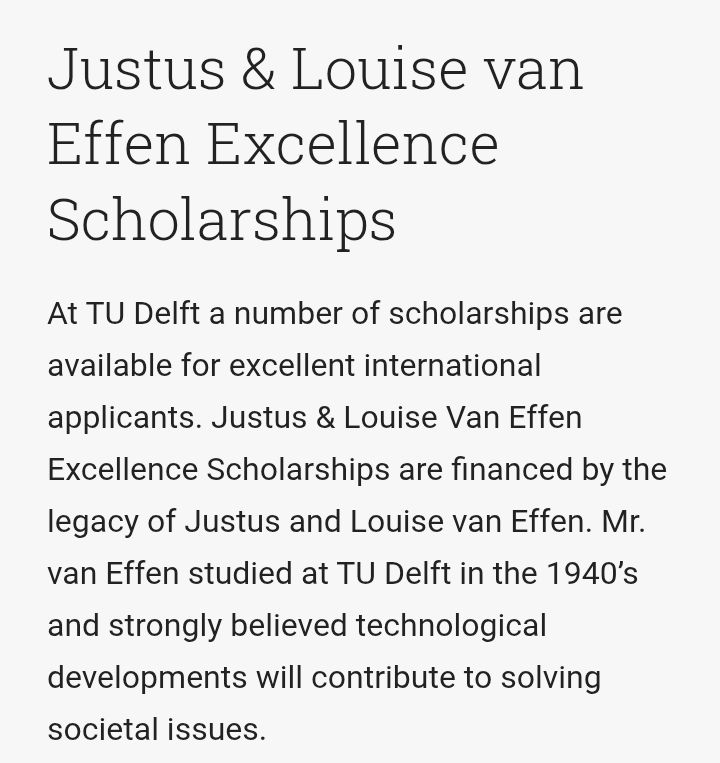
The Justus & Louise van Effen Excellence Scholarships are intended for excellent international students applying for eligible two-year MSc programmes at TU Delft. The scholarship is financed through the legacy of Justus and Louise van Effen, with the aim of supporting outstanding international students who want to use technological education to contribute to society.
For the current scholarship cycle, the application deadline is 1 December 2026 at 23:59 CET, and successful candidates are expected to be informed by TU Delft by the end of March 2027.
What immediately stands out to me is the timing. I would not wait until December to start preparing.
The scholarship application is submitted together with the TU Delft MSc application, and once that application has been submitted, additional scholarship documents cannot simply be added later. That detail alone can make a huge difference.
What Is the Justus & Louise van Effen Excellence Scholarship?
The Justus & Louise van Effen Excellence Scholarship is a merit-based scholarship for excellent international applicants seeking admission to eligible two-year Master’s programmes at TU Delft in the Netherlands.
There are two scholarships available per faculty, making this a highly competitive opportunity.
The scholarship provides:
- Full tuition fees for the TU Delft MSc programme
- A contribution toward living expenses
- Funding for the duration of the Master’s programme, subject to the scholarship conditions
- The opportunity to study at one of Europe’s leading technical universities
If I were applying, I would not interpret “full tuition” as meaning that every possible expense associated with moving to the Netherlands disappears. The scholarship is primarily designed to cover the tuition component and provide a contribution toward living costs. I would therefore still examine the actual cost of accommodation, insurance, transportation, residence-related expenses and everyday life in Delft before making financial plans.
That distinction matters because receiving a scholarship and having no financial planning whatsoever are two different things.
Why TU Delft Matters
TU Delft is particularly attractive to students interested in engineering, technology, design, architecture, innovation and related disciplines.
What I find interesting about the scholarship is that the foundation behind it has a very specific philosophy. Justus van Effen studied at TU Delft in the 1940s and believed technological development could play an important role in solving societal problems.
That makes the scholarship more than simply an academic award.
The strongest application, in my view, would therefore not just communicate, “I have excellent grades and I want to study at TU Delft.”
I would want my application to make it obvious why my academic background, Master’s programme and longer-term ambitions fit the kind of technological and societal impact associated with the scholarship.
Who Can Apply for the Justus & Louise van Effen Scholarship?
The first thing I would check is whether I actually fall into the correct applicant category.
The scholarship is intended for excellent international applicants who have been conditionally admitted to an eligible two-year regular TU Delft MSc programme.
There are several important exclusions.
I would not apply assuming that every international student at TU Delft is automatically eligible.
You are not eligible if you are a TU Delft Bachelor’s student
Being an international student does not change this condition.
The scholarship is designed for new international Master’s applicants rather than current TU Delft Bachelor’s students moving into a Master’s programme.
You are not eligible if you earned your Bachelor’s degree at a Dutch university
This is another detail I would check carefully before spending time preparing the scholarship application.
An international applicant who obtained their Bachelor’s degree from a Dutch university is not eligible for this particular scholarship.
You cannot already have started your TU Delft Master’s
The scholarship is for new incoming MSc students.
So I would make sure I understand the timing of my application and admission. Starting the Master’s first and expecting to apply for this scholarship afterward is not the intended route.
The Academic Standard Is High
This is probably the part I would take most seriously.
TU Delft describes the ideal scholarship candidate as an excellent student, with previous academic results that are relevant to the Master’s programme.
As an indication of competitiveness, applicants are expected to be around the top 10% of graduates in their previous study programme.
There is an important detail here: applicants do not have to submit official proof of being ranked in the top 10%.
The top-10% statement is an indication of the academic level expected.
If I were preparing my application, I would therefore ask myself a more useful question than “Do I have a good GPA?”
I would ask:
How strong is my academic record compared with other students who are likely to apply?
That changes the way I would approach the application.
A good result in a difficult, highly relevant programme may tell a stronger story than simply presenting a number without context.
I would also make sure my previous degree is clearly relevant to the Master’s programme I am applying for.
The Master’s Programme Matters
The scholarship is not available for every possible programme or study arrangement at TU Delft.
The eligibility condition refers specifically to regular two-year TU Delft MSc programmes.
Applicants to an International Joint Education Programme are not eligible for this scholarship.
That means I would start with the Master’s programme rather than starting with the scholarship.
I would first identify the TU Delft MSc programme that matches my academic background and career direction.
Then I would check:
- Whether the programme is eligible.
- Whether I meet its academic requirements.
- Whether I meet the English-language requirements.
- What documents the programme requires.
- The Master’s application deadline.
- The scholarship deadline.
I would keep these dates together because missing one document can affect the scholarship application even if the rest of the application is strong.
How I Would Apply for the TU Delft Excellence Scholarship
The application process is where I would be particularly careful.
The scholarship application is not something I would treat as a separate form that I could complete weeks after submitting my Master’s application.
The required scholarship documents must be submitted together with the MSc application.
Once the MSc application has been submitted, additional documents cannot be added.
That is probably one of the most important practical details in the entire process.
Step 1: Choose an Eligible TU Delft MSc Programme
I would begin by selecting the Master’s programme I genuinely want to study.
I would read the programme requirements carefully instead of assuming that my Bachelor’s degree automatically qualifies me.
I would also check the programme’s specific application deadline because TU Delft Master’s programmes can have their own admission requirements and timelines.
The scholarship deadline for this cycle is:
1 December 2026 at 23:59 CET.
I would work backward from that date.
Step 2: Prepare the MSc Application
The next step is completing the regular TU Delft Master’s application.
This is important because scholarship consideration depends on having a complete MSc application submitted before the scholarship deadline.
I would therefore prepare the admission documents well in advance.
Depending on the programme, these may include academic records, degree documentation, English-language evidence and other programme-specific materials.
I would not assume that because a document is not specifically mentioned on a scholarship page, it is irrelevant to my Master’s application.
The Master’s programme requirements still apply.
Step 3: Prepare the Scholarship Application Form
Once I had the MSc application underway, I would prepare the Justus & Louise van Effen Excellence Scholarship application form.
I would complete it carefully and check that the information matches the details in my Master’s application.
At this stage, I would pay particular attention to consistency.
My academic history, programme choice, personal information and other details should not contradict information elsewhere in the application.
Step 4: Arrange Two Reference Letters Early
This is one area where I would start much earlier than the deadline.
The scholarship requires two reference letters.
There are two ways the reference letters can be handled during the MSc application process.
I could upload the reference letters as one PDF document according to the stated requirements.
Alternatively, I could enter my referees’ information and use the invitation function so that TU Delft sends them an automatic email asking them to upload their references.
The two methods can also be combined.
For example, one referee could provide a letter that I upload, while the second referee could be invited through the system.
The critical point is that the references must be submitted before the scholarship deadline.
References submitted after the scholarship deadline will not be accepted for scholarship consideration.
The mistake I would avoid
I would never assume that asking a professor for a reference on 30 November means the reference will automatically arrive before the deadline.
The scholarship deadline applies to the required documents, not merely to the moment when I personally begin the process.
I would contact my referees early, explain the scholarship I am applying for and give them enough time to prepare a thoughtful reference.
A rushed reference is also unlikely to tell the scholarship committee much about me.
I would ideally choose referees who can discuss my academic ability in concrete terms rather than someone who simply knows my name.
Step 5: Submit My English-Language Certificate
Applicants who require an English-language test must include the required English certificate with the MSc application before the scholarship deadline.
This is another reason I would not leave everything until the final week.
If my English test result is still pending when the scholarship deadline arrives, I could potentially create a problem for my scholarship application.
I would therefore take the test early enough to receive the official result before submission.
The exact English-language requirements should be checked against the Master’s programme I am applying for because admission requirements can vary.
What Does the Scholarship Cover?
The Justus & Louise van Effen Excellence Scholarship provides:
Full tuition fees for the TU Delft MSc programme, plus a contribution toward living expenses.
The tuition component is based on the applicable statutory fee or institutional rate according to the student’s registered nationality.
The scholarship is intended to support the student throughout the Master’s programme, subject to the scholarship’s conditions.
For me, one of the biggest advantages would be removing the largest financial barrier to studying at TU Delft.
International Master’s tuition can otherwise be a significant expense.
Having the tuition covered would allow me to concentrate much more heavily on the academic side of the programme instead of worrying constantly about how to finance the next semester.
But I would still create a realistic budget for the Netherlands.
The living-expense contribution is important, but Delft is not a place where I would arrive without understanding the cost of housing and daily expenses.
How Competitive Is the Scholarship?
The university offers two scholarships per faculty.
That number immediately tells me that meeting the eligibility requirements is not the same as being competitive.
A student can meet every basic requirement and still not receive the scholarship.
This is why I would not build my application around simply proving that I am eligible.
I would build it around showing that I am an unusually strong candidate.
The top-10% academic indication is particularly useful here.
I would look at my transcript honestly and consider how my academic performance compares with other applicants.
I would also make sure my previous degree is directly connected to the MSc programme I am pursuing.
What I Would Learn From Previous Scholarship Recipients
TU Delft’s student stories are useful because they show something that a simple eligibility checklist cannot.
The successful recipients do not all have identical backgrounds.
Their paths include academic achievement, professional experience, research, design work, international exposure and demonstrated interest in solving real problems.
Ömer Taha Döver
Ömer Taha Döver studied Strategic Product Design at TU Delft after completing his Bachelor’s degree at Istanbul Technical University.
Before beginning his Master’s, he had experience working as a strategist in purpose-driven innovation.
He had also previously participated in an exchange programme at TU Delft during his undergraduate studies, which helped develop his interest in design and innovation.
His design work had received recognition through awards and exhibitions.
What I would take from his story is not that an applicant needs an identical profile.
Instead, I would notice the connection between his academic background, professional experience, design interests and the societal purpose behind his work.
That is the kind of coherent story I would try to build in my own application.
Berkay Onur Türk
Berkay’s background also illustrates how academic excellence can be accompanied by broader involvement.
He studied Industrial Engineering with a minor in Economics at Boğaziçi University.
He had international academic experience through an exchange programme at Eindhoven University of Technology before returning to the Netherlands as a Justus & Louise van Effen scholarship recipient.
During his Master’s at TU Delft, he worked as a student assistant and became involved in the Faculty Student Council.
He eventually graduated cum laude.
His story reminds me that the scholarship can become part of a much larger academic and professional journey.
Mythili
Mythili’s path is particularly interesting because it shows how a research interest can evolve across several stages of education.
She studied Mechanical Engineering in India, later completed an MSc in Acoustical Engineering at the University of Southampton, and subsequently worked as a researcher in biomechanics.
Her Master’s research had involved cochlear mechanics, which helped develop her interest in biomedical engineering.
She eventually received the Justus & Louise van Effen Excellence Scholarship to study Biomedical Engineering at TU Delft.
The important lesson I would take from this is the value of having a clearly developing academic interest.
Her background does not look like a collection of unrelated degrees and jobs. There is a research thread running through it.
Adalberto de Paula
Adalberto’s background combines academic achievement with substantial professional experience.
Originally from Brazil, he studied at the Federal University of Mato Grosso do Sul and later gained four years of professional experience as an architect in São Paulo.
He had also participated in international exchange programmes through previous scholarships.
At TU Delft, his Master’s research in Building Technology focused on automated strategies for computational design and digital fabrication, including applications related to robotic construction and timber housing.
His story is another example of how professional experience can strengthen an academic profile when there is a clear connection between the experience and the proposed Master’s direction.
The Biggest Lesson I Would Take From These Profiles
If I were applying, I would not try to copy any previous recipient.
There is no single “TU Delft scholarship profile.”
Instead, I would try to make my own profile make sense.
My academic record should support my chosen Master’s programme.
My experiences should reinforce my interests.
My proposed Master’s should fit my longer-term direction.
And the work I have already done should give the scholarship committee a reason to believe I can make meaningful use of the opportunity.
That is much stronger than trying to fill my CV with random activities simply because I believe scholarship committees like them.
Scholarship Application Deadline
For the current cycle, the deadline for the Justus & Louise van Effen Excellence Scholarships is 1 December 2026 at 23:59 CET.
I would treat this as the final point at which every required scholarship document needs to be in place.
I would not plan to submit at 23:58.
A technical problem, missing reference or incomplete upload can turn a strong application into an unsuccessful one.
My personal target would be to have everything ready several days before the actual deadline.
When Will Scholarship Results Be Announced?
TU Delft states that students who are awarded the scholarship will be informed by email by the end of March 2027.
The scholarship award remains conditional on the student fulfilling all admission requirements.
That means I would continue paying attention to the Master’s admission process even after submitting my scholarship application.
A scholarship application does not replace the requirement to satisfy the university’s admission conditions.
What I Would Do Differently If I Were Starting Today
If I were preparing this application now, I would divide the work into four stages.
Stage 1: Academic assessment
I would first look at my academic record honestly.
Am I genuinely a competitive candidate?
Is my Bachelor’s degree relevant to the MSc programme?
Is my academic performance strong enough to compete for a scholarship that may have only two awards per faculty?
I would answer those questions before spending weeks on the application.
Stage 2: Programme preparation
Next, I would identify the TU Delft MSc programme and read its admission requirements line by line.
I would make a checklist of every document.
I would also identify anything that could take time, particularly language testing and academic documentation.
Stage 3: Scholarship preparation
Then I would prepare the scholarship application form and arrange my two references.
I would not wait for the final weeks.
I would also make sure my scholarship application tells the same academic story as my Master’s application.
Stage 4: Final submission
Finally, I would check everything together:
- MSc application
- Scholarship application form
- Two reference letters
- English-language certificate, where required
- Academic documents
- Other required programme documents
Only after confirming that everything was complete would I submit.
The crucial thing is that additional scholarship documents cannot be added after the MSc application has been submitted.
That is the detail I would keep at the top of my checklist.
My Final Summary on the Justus & Louise van Effen Excellence Scholarship
The Justus & Louise van Effen Excellence Scholarship at TU Delft is one of those opportunities where the basic eligibility requirements can look deceptively simple.
You need to be an excellent international applicant, gain admission to an eligible two-year TU Delft MSc programme, submit a complete application before the scholarship deadline and provide the required scholarship documents.
But the competition happens beyond that checklist.
With only two scholarships per faculty, I would approach the application as a serious academic competition.
I would not try to make myself look impressive by adding everything I have ever done.
I would focus on showing a strong and believable connection between my academic performance, previous studies, Master’s programme, experience and future direction.
The profiles of previous recipients also show that excellence can take different forms. One applicant may have research experience, another may have professional experience, another may have design achievements or international academic exposure.
What matters is that the pieces fit together.
For the 2026 application cycle, the key date to remember is 1 December 2026 at 23:59 CET.
If I were applying, I would aim to have my application essentially finished well before that date, especially the two reference letters and English-language documentation.
The scholarship is competitive, but that is precisely why I would start with an honest assessment of my profile rather than waiting until the deadline and hoping for the best.
The goal would be simple: submit a complete TU Delft Master’s application and make it immediately clear why my academic record and future plans make me a strong candidate for the Justus & Louise van Effen Excellence Scholarship.
see list of other related scholarships to apply for if you are interested in more scholarship opportunities.
One Young World Leading Scholarship 2026 Is Now Open: A Fully Funded Opportunity
Apply for SEARCA Research Scholarship Program 2026–2027: A Funding for Master’s & PhD Students
Discover more from Scholars Africa
Subscribe to get the latest posts sent to your email.

About Scholars Africa Editorial Team
Scholars Africa Editorial Team is dedicated to researching and publishing verified scholarships, jobs, and global opportunities. Our content is built on extensive analysis of application trends, eligibility criteria, and selection patterns to help applicants succeed at every stage. Our team has reviewed hundreds of scholarship programs and application processes across multiple countries.