Are you looking for an opportunity to gain international experience, contribute to the fight against hunger, and support the work of a United Nations organisation?
The Food and Agriculture Organization of the United Nations (FAO) Regular Volunteer Programme 2026 offers eligible applicants an opportunity to contribute their skills to the organisation’s mission while gaining exposure to international development work.
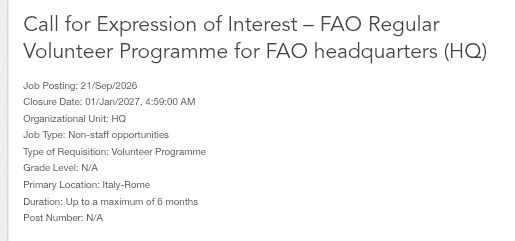
FAO has opened a Call for Expression of Interest for its Regular Volunteer Programme at its headquarters in Rome, Italy.
The programme is designed for individuals who want to contribute to work connected to food security, nutrition, agriculture, sustainable agri-food systems, and other areas relevant to FAO’s mandate.
The assignment can last for up to six months, depending on the needs of the hiring office and the terms of reference established for the selected volunteer.
One important point deserves attention from the beginning: this is a volunteer programme, not a paid employment opportunity.
FAO explicitly states that it does not provide remuneration to volunteers. Applicants must therefore consider their financial circumstances, immigration status, and ability to live in the proposed country of assignment before submitting an application.
In this guide, I explain the available opportunity, who can apply, the requirements candidates need to meet, the documents to prepare, and how to complete the online application.
I also discuss practical ways to present your experience so that your application clearly demonstrates how you could contribute to FAO’s work.
FAO Regular Volunteer Programme 2026: Overview
Here are the main details to know before beginning your application.
| Opportunity Detail | Information |
| Programme | FAO Regular Volunteer Programme |
| Organisation | Food and Agriculture Organization of the United Nations |
| Vacancy reference | 2601985 |
| Opportunity type | Volunteer programme |
| Location | FAO Headquarters, Rome, Italy |
| Posting date | 21 September 2026 |
| Application deadline | 31 December 2026, at 4:59 p.m. |
| Maximum duration | Up to six months |
| Minimum educational requirement | Completed secondary school education |
| Minimum age | 18 years |
| Nationality requirement | Must be a national of an FAO Member |
| Language requirement | Working knowledge of at least one FAO official language |
| Official FAO languages | Arabic, Chinese, English, French, Russian and Spanish |
| Remuneration | No remuneration provided |
| Application method | Online application through the FAO recruitment portal |
| Required application documents | Letter of motivation and copy of academic qualifications |
| Reference number | 2601985 |
Application deadline: The vacancy notice gives the closing date as 31 December 2026 at 4:59 p.m. Applicants should check the official vacancy page for the applicable time zone and confirm that the recruitment notice remains open before submitting their applications.
What Is the FAO Regular Volunteer Programme?
The FAO Regular Volunteer Programme is an initiative through which individuals can contribute their time and skills to work that supports FAO’s mission and the United Nations Sustainable Development Goals.
FAO works to defeat hunger, improve food security, and ensure that people have regular access to sufficient, safe, and nutritious food. Its activities also support more sustainable, inclusive, resilient, and efficient agri-food systems.
The organisation operates internationally, working with governments, institutions, communities, development partners, researchers, and other stakeholders.
Through its volunteer programme, FAO seeks to mobilise people who can contribute to relevant activities and support its wider objectives.
For a prospective volunteer, this means the opportunity is not simply about having an international experience on your CV.
It is about identifying where your knowledge, research background, professional experience, or practical skills could support the work of the organisation.
The vacancy notice states that volunteers will be assigned to a field relevant to FAO’s mission. The specific responsibilities will depend on the needs of the hiring office and the Terms of Reference prepared for the assignment.
Consequently, applicants should not assume that every volunteer will work directly with farmers or participate in field-based agricultural projects.
Depending on the assignment, the relevant work could be connected to research, technical support, communication, data, administration, or another area aligned with FAO’s activities.
The exact duties will depend on the position offered.
Why Consider Volunteering With FAO in Rome?
The programme may appeal to students, graduates, early-career professionals, researchers, and other eligible individuals interested in international development.
However, the value of the opportunity depends on what you want to gain from it and whether you can meet the practical costs of participating.
1. Exposure to an International Organisation
FAO is a specialised agency of the United Nations. Depending on the assignment, volunteering at its headquarters could provide exposure to the working environment of an international organisation.
You may have opportunities to understand how teams collaborate, how technical assignments are organised, and how work connected to food security and sustainable development is supported.
The specific experience will depend on the responsibilities assigned to you and the team supervising your work.
2. An Opportunity to Apply Your Existing Skills
The programme is not limited in the vacancy notice to one specific academic discipline.
FAO asks applicants to demonstrate relevant working or research experience in one of the organisation’s fields.
This makes it important to identify a clear connection between your background and the organisation’s mission.
For example, someone with experience in agricultural research could highlight relevant research tasks, while an applicant with a background in communication could explain their experience preparing reports, communicating technical information, or supporting public-facing projects.
These are examples of how applicants might present relevant experience, not confirmation that specific positions are currently available in those fields.
3. Contribution to Food Security and Sustainable Development
FAO’s work is connected to important global development challenges, including hunger, malnutrition, food insecurity, and the sustainability of agri-food systems.
For someone interested in these issues, the programme could provide an opportunity to contribute to an organisation working toward these goals.
The strongest motivation statements should explain why this work matters to the applicant and how their existing skills could contribute to a relevant assignment.
4. A Potentially Valuable Addition to Your Professional Experience
International volunteer experience may be useful when applying for future opportunities in development, research, public policy, agriculture, humanitarian work, or related areas.
However, volunteering with FAO does not guarantee future employment with the organisation or any other employer.
The practical value of the experience will depend on the work undertaken, the skills developed, and how effectively the volunteer can explain their contribution in future applications.
Is the FAO Regular Volunteer Programme Fully Funded?
No. The published vacancy notice does not describe the FAO Regular Volunteer Programme as fully funded.
This is one of the most important details to understand before applying.
FAO explicitly states that it does not provide remuneration to volunteers. The notice also requires selected candidates to have appropriate residence or immigration status in the proposed country of assignment before joining the organisation.
The vacancy information does not confirm that FAO will pay for:
International flights to and from Italy.
Accommodation in Rome.
Monthly living expenses.
Meals and daily transportation.
Visa or residence-related costs.
Health insurance or other personal expenses.
These items should not be assumed to be covered unless FAO confirms the arrangements applicable to the particular assignment.
What Does This Mean for Applicants?
If you are applying from outside Italy, calculate the potential cost of living in Rome before committing to the opportunity.
Consider where you would stay, how you would cover food and transportation, whether you need to obtain or change your immigration status, and how you would manage healthcare and other expenses.
If you have family support, personal savings, institutional assistance, or another legitimate source of financial support, consider whether it would be sufficient for the proposed period.
Do not rely on an assumption that a United Nations opportunity automatically includes a stipend, accommodation, or travel funding.
The programme may be professionally attractive, but the absence of remuneration makes financial planning especially important.
Important: Confirm any applicable arrangements directly with FAO before making travel bookings, paying deposits, or accepting an assignment.
Who Can Apply for the FAO Regular Volunteer Programme 2026?
The vacancy notice sets out several minimum requirements. Applicants should check each one carefully before completing their profiles.
1. Applicants Must Be at Least 18 Years Old
Candidates must be aged 18 or older.
Applicants should ensure that their personal information and date of birth are entered accurately in the online recruitment profile.
2. Applicants Must Have Completed Secondary Education
The minimum educational requirement is completion of secondary school education.
This means the vacancy notice does not establish a university degree as a universal minimum requirement for the programme.
However, applicants should not interpret this to mean that every candidate with secondary education will be competitive for every assignment.
FAO also considers relevant working or research experience, and the hiring office will assess applicants against the requirements of the assignment.
If you have a university degree, professional qualification, research experience, or specialised training relevant to FAO’s work, include that information in your profile.
If your highest qualification is secondary education, demonstrate any relevant experience and skills clearly and accurately.
3. Applicants Must Be Nationals of FAO Members
Candidates must be nationals of an FAO Member.
This is a specific eligibility condition. Being interested in agriculture, studying in a particular country, or currently residing in a Member country does not necessarily satisfy the nationality requirement.
Before applying, verify that your nationality meets FAO’s requirement.
Applicants should consult FAO’s official information about its Members if they are uncertain about their eligibility.
4. Applicants Must Know at Least One FAO Official Language
Candidates must have a working knowledge of at least one of FAO’s six official languages:
Arabic
Chinese
English
French
Russian
Spanish
Knowledge of a second FAO language is considered an asset.
You should list your language skills accurately in your recruitment profile. If you can work professionally in English and also have a working knowledge of French, for example, make sure both are recorded.
Avoid overstating your proficiency. If you have basic conversational knowledge of a language but cannot use it comfortably in a professional setting, describe your ability honestly.
5. Applicants Should Be Comfortable in a Multicultural Environment
FAO requires candidates to be able to adapt to an international, multicultural environment and demonstrate good communication skills.
This requirement matters because international organisations often bring together people with different professional backgrounds, nationalities, languages, and approaches to work.
Applicants can demonstrate this ability through relevant examples from employment, volunteering, academic projects, research teams, student organisations, or community initiatives.
For instance, if you have worked with a team whose members had different responsibilities or cultural backgrounds, explain your contribution and how you helped the group complete its work.
A specific example is more useful than simply describing yourself as adaptable or a good communicator.
6. Applicants Need Relevant Working or Research Experience
The vacancy notice lists relevant working or research experience in one of FAO’s fields among the technical and functional skills.
The exact experience required may depend on the hiring office and the Terms of Reference for the assignment.
Relevant experience might include work, research, internships, or volunteering connected to areas such as agriculture, food security, nutrition, sustainable development, or other subjects relevant to FAO’s mission.
These are illustrative examples, not an exhaustive list of available assignments.
When preparing your application, focus on what you actually did. Describe the project, your responsibilities, the tools or methods you used, and the outcome where you can substantiate it.
7. Applicants Must Demonstrate Professional Integrity
FAO requires everyone working for the organisation to adhere to high standards of integrity and professional conduct.
Its stated values include commitment to FAO, respect for all, integrity, and transparency.
Candidates should understand that selection involves rigorous reference and background checks.
Provide accurate information about your education, employment, language abilities, and experience. Make sure that the information in your CV or motivation letter is consistent with your online profile.
Who Is Encouraged to Apply?
FAO specifically encourages applications from qualified female applicants, qualified nationals of non- and under-represented Members, and persons with disabilities.
The vacancy also encourages applications from candidates from:
Low-Income Food-Deficit Countries (LIFDCs).
Least Developed Countries (LDCs).
Landlocked Developing Countries (LLDCs).
Small Island Developing States (SIDS).
These encouragements reflect FAO’s commitment to diversity and representation.
They should not be interpreted as a guarantee of selection or as a replacement for the programme’s minimum eligibility requirements.
All applicants must still satisfy the applicable criteria and demonstrate suitability for the assignment.
Who Is Not Eligible?
The vacancy notice identifies an important restriction concerning family members employed by FAO.
Candidates whose family members are employed by FAO under any type of contractual arrangement are not eligible for the Regular Volunteer Programme.
For this rule, the notice defines family members as:
Mother
Father
Sister
Brother
Daughter
Son
If this restriction applies to you, do not assume that the relationship is irrelevant because the family member works in a different department or holds a different type of contract.
Review the official vacancy notice and seek clarification from FAO if you are uncertain how the rule applies to your circumstances.
What Would a Volunteer Actually Do?
The vacancy announcement does not provide a single, detailed list of duties for every applicant.
Instead, it states that the volunteer will perform the functions described in the Terms of Reference prepared by the hiring office.
The volunteer will report to an assigned supervisor and will be placed in a field relevant to FAO’s mission and work.
This means the responsibilities will depend on the assignment for which a candidate is considered. Before accepting an offer, ask for a clear understanding of the following:
- The main duties and expected deliverables.
- The team or unit to which you will be assigned.
- The supervisor’s expectations.
- The proposed start date and duration.
- The working arrangements and any location requirements.
- Any costs or practical arrangements the volunteer must manage independently.
These questions are especially important for an unpaid opportunity. You should understand both the work expected of you and the conditions under which you will perform it.
FAO Core Competencies: What Applicants Should Demonstrate
FAO identifies five core competencies for this opportunity.
Understanding them can help you prepare a stronger motivation letter and present your experience more clearly.
1. Results Focus
Results focus means concentrating on completing assigned work and producing useful outcomes.
In your application, describe a task or project you completed successfully. Explain what you were responsible for, what steps you took, and what the result was.
Instead of writing, “I am a hardworking person,” you could describe how you organised research materials, completed a report before a deadline, or helped a team deliver a project.
Use examples that are accurate and relevant to your background.
2. Teamwork
Teamwork involves cooperating with others to achieve shared objectives.
Think about a time you worked with classmates, colleagues, researchers, volunteers, or community members.
Explain your role, how you coordinated with others, and how the team achieved its objective.
You do not need to have worked for a large international organisation to demonstrate teamwork. A well-described example from a smaller project can still show how you collaborate.
3. Communication
Communication includes expressing ideas clearly, listening to others, and sharing information in a way that helps people understand what needs to be done.
Relevant examples might include preparing reports, explaining research findings, presenting information, writing project updates, or communicating with stakeholders.
If the assignment involves written work, make sure your motivation letter itself demonstrates clear and professional writing.
4. Building Effective Relationships
FAO values the ability to develop constructive working relationships.
Applicants can demonstrate this competency by describing how they worked with colleagues, responded to feedback, resolved misunderstandings, or maintained professional relationships while completing a task.
The aim is to show that you can work respectfully with people and contribute positively to a team.
5. Knowledge Sharing and Continuous Improvement
This competency concerns learning, sharing useful information, and improving the quality of work over time.
You might discuss how you learned a new research method, shared findings with colleagues, incorporated feedback into a report, or improved a process after identifying a problem.
Choose an example that shows both what you learned and how you applied that learning.
Required Documents for the FAO Volunteer Application
According to the vacancy notice, candidates are requested to attach two main documents to their online profiles:
- A letter of motivation.
- A copy of their academic qualifications.
FAO also strongly recommends that applicants complete their online profiles accurately and include their employment records, academic qualifications, and language skills.
Although the notice identifies the two requested attachments, applicants should check the recruitment portal for any additional information or fields required during submission.
1. Letter of Motivation
Your motivation letter should explain why you are interested in the programme and how your background relates to FAO’s mission.
Avoid using a generic letter that could be submitted to any international organisation. A useful letter should answer four questions:
Why are you interested in contributing to FAO’s work?
What relevant education, research, work, or volunteer experience do you have?
Which skills could you contribute to a suitable assignment?
How does this opportunity relate to your professional or development interests?
Keep the letter focused. The purpose is not to repeat your entire CV but to help the hiring office understand the connection between your experience and the opportunity.
2. Copy of Academic Qualifications
Prepare a clear copy of your academic qualifications. Make sure the document is readable and corresponds to the education information entered in your recruitment profile.
If you have multiple qualifications, check the portal instructions to determine which documents should be attached.
Do not assume that every applicant must submit a specific degree certificate when the vacancy states that the minimum educational requirement is completed secondary education.
3. Complete Your Online Recruitment Profile
Your online profile is an important part of the application because FAO states that applications will be screened based on the information provided there.
Include your educational background, employment history, relevant experience, and language skills.
Do not rely on the motivation letter to communicate information that should also appear in the relevant profile fields.
For example, if you have worked on a research project, provide the project information in the appropriate section of your profile and then explain its relevance in your motivation letter.
Check all dates, organisation names, qualifications, and descriptions before submission.
How to Apply for the FAO Regular Volunteer Programme 2026: Step-by-Step Guide
The application must be submitted through the official FAO recruitment portal. Applications sent through unofficial channels will not be considered.
Follow these steps to prepare your submission.
Step 1: Open the Official Vacancy Announcement
Start with the official vacancy page for FAO Regular Volunteer Programme, vacancy reference 2601985.
Read the full announcement carefully before creating or updating your application.
Confirm the closing date, nationality requirement, educational requirement, language criteria, and family-member restriction.
If the vacancy page has been updated, use the current information shown by FAO rather than relying exclusively on copied descriptions published elsewhere.
Step 2: Check Your Eligibility
Before spending time preparing your documents, confirm that you meet the minimum criteria.
Ask yourself:
Am I at least 18 years old?
Have I completed secondary school education?
Am I a national of an FAO Member?
Do I have working knowledge of at least one FAO official language?
Can I demonstrate relevant working or research experience?
Can I adapt to an international and multicultural working environment?
Does the family-member restriction affect my eligibility?
If you cannot confidently answer a question, review the official notice or contact FAO for clarification.
Step 3: Create or Update Your FAO Recruitment Profile
Visit the FAO recruitment website and complete your online profile.
Enter your personal details, educational qualifications, employment records, and language skills accurately.
If you have previous experience in research, agriculture, food security, community development, communication, or another relevant field, describe it in a way that makes your responsibilities clear.
Avoid vague statements such as “assisted with various duties” when you can explain the actual work you performed.
For example, if accurate, you might state that you collected survey data, supported literature reviews, prepared project documentation, or helped organise a community programme.
Specific descriptions allow a reviewer to understand your contribution.
Step 4: Prepare a Focused Motivation Letter
Write a letter that connects your experience with FAO’s mission.
A practical structure is:
Opening paragraph: Introduce yourself and state your interest in the FAO Regular Volunteer Programme.
Relevant background: Explain your education and any professional, research, internship, or volunteer experience connected to the assignment’s subject area.
Skills and contribution: Identify the skills you could bring to a suitable assignment and support them with specific examples.
Closing paragraph: Reaffirm your interest and willingness to contribute to FAO’s work.
Avoid making claims about experience or achievements you cannot substantiate.
You should also avoid writing that you expect a paid position or financial benefits when the vacancy explicitly states that the programme is unpaid.
Step 5: Attach Your Academic Qualifications
Upload a readable copy of your academic qualifications as requested.
Check that the file opens correctly and that the information is consistent with the education details in your online profile.
If the portal specifies file formats or size limits, follow those instructions.
Step 6: Review Your Application Carefully
Before submission, review the entire profile and each attachment.
Pay particular attention to:
Correct personal details.
Accurate education and employment dates.
Clear descriptions of relevant experience.
Correct language proficiency information.
A complete motivation letter.
Readable academic documents.
Any required fields that have been left blank.
The vacancy notice explicitly warns that incomplete applications will not be considered.
A careful final review is therefore more useful than rushing to submit an application with missing information.
Step 7: Submit Through the Official Portal
Once your profile and documents are complete, select the relevant vacancy and submit your application through the FAO recruitment portal.
Only applications received through the official recruitment system will be considered.
Do not assume that saving a profile or uploading documents automatically means that your application has been submitted successfully.
Follow the portal’s submission process and look for any confirmation provided by the system.
Step 8: Monitor Your Application and Email
FAO states that only qualified applicants will be contacted directly for interviews by the hiring office. Selected candidates will be contacted again as appropriate.
This means applicants should not assume that every submission will lead to an interview or that a lack of immediate communication means the recruitment process has ended.
Check the contact details in your profile and monitor your email, including spam or junk folders.
If you are not selected before the closing date but want to remain under consideration for a future assignment, FAO asks candidates to apply again when new Calls for Expression of Interest are issued.
Do not assume that an application automatically carries over to future calls.
How to Write a Strong Motivation Letter for FAO
The motivation letter deserves particular attention because it is one of the documents explicitly requested in the vacancy notice.
A common mistake is to focus almost entirely on how much the applicant wants to work with the United Nations.
Your interest matters, but the letter should also demonstrate what you could contribute.
Begin With a Clear Reason for Applying
Explain your interest in FAO’s mission and connect it to your academic or professional background.
For example, an applicant with relevant agricultural research experience could explain how that experience influenced their interest in food security or sustainable agri-food systems.
An applicant with a background in communication could discuss an interest in helping make development-related information clearer and more accessible.
Use examples that reflect your real experience.
Show Evidence of Relevant Skills
Choose one or two examples that demonstrate skills related to the assignment. For each example, explain:
- The project or situation.
- Your specific responsibility.
- The action you took.
- The outcome or lesson, where relevant.
This structure makes your experience easier to evaluate than a long list of personal qualities.
Explain What You Could Contribute
Do not stop at explaining what you hope to learn. Describe how your skills could be useful to a team working on a relevant task.
Your contribution might involve research, organising information, preparing documentation, communicating findings, or another activity supported by your background.
The precise contribution will depend on the assignment, so avoid claiming that you can perform duties you have not been trained to handle.
Keep Your Claims Accurate
FAO conducts reference and background checks. Make sure that your letter and profile describe your actual experience and qualifications.
If you participated in a project as a volunteer, do not present yourself as the project manager unless that was genuinely your role.
If you assisted with research, explain the assistance you provided rather than claiming responsibility for the entire research project.
Honest, specific descriptions are more defensible than exaggerated claims.
How to Improve Your Chances of Being Considered
No strategy can guarantee selection, and the vacancy notice does not provide a formula for success. However, applicants can make their submissions clearer and more relevant by focusing on the requirements FAO has actually published.
Match Your Experience to FAO’s Mission
Identify the parts of your background that are relevant to the organisation’s work.
If you have experience in agriculture, nutrition, food security, sustainable development, research, or another related field, explain the connection rather than expecting the reviewer to make it for you.
Demonstrate Competencies With Examples
Use examples to demonstrate teamwork, communication, results focus, relationship-building, and continuous improvement.
A short, concrete example is usually more informative than a series of unsupported adjectives.
Complete Every Relevant Profile Section
FAO specifically recommends an accurate and complete profile.
Make sure your education, employment history, and language skills are recorded clearly. Where relevant, include internships, research assignments, and volunteer experience.
Do not leave out relevant experience simply because it was unpaid or took place during your studies.
Make Your Motivation Letter Specific
Avoid sending the same generic letter to every employer. Explain why FAO’s work interests you and identify the experience you could contribute to a relevant assignment.
If the recruitment portal provides additional details about a particular hiring office or assignment, use those details to make your letter more targeted.
Apply Before the Deadline
FAO encourages applicants to submit their applications well before the closing date.
Preparing your documents early gives you time to correct mistakes, review your profile, and resolve technical problems.
Do not wait until the final hours to begin creating your application.
Be Realistic About the Financial Requirements
Because the programme is unpaid, assess whether you can participate without relying on unconfirmed financial support.
If you would need international travel, accommodation, or immigration arrangements, determine how these would be handled before accepting an assignment.
This is not a substitute for meeting the selection criteria, but it is an essential part of deciding whether the opportunity is practical for you.
Important Rules Applicants Should Know
Before applying, keep the following points in mind.
FAO Does Not Charge Recruitment Fees
FAO states that it does not charge any fee at any stage of the recruitment process, including the application, interview, or processing stages.
Be cautious if anyone claims they can secure your selection in exchange for money.
Do not pay an individual or unofficial agency that promises guaranteed access to the programme. Use the official FAO recruitment portal and official contact channels.
Applications Are Treated Confidentially
FAO states that applications will be treated with strict confidentiality.
However, the vacancy notice also explains that personal information may be shared within FAO and with companies acting on its behalf to provide recruitment-related services, including screening, assessment, and background checks.
Candidates will be asked to provide consent before submitting their applications. Read the relevant privacy information and consent terms on the recruitment portal before proceeding.
Selected Candidates Must Have Appropriate Immigration Status
The notice states that selected candidates must have appropriate residence or immigration status in the proposed country of assignment before joining FAO.
Applicants should not assume that selection automatically provides a visa, residence permit, or permission to undertake the assignment in Italy.
If you are applying from outside Italy, verify your individual requirements through the appropriate official channels and clarify any relevant arrangements with FAO.
Selection Is Not Guaranteed
FAO will review applications, but only qualified applicants will be contacted for interviews. Meeting the minimum requirements does not guarantee selection.
The final decision will depend on the assessment of candidates and the needs of the hiring office.
Frequently Asked Questions About the FAO Regular Volunteer Programme 2026
1. Is the FAO Regular Volunteer Programme 2026 open to international applicants?
The vacancy requires candidates to be nationals of FAO Members. It does not limit applications to Italian citizens.
However, applicants must meet the nationality requirement and all other eligibility criteria. International applicants should also consider the immigration requirements applicable to the proposed assignment in Italy.
2. Can applicants from Nigeria apply?
Applicants from Nigeria may apply if they meet the programme’s nationality and other eligibility requirements.
Before submitting your application, verify your eligibility against the official FAO vacancy announcement and ensure that you meet the education, language, experience, and other applicable conditions.
3. Is the FAO Regular Volunteer Programme fully funded?
The published vacancy notice does not describe the programme as fully funded.
FAO explicitly states that volunteers do not receive remuneration. The notice does not confirm coverage of international flights, accommodation, meals, or other living expenses.
Applicants should obtain clarification about any applicable arrangements before making financial commitments.
4. Does FAO pay a monthly stipend to volunteers?
No monthly stipend is specified in the vacancy announcement, and FAO states that it does not provide remuneration to volunteers.
Do not assume that a stipend will be available unless FAO confirms otherwise for the assignment.
5. How long does the volunteer assignment last?
The maximum duration stated in the vacancy notice is six months.
The actual duration will depend on the assignment and its Terms of Reference.
6. What is the minimum educational requirement?
Applicants must have completed secondary school education.
A university degree is not stated as a universal minimum requirement. However, relevant working or research experience is also part of the assessment criteria, and individual assignments may have particular needs.
7. Is IELTS required?
The published vacancy notice requires working knowledge of at least one FAO official language: Arabic, Chinese, English, French, Russian, or Spanish.
It does not specify IELTS as a requirement.
Applicants should demonstrate their language abilities accurately in their recruitment profiles and follow any additional instructions provided by the hiring office.
8. Can a university student apply?
A university student may be eligible if they meet the published minimum requirements, including completed secondary education, the nationality requirement, the language requirement, and relevant experience.
The notice does not state that applicants must already have graduated from university.
9. Can someone with no professional work experience apply?
The vacancy identifies relevant working or research experience as a technical or functional skill.
It does not specify a universal minimum number of years of experience. Applicants with limited formal employment experience should review the requirements carefully and describe any relevant research, academic projects, internships, or volunteer activities accurately.
Whether that background is sufficient will depend on the assignment and the hiring office’s assessment.
10. What documents are required?
The notice requests a letter of motivation and a copy of academic qualifications.
Applicants must also complete their online recruitment profiles, including employment records, academic qualifications, and language skills. Check the portal for any additional fields or requirements before submitting.
11. What is the deadline for the FAO Regular Volunteer Programme 2026?
The vacancy announcement lists 31 December 2026 at 4:59 p.m. as the closing date.
Applicants should verify the current status of vacancy reference 2601985 on the official recruitment website and confirm the applicable time zone.
12. Will every applicant be invited for an interview?
No. FAO states that only qualified applicants will be contacted directly for interviews by the hiring office.
Submitting an application does not guarantee an interview or selection.
13. Can I apply if a family member works for FAO?
The vacancy notice states that candidates whose mother, father, sister, brother, daughter, or son is employed by FAO under any type of contractual arrangement are not eligible for the Regular Volunteer Programme.
If you are unsure whether a particular situation falls under this restriction, contact FAO for clarification before applying.
14. Does volunteering with FAO guarantee a permanent job?
No. The vacancy announcement does not promise permanent employment or a future paid position.
The programme is a volunteer opportunity, and selection should not be treated as a guarantee of later employment with FAO.
15. Where can I apply?
Applications must be submitted through the official FAO recruitment portal using the vacancy reference 2601985.
Do not submit your application through an unofficial website or pay anyone who promises to secure your selection.
Conclusion: Is the FAO Regular Volunteer Programme Worth Applying For?
The FAO Regular Volunteer Programme 2026 could be worth considering if you want to contribute to international development work and have skills or experience relevant to the organisation’s mission.
The opportunity has several clear requirements: applicants must be at least 18 years old, have completed secondary education, be nationals of FAO Members, demonstrate working knowledge of at least one official FAO language, and have relevant working or research experience.
The application itself requires careful preparation. You need to complete your online profile accurately, attach your motivation letter and academic qualifications, and submit the application through the official recruitment portal.
However, there is one practical consideration that should not be overlooked: the programme is unpaid. Before applying, consider how you would manage the financial and immigration requirements associated with a potential assignment in Rome.
If you meet the eligibility criteria and can realistically manage the arrangements, prepare a focused application that explains your relevant experience and how you could contribute to FAO’s work.
Read the vacancy announcement carefully, submit before the deadline, and rely on official information when making decisions about your application.
Official Application Link
To review the vacancy details and begin your application, use the official FAO recruitment page below.
Vacancy title: Call for Expression of Interest – FAO Regular Volunteer Programme for FAO Headquarters (HQ)
Vacancy reference: 2601985
Location: Rome, Italy
Closing date: 31 December 2026, at 4:59 p.m.
Visit the official website for more information
Application link here
Browse more internships opportunities on our website below
How to Apply for OECD Internship Program Open to Postgraduate and Undergraduate Students Only
WHO Ethics Internship 2027 in Switzerland, Living Allowance, Lunch Vouchers and Application Guide
CERN Short-Term Internship 2026 in Switzerland: What I Would Know Before Applying
CSIS Communications and Operations Internship 2026, Paid Full-Time Opportunity for Graduates
Discover more from Scholars Africa
Subscribe to get the latest posts sent to your email.

About Scholars Africa Editorial Team
Scholars Africa Editorial Team is dedicated to researching and publishing verified scholarships, jobs, and global opportunities. Our content is built on extensive analysis of application trends, eligibility criteria, and selection patterns to help applicants succeed at every stage. Our team has reviewed hundreds of scholarship programs and application processes across multiple countries.