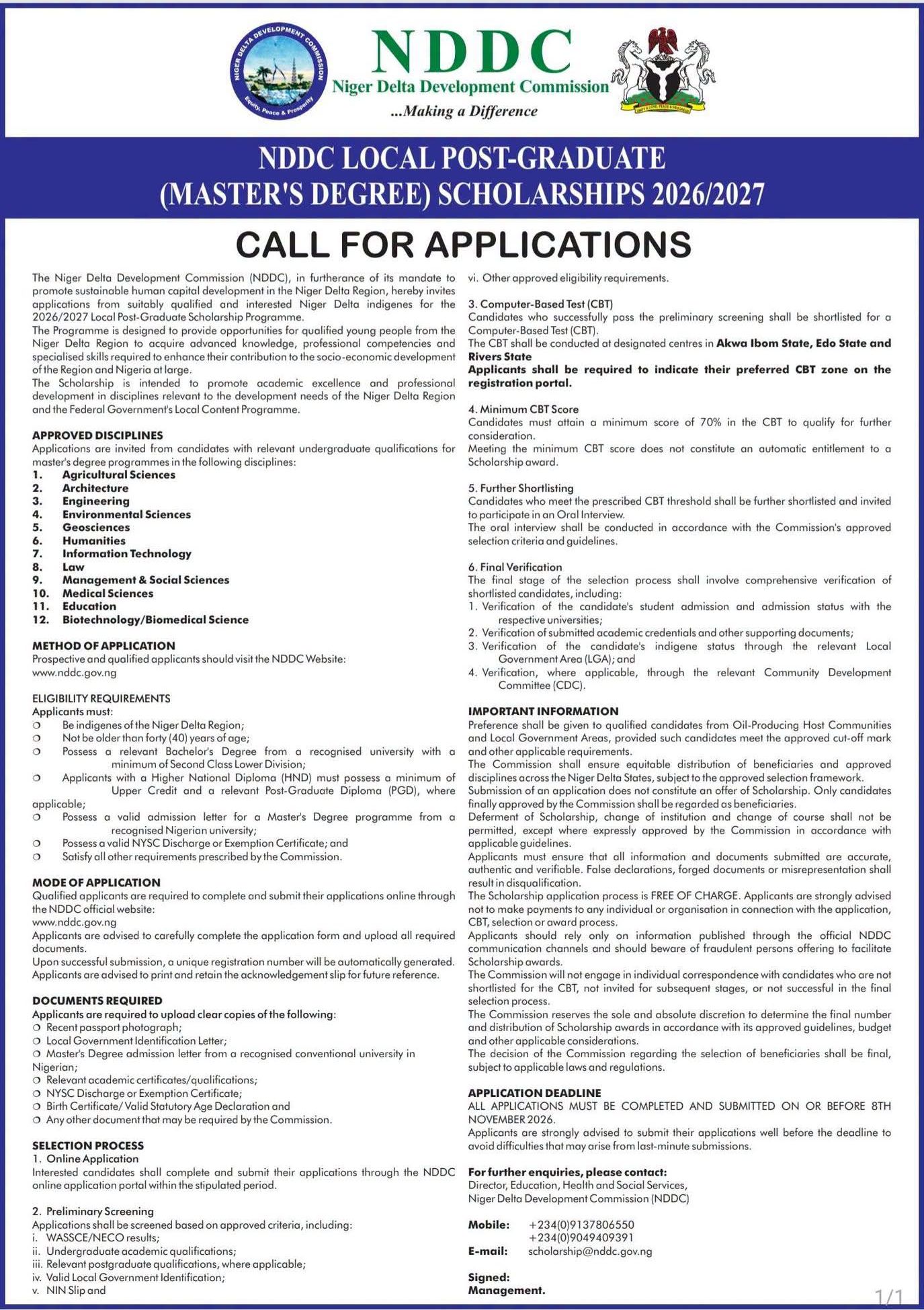
The Niger Delta Development Commission (NDDC) Postgraduate Scholarship 2026/2027 is an opportunity for eligible indigenes of Nigeria’s Niger Delta Region who want to pursue postgraduate studies and develop specialised skills that can contribute to the region’s development.
For many graduates, gaining admission to a master’s or other approved postgraduate programme is only one part of the challenge.
Tuition, academic expenses, research costs, and other financial responsibilities can make further education difficult to pursue. A scholarship can help reduce some of these financial pressures and make advanced training more accessible.
The NDDC’s Local Postgraduate Scholarship Programme is designed to support qualified young people from the Niger Delta in acquiring advanced knowledge and professional skills.
According to the announcement provided, the 2026/2027 programme targets applicants interested in approved postgraduate programmes across selected academic disciplines.
However, this is not simply a matter of submitting an application and waiting for an award.
Applicants must meet the Commission’s eligibility requirements and pass through a selection process that includes preliminary screening, a computer-based test (CBT), an oral interview, and final verification.
Understanding these stages before applying can help you prepare properly and avoid mistakes that could affect your application.
Important deadline information: The announcement states that completed applications must be submitted on or before the 8th.
However, the month and year are missing from the supplied text. Applicants should confirm the complete deadline through an official NDDC announcement before submitting an application.
This guide explains what the NDDC Postgraduate Scholarship is, who may qualify, the disciplines mentioned in the announcement, the selection process, the documents applicants should prepare, and how to find the official application information.
NDDC Postgraduate Scholarship 2026/2027: Programme Overview
Here are the main details available from the announcement.
Scholarship Name: NDDC Local Postgraduate Scholarship Programme
Academic Session: 2026/2027
Organising Body: Niger Delta Development Commission (NDDC)
Target Applicants: Qualified indigenes of the Niger Delta Region
Study Level: Postgraduate studies
Programme Objective: To develop advanced knowledge and specialised professional skills among young people from the Niger Delta
Eligible Courses: Approved postgraduate programmes in selected disciplines
Selection Process: Preliminary screening, computer-based test, oral interview, and final verification
Application Deadline: Incomplete in the supplied announcement; the text states that applications must be submitted on or before the 8th
Official Information: Applicants should consult the NDDC’s official website and scholarship application portal
Enquiry Email Provided: scholarship@nddc.gov.ng — verify this address against the official NDDC website before sending personal documents
The announcement does not provide a confirmed scholarship amount, a complete list of eligible courses, the CBT date, or the full application URL. These details should be verified before relying on the opportunity.
What Is the NDDC Postgraduate Scholarship Programme?
The Niger Delta Development Commission is a public institution established to support the development of Nigeria’s Niger Delta Region.
One of the programme’s stated objectives is to promote sustainable human capital development by helping qualified young people acquire advanced knowledge and specialised skills.
The NDDC Local Postgraduate Scholarship Programme forms part of this broader objective. It is intended to provide opportunities for eligible indigenes of the region to pursue further education in approved fields.
Postgraduate education can help graduates develop more advanced expertise in their chosen professions. Depending on the course, this may involve technical training, research, professional development, policy analysis, or specialised practical knowledge.
For example, a graduate pursuing an approved engineering programme may gain advanced technical skills, while someone studying information technology may develop expertise relevant to digital systems and technology-related challenges.
A postgraduate qualification in environmental sciences may also help prepare a graduate for work involving environmental management, research, or sustainability.
These are examples of how advanced education can support professional development; they are not guarantees of employment or specific outcomes from the NDDC scholarship.
The programme’s wider goal is to help develop people whose knowledge and skills can contribute to the Niger Delta and Nigeria as a whole.
Who Is the NDDC Postgraduate Scholarship Intended For?
The announcement specifically invites applications from suitably qualified indigenous people of the Niger Delta Region.
This means that applicants should pay close attention to the requirement concerning their origin and any documentation the Commission requires to establish eligibility.
Being a graduate or having an interest in postgraduate study does not automatically mean that you qualify. Applicants must satisfy the official eligibility conditions and any additional requirements approved by the Commission.
The information supplied identifies several important academic requirements.
1. Applicants Must Be Indigenes of the Niger Delta Region
The programme is designed for qualified young people from the Niger Delta Region.
Applicants should verify the Commission’s current definition of eligible indigene status and the documents accepted as proof.
If an application requires a certificate of origin or another official document, make sure the information is accurate and that the document meets the stated requirements.
Do not assume that residence in a Niger Delta state alone is sufficient if the official rules require proof of indigene status.
2. Applicants Must Hold a Relevant Bachelor’s Degree
The announcement states that applicants should possess a relevant bachelor’s degree from a recognised university.
The degree should be relevant to the intended postgraduate programme and meet any academic standards established by the Commission.
For example, an applicant seeking admission to an advanced programme in engineering would generally need an appropriate academic background, subject to the course’s specific entry requirements.
Applicants should confirm whether their previous qualification is accepted for their proposed programme before applying.
3. Applicants With an HND May Need Additional Qualifications
The supplied announcement refers to applicants with a Higher National Diploma (HND) and specifies an Upper Credit requirement, together with a Postgraduate Diploma (PGD) where applicable.
Because the original text is incomplete, it is important to confirm the precise wording and conditions in the official guidelines.
An HND holder should not assume that an HND alone automatically satisfies the scholarship’s postgraduate admission requirements.
Check the entry requirements of the intended university and the NDDC’s rules to determine whether a PGD or another qualification is required.
4. Applicants Must Have Valid Postgraduate Admission
The announcement refers to valid admission and an admission letter from a recognised institution.
Applicants should therefore confirm whether they must already have secured admission to an approved postgraduate programme before applying.
If an admission letter is required, ensure that it clearly identifies the university, programme, and level of study.
The announcement also mentions admission-related verification during the final selection stage, making the accuracy of academic information particularly important.
5. Applicants Must Meet Other Approved Eligibility Requirements
The NDDC announcement refers to additional eligibility requirements approved by the Commission.
These may include further conditions relating to academic qualifications, documentation, or the approved programme of study. However, the supplied text does not provide a complete list.
Applicants should consult the official guidelines rather than relying exclusively on summaries published elsewhere.
Eligible Courses and Disciplines for the NDDC Scholarship 2026/2027
The announcement identifies several disciplines that may be covered by the scholarship.
The text supplied is incomplete, so the list below includes the fields that can be identified from it. Applicants must confirm the complete and official list before choosing a course.
1. Agricultural Sciences
Agricultural sciences cover areas connected to agricultural production, research, food systems, and the management of agricultural resources.
Postgraduate study in this field may be relevant to graduates interested in agricultural development, food security, agricultural technology, or research.
Applicants should confirm which specific agricultural programmes are approved for the 2026/2027 scholarship.
2. Architecture
Architecture is another discipline mentioned in the supplied announcement.
Postgraduate training in architecture may help graduates develop advanced knowledge in building design, planning, and related professional areas.
However, applicants should confirm that their intended programme meets the NDDC’s approved course requirements and the university’s admission criteria.
3. Engineering
Engineering is listed among the disciplines in the announcement.
The field includes several specialisations, and eligibility may depend on the specific course being offered by the university.
Applicants interested in engineering should verify whether their proposed specialisation is included in the approved scholarship list.
4. Environmental Sciences
Environmental sciences focus on the study and management of environmental systems and challenges.
Advanced training in this area may be relevant to graduates interested in environmental research, resource management, sustainability, and environmental protection.
Given the environmental challenges affecting parts of the Niger Delta, this field may be of interest to applicants who want to develop expertise relevant to environmental and community development.
Nevertheless, the exact environmental science programmes eligible for funding must be confirmed through the official NDDC guidelines.
5. Information Technology
Information technology is also mentioned in the announcement.
Postgraduate study in this area may help graduates develop advanced skills in digital systems, information management, software-related fields, and other technology-focused disciplines, depending on the programme.
Applicants should check whether their intended course falls within the Commission’s approved category.
Other Disciplines
The supplied text appears to contain additional course names, but several entries are incomplete or difficult to identify reliably.
Applicants should not treat the disciplines listed in this article as the complete official course list.
Before applying, check the current NDDC announcement for all approved disciplines and confirm that your intended postgraduate programme is eligible.
What Documents Should You Prepare?
The available announcement refers to academic qualifications, postgraduate admission documents, and final verification.
Although it does not provide a complete application checklist, there are several documents you should review against the official instructions.
Academic Certificates
Prepare the academic certificates relevant to your qualifications.
These may include your bachelor’s degree certificate and, where applicable, an HND certificate or postgraduate diploma certificate.
Only submit documents requested by the official application process.
Academic Transcripts
Check whether the application requires an academic transcript or other evidence of your results.
If a transcript is required, ensure that it comes from the appropriate institution and follows the format specified by the application guidelines.
Postgraduate Admission Letter
The announcement refers to valid admission and verification of admission details.
If the official rules require an admission letter, make sure you have the correct document for the postgraduate programme you intend to pursue.
Do not submit an admission letter for a different course or institution if it does not meet the scholarship’s requirements.
Proof of Indigene Status
Because the programme is intended for Niger Delta indigenes, check which documents the Commission accepts as proof of origin.
The official instructions should determine whether a certificate of origin or another document is required.
Other Supporting Documents
The Commission may require additional documents under its approved eligibility and application guidelines.
Do not assume that the list above is exhaustive. Review the official application portal and follow its instructions carefully.
Important: The source announcement does not provide a complete document checklist. Confirm every requirement through the official NDDC application portal before submitting your application.
How the NDDC Postgraduate Scholarship Selection Process Works
The supplied announcement describes a selection process involving preliminary screening, a computer-based test, an oral interview, and final verification.
Understanding these stages can help applicants prepare for what may be required.
Stage 1: Preliminary Screening
Applications are subject to preliminary screening before candidates are shortlisted for the computer-based test.
At this stage, applicants should expect their submitted information and qualifications to be considered against the programme’s eligibility requirements.
The announcement does not provide the full screening criteria or the exact method used to assess applications.
For this reason, it is important to submit accurate information and ensure that your academic qualifications and other documents match the official requirements.
An incomplete application or an application that does not satisfy the eligibility conditions may not progress to the next stage.
Stage 2: Computer-Based Test (CBT)
According to the announcement, candidates who successfully pass preliminary screening will be shortlisted for a computer-based test.
The CBT is expected to take place at designated centres in Akwa Ibom State and the Federal Capital Territory, Abuja, based on the supplied text.
However, the original announcement is incomplete in this section, so applicants should confirm the final examination locations, date, venue, and other instructions through official NDDC communication.
The source does not identify the examination subjects, question format, duration, or scoring method.
Applicants should therefore avoid relying on unverified claims about the test’s contents.
Once the official CBT instructions are released, read them carefully and prepare according to the stated requirements.
Stage 3: Oral Interview
Candidates who progress through the earlier stages may be invited to participate in an oral interview.
The announcement indicates that the interview will form part of the selection process and will be conducted according to approved criteria and guidelines.
The exact interview questions and assessment format are not provided in the supplied material.
Applicants invited to an interview should review their submitted application and be prepared to discuss their academic background, intended postgraduate programme, and other information relevant to their application.
It is particularly important to ensure that your answers are consistent with your submitted documents.
Stage 4: Final Verification
The final stage involves comprehensive verification.
The supplied announcement specifically mentions verification of the candidate’s student admission and admission-related information.
This means that information provided during the application process may be checked before a final award decision is made.
Applicants should ensure that their admission details, academic qualifications, and other submitted information are genuine and accurate.
If the Commission requests further documentation, respond through the official channel and within the stated timeframe.
Stage 5: Final Selection and Award
The announcement indicates that scholarship awards will be subject to approved guidelines, budgetary provisions, and applicable laws and regulations.
Meeting the initial eligibility requirements or progressing through the selection stages should not be interpreted as an automatic guarantee of a scholarship award.
Applicants should wait for official communication confirming the final outcome and any conditions attached to the award.
How to Apply for the NDDC Postgraduate Scholarship 2026/2027
The original announcement refers to an application portal but does not provide a complete, verifiable application URL.
For that reason, applicants should begin by locating the current scholarship announcement through the official NDDC website.
Step 1: Visit the Official NDDC Website
Start with the Commission’s official website:
https://www.nddc.gov.ng/
Look for the current Local Postgraduate Scholarship Programme announcement and any accompanying application instructions.
Make sure the announcement relates to the 2026/2027 academic session.
Step 2: Confirm That the Application Portal Is Official
Use the application link provided through the official NDDC website or another official NDDC communication channel.
Do not rely on an unfamiliar website simply because it uses the scholarship’s name or displays the Commission’s logo.
Before entering personal information, confirm that the application page is the correct one.
Step 3: Read the Eligibility Requirements
Review the official rules for indigene status, academic qualifications, admission requirements, approved disciplines, and any additional conditions.
Check that you meet the requirements before proceeding.
If you hold an HND or a qualification other than a conventional bachelor’s degree, pay particular attention to the rules governing your qualification.
Step 4: Confirm That Your Course Is Approved
Check the official list of eligible disciplines.
Do not assume that every postgraduate programme offered by a recognised university is automatically eligible for NDDC scholarship support.
If your intended course is not clearly listed, seek clarification from the Commission through its official contact channels.
Step 5: Prepare the Required Documents
Gather the documents specified by the application guidelines.
Check that the information in your application matches your certificates, admission letter, and other supporting documents.
If the portal specifies file formats or upload limits, follow those instructions.
Step 6: Complete the Application Form
Enter the requested information accurately.
Review your details before submitting the form, particularly your name, academic qualifications, intended course, admission information, and contact details.
Do not submit false information or documents that you cannot verify.
Step 7: Submit Before the Confirmed Deadline
The supplied announcement states that completed applications must be submitted on or before the 8th, but the month and year are missing.
Do not rely on the incomplete date. Confirm the complete application deadline from the official NDDC announcement or portal before submitting.
If a submission confirmation is provided, save it for your records.
Step 8: Monitor Official Communication
After applying, check the official communication channels for updates about screening, the CBT, interview invitations, and other selection stages.
If you are shortlisted, follow the instructions provided by the Commission and use only the official channels to communicate about your application.
What Is the Scholarship Worth?
The supplied announcement does not state the scholarship’s financial value or provide a detailed breakdown of the benefits.
It would therefore be misleading to describe the programme as covering a specific tuition amount, accommodation allowance, monthly stipend, travel expenses, or other costs without confirmation.
Before accepting an award, applicants should seek official clarification about:
The financial value of the scholarship.
Which academic expenses are covered.
Whether tuition or other university charges are included.
The duration of the award.
Whether funding is subject to academic performance or other conditions.
Any payment arrangements and responsibilities attached to the award.
These details matter because a scholarship’s title alone does not establish exactly which expenses will be covered.
Use the official award terms to determine how the funding applies to your intended programme.
Important Things to Know Before Applying
A few details in the announcement deserve particular attention.
The Application Deadline Needs Confirmation
The supplied text states that applications must be completed and submitted on or before the 8th, but the month and year are missing.
Applicants should obtain the complete deadline from an official source before making decisions about their application.
The Complete Course List Is Not Available in the Supplied Text
Agricultural Sciences, Architecture, Engineering, Environmental Sciences, and Information Technology can be identified from the announcement.
Other course names appear incomplete. Check the official list before deciding which programme to pursue.
Admission Requirements Matter
The announcement refers to a relevant bachelor’s degree from a recognised university and includes conditions concerning HND holders and postgraduate diplomas.
Confirm how these requirements apply to your qualification and intended course.
Passing One Stage Does Not Guarantee an Award
The selection process includes screening, a CBT, an oral interview, and final verification.
Applicants should not assume that being shortlisted or completing an interview automatically means they have been selected.
Confirm All Information Through Official Channels
The announcement advises applicants to rely on information published through official NDDC channels.
This is particularly important when checking deadlines, application links, selection results, and scholarship conditions.
Frequently Asked Questions About the NDDC Postgraduate Scholarship 2026/2027
1. What is the NDDC Postgraduate Scholarship?
The NDDC Postgraduate Scholarship is a programme intended to support eligible indigenous people of the Niger Delta Region in pursuing approved postgraduate studies and developing specialised knowledge and professional skills.
2. Who can apply for the NDDC Scholarship 2026/2027?
The programme is intended for suitably qualified indigenous people of the Niger Delta Region.
Applicants must also meet the academic, admission, and other eligibility requirements set out in the official guidelines.
3. Can HND holders apply?
The supplied announcement refers to HND holders with an Upper Credit and a Postgraduate Diploma where applicable.
However, the original text is incomplete. HND holders should consult the official guidelines to confirm the precise requirements for their qualifications and intended programmes.
4. Which courses are eligible?
The available text identifies Agricultural Sciences, Architecture, Engineering, Environmental Sciences, and Information Technology.
The full approved list is not available in the supplied announcement, so applicants should confirm the complete list through official NDDC communication.
5. Is postgraduate admission required before applying?
The announcement refers to valid postgraduate admission and verification of admission details.
Applicants should confirm whether an admission letter is mandatory at the point of application and what type of institution or programme is accepted.
6. Is the NDDC scholarship fully funded?
The supplied announcement does not state the scholarship’s financial value or provide a complete breakdown of covered expenses.
Applicants should consult the official scholarship guidelines to determine which costs are covered and whether any conditions apply.
7. Will applicants take a computer-based test?
Yes. The announcement states that candidates who pass preliminary screening will be shortlisted for a computer-based test.
The exact date, examination format, subjects, and final venue details should be confirmed through official NDDC communication.
8. Is there an oral interview?
Yes. The announcement identifies an oral interview as part of the selection process for candidates who progress through the earlier stages.
9. What happens during final verification?
The announcement indicates that the Commission will conduct comprehensive verification, including checking student admission and admission-related information.
Applicants should ensure that all submitted documents and details are accurate.
10. What is the application deadline?
The supplied announcement says applications must be submitted on or before the 8th, but the month and year are missing.
Applicants must confirm the complete deadline through the official NDDC website or application portal.
11. Where can I apply?
Begin at the official NDDC website:
https://www.nddc.gov.ng/
Locate the current 2026/2027 Local Postgraduate Scholarship Programme announcement and follow the application link published there.
12. How can I contact the NDDC about the scholarship?
The supplied announcement lists the email address scholarship@nddc.gov.ng and a telephone contact beginning with 091378065, but the telephone number appears incomplete.
Verify both contact details through the official NDDC website before using them.
Final Thoughts
The NDDC Local Postgraduate Scholarship Programme 2026/2027 is intended to help qualified indigenous people of the Niger Delta Region pursue advanced education and acquire specialised skills.
The programme may be relevant to graduates seeking postgraduate training in approved fields such as Agricultural Sciences, Architecture, Engineering, Environmental Sciences, and Information Technology.
However, the complete list of eligible disciplines and the precise academic requirements must be confirmed through the official guidelines.
The selection process is also important. According to the supplied announcement, candidates may have to pass preliminary screening, a computer-based test, an oral interview, and final verification before the award process is completed.
Before applying, confirm your eligibility, check the approved course list, review the admission requirements, and prepare the documents specified by the Commission.
Most importantly, verify the complete application deadline and official application link.
The source text contains an incomplete deadline and does not provide a complete portal URL, so these details should not be guessed.
For the latest information, visit the official NDDC website:
https://www.nddc.gov.ng/
Use the Commission’s published announcement and application instructions as your final reference when preparing an application for the NDDC Postgraduate Scholarship 2026/2027. https://scholarship.nddc.gov.ng/login
Browse related scholarships on scholars Africa website below
SDG Innovation Summit Malaysia 2026: 30 Scholarships, $1,000 Seed Grant and International Youth Summit
Commonwealth PhD Scholarships 2027: My Experience Applying for a Fully Funded PhD in the UK
Full Application Guides and Details for Scholarships Programs to Study at the University of Tasmania
University of Michigan-Dearborn Scholarships 2026–2027: Eligibility, Benefits and How to Apply
University of Cologne Humanities Scholarship 2027 in Germany: Fully Funded PhD Opportunity
Discover more from Scholars Africa
Subscribe to get the latest posts sent to your email.

About Scholars Africa Editorial Team
Scholars Africa Editorial Team is dedicated to researching and publishing verified scholarships, jobs, and global opportunities. Our content is built on extensive analysis of application trends, eligibility criteria, and selection patterns to help applicants succeed at every stage. Our team has reviewed hundreds of scholarship programs and application processes across multiple countries.