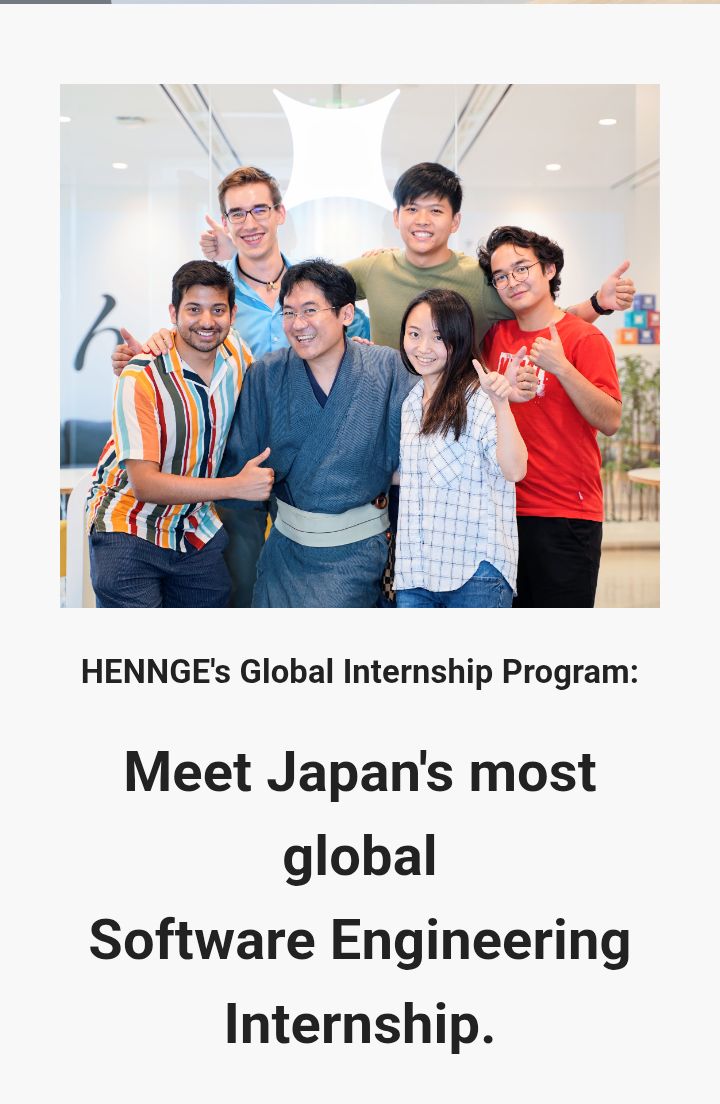
Are you a computer science student, aspiring software engineer, or recent graduate hoping to gain international experience in Japan?
The HENNGE Global Internship Program (GIP) offers an opportunity to develop your software engineering skills in Tokyo while learning directly from experienced engineers in an English-speaking environment.
Hosted by HENNGE K.K., a technology company based in Japan, the programme is designed for students and early-career engineers who want to strengthen their technical foundations through practical projects, mentorship, and collaboration with a professional engineering team.
One feature that makes this internship particularly interesting is its financial support package.
Although the programme is unpaid, HENNGE lists several benefits for selected interns, including a monthly subsidy, round-trip airfare, pre-arrival support and visa guidance, and medical insurance for interns who do not reside in Japan. Interns also receive a Japanese mobile phone with data.
The internship takes place on-site at HENNGE’s headquarters in Tokyo and normally runs for four to six weeks. Applicants can choose between two technical pathways: Front-End Engineering and Full-Stack Engineering.
There is an important distinction to understand before applying: this is not simply a short course in programming.
HENNGE describes the Global Internship Program as part of its pre-hiring process. Candidates interested in pursuing a software engineering career in Japan may therefore find the opportunity especially relevant.
In this guide, I will walk you through the programme, explain the eligibility requirements, compare the two pathways, outline the application process, and share practical ways to prepare a stronger application.
If I were applying, I would pay particular attention to the coding challenge, my understanding of the chosen pathway, and my ability to explain the decisions behind my code.
Those details are central to presenting myself as an engineer who understands the work rather than someone who has simply copied a solution.
HENNGE Global Internship Program 2026–2027: Overview
Here are the key details to know before starting your application.
Programme name: HENNGE Global Internship Program (GIP)
Host organisation: HENNGE K.K.
Host country: Japan
Location: HENNGE headquarters in Tokyo
Opportunity type: On-site software engineering internship
Duration: Four to six weeks
Working schedule: Monday to Friday, 10:00 a.m. to 7:00 p.m. Japan Standard Time
Eligible applicants: Qualified undergraduate students in their third year or above, master’s students, doctoral students, and recent graduates
Academic background: Computer Science or a related field, or equivalent experience from a technology internship or bootcamp where applicable
Working language: English
Japanese language requirement: Japanese is not required for this programme
Available pathways: Front-End Engineering and Full-Stack Engineering
Financial status: Unpaid internship with listed financial and practical support
Financial benefits: Monthly subsidy, round-trip airfare, pre-arrival support and visa guidance
Additional benefits: Medical insurance for interns residing outside Japan, a Japanese mobile phone with data, technical sessions, cultural activities, and office facilities
Application method: Online registration, coding challenge, CV, cover letter, and interviews for candidates who pass the initial screening
Application deadline: Applications may close once all places in a batch have been filled
Official application website: HENNGE Global Internship Program
Important: The information provided does not specify a universal calendar deadline, a fixed monthly subsidy amount, or a guaranteed employment offer. Applicants should check the official website for the current batch schedule, application status, and complete terms.
What Is the HENNGE Global Internship Program?
The HENNGE Global Internship Program is an on-site software engineering training programme that gives selected participants the opportunity to work on technical assignments while learning from experienced engineers at HENNGE.
The programme focuses on engineering fundamentals, problem-solving, technical decision-making, and collaboration. Rather than treating interns primarily as a source of production work, HENNGE emphasises learning through structured projects and direct mentorship.
This distinction matters. If you are looking for a programme where you can learn how professional engineers approach problems, discuss technical trade-offs, and improve your implementation through feedback, HENNGE’s model may suit your goals.
The programme also provides exposure to a global, English-speaking working environment in Japan. According to HENNGE, applicants do not need Japanese-language proficiency to participate in this internship.
However, the programme is conducted on-site in Tokyo. Applicants should therefore consider travel arrangements, the working schedule, and their availability for the entire placement before applying.
Why Is HENNGE’s Internship Different?
Several features distinguish the programme from a conventional online coding course.
First, the internship takes place in a professional engineering environment. Participants work alongside HENNGE’s engineering team rather than learning entirely through recorded lessons.
Second, the programme includes a dedicated mentor. This creates an opportunity to receive guidance and discuss technical decisions as the work progresses.
Third, the assignments cover practical software engineering concepts. Depending on the pathway, these may include application development, APIs, state management, security, testing, cloud deployment, or infrastructure.
Finally, the programme is connected to HENNGE’s recruitment process. Participants interested in future employment in Japan may find that particularly relevant, although successful completion does not guarantee a full-time job.
For applicants, the central question is not simply whether the company is well known. It is whether the training matches the skills they want to develop and the career they hope to pursue.
Who Should Apply for the HENNGE Global Internship Program?
The programme is aimed at students and early-career engineers who already have a foundation in software development and want to improve through practical engineering work.
It is not presented as a complete beginner’s introduction to programming.
For example, an applicant who has built web applications, completed programming projects, participated in a technology bootcamp, or contributed to an open-source project may have relevant experience to discuss.
By contrast, someone who has only recently started learning programming and cannot yet work with the technologies required by the chosen pathway may need more preparation before applying.
That does not mean every applicant must have professional employment experience. It means you should be able to demonstrate the technical foundation requested by the programme.
Eligibility Requirements for the HENNGE Global Internship Program
HENNGE lists several essential qualifications. Applicants should review each one carefully before registering.
1. You Must Be a Third-Year Undergraduate Student or More Advanced
The programme accepts applicants who are in the third year of an undergraduate degree or beyond. Eligible academic stages include:
Third-year undergraduate students.
Fourth-year undergraduate students.
Other undergraduate students at a more advanced stage who meet the stated requirement.
Master’s students.
Doctoral students.
Recent graduates.
If you have already graduated, the programme information says recent graduates are welcome to apply. It does not specify a universal maximum number of years since graduation, so applicants who are unsure should check the current official guidance.
2. You Need a Computer Science or Related Background, or Equivalent Experience
Applicants should be pursuing or hold a degree in Computer Science or a related field.
HENNGE also indicates that candidates without the relevant degree background may demonstrate equivalent experience through a technology internship or bootcamp.
The important point is that you need a credible technical foundation.
If you studied a different subject, consider whether you can demonstrate the relevant skills through completed projects, formal technology training, or internship experience.
For example, if you are applying for the Full-Stack Pathway, you should be able to discuss your experience with application development and the programming languages or tools relevant to the pathway.
Do not assume that simply expressing an interest in technology will satisfy the technical requirements.
3. You Must Be Proficient in English
The programme operates in an English-speaking environment.
Applicants should be comfortable discussing technical ideas, reading documentation, asking questions, and explaining their work in English.
This is particularly important because the internship emphasises mentorship and collaboration.
You may be asked to explain why you structured an application in a particular way, how you approached a problem, or what you would improve in your implementation.
You do not need to present yourself as a perfect speaker. What matters is being able to communicate clearly enough to participate in the technical work.
4. Japanese Is Not Required
One of the programme’s appealing features is that Japanese-language proficiency is not required for the Global Internship Program.
This makes the opportunity potentially accessible to international applicants who have the necessary technical skills but do not speak Japanese.
However, applicants should distinguish between the internship’s language requirements and the language expectations of other HENNGE positions.
For example, HENNGE separately advertises certain non-technical positions for new graduates that require Japanese. Those positions should not be confused with the English-language software engineering internship described here.
5. You Need Relevant Programming Skills
Your technical skills should match the pathway you choose.
The Full-Stack Pathway highlights Python, Go, and TypeScript with React or Vue in its technical profile. The programme also expects familiarity with Linux, macOS, or another Unix-like environment.
Applicants should review the specific requirements for their selected pathway rather than assuming that all programming languages are interchangeable.
If you have experience in a different language, identify the underlying concepts you understand and be honest about which technologies you have used directly.
6. Interest in Open Source and Technology Communities
HENNGE identifies interest in open-source projects or technology community activities as part of its candidate profile. This is worth considering when preparing your application.
If you have contributed to an open-source repository, attended programming meetups, participated in a hackathon, shared technical knowledge, or worked with a developer community, include relevant details where appropriate.
You do not need to invent a contribution to appear involved in technology.
If you have not participated in formal community activities, focus on the genuine projects and learning experiences that demonstrate your commitment to software development.
7. Interest in Pursuing a Career in Japan
HENNGE states that the programme is part of its pre-hiring process and that applicants interested in pursuing a career in Japan may have a significant advantage.
This does not mean that every intern will receive an employment offer. It does mean that applicants should think carefully about their longer-term professional interests before applying.
If you genuinely want to explore software engineering opportunities in Japan, explain why the environment and the company’s work interest you.
Avoid making promises you do not intend to keep. A clear, honest explanation of your career interests is more useful than claiming that you will definitely relocate simply to improve your application.
Choose Your Pathway: Front-End or Full-Stack Engineering?
One of the most important decisions in the HENNGE internship application is choosing your technical pathway.
Applicants must select at least one pathway when registering. Each pathway follows a different schedule, and interns cannot change pathways midway through the programme.
If you want to apply for both pathways, HENNGE instructs applicants to submit separate applications using different email addresses for the coding challenge.
Because the choice affects your internship experience, I would make it based on my current skills and learning goals rather than choosing whichever title sounds more impressive. Let’s look at the options.
1. HENNGE Front-End Engineering Pathway
The Front-End Pathway focuses on front-end software development using TypeScript and modern frameworks such as React or Vue.
Front-end engineering involves building the parts of an application users interact with directly. Depending on the project, that can include interfaces, forms, navigation, data presentation, and the way an application responds to user actions.
A good candidate for this pathway should have an interest in creating usable interfaces and understanding how front-end applications are structured.
Who Is the Front-End Pathway Suitable For?
You may want to consider this pathway if you have experience with:
JavaScript and TypeScript.
React or Vue.
Building interactive web interfaces.
Managing application state.
Working with APIs from a front-end application.
Debugging browser-based applications.
Writing maintainable front-end code.
These are useful areas to review, but applicants should confirm the precise technical expectations in the current official programme information.
How I Would Prepare for the Front-End Pathway
If I were applying for the Front-End Pathway, I would begin by reviewing the projects I had already built.
I would ask myself whether I could explain how the interface works, how data moves through the application, how errors are handled, and why I chose a particular component structure.
I would also make sure I could explain the difference between JavaScript and TypeScript and describe my experience with React or Vue, depending on the framework I had used.
A small, complete project that you understand thoroughly can provide a better discussion point than a large application assembled from code you cannot explain.
I would also review the code for readability, unnecessary complexity, and obvious bugs before using it as a portfolio example.
The objective is not to pretend that every project is perfect. It is to demonstrate that you can reason about the code you have written and learn from problems.
2. HENNGE Full-Stack Engineering Pathway
The Full-Stack Pathway is intended for candidates interested in developing both back-end and front-end applications, with additional exposure to DevOps and cloud infrastructure.
The programme description emphasises building and connecting applications, designing back-end APIs and front-end interfaces, and understanding topics such as security, state management, and testing.
It also includes work with Unix-like environments and DevOps tooling, with mentor feedback helping interns improve their technical decisions.
Full-Stack Internship Schedule
HENNGE describes the pathway as follows:
Weeks 1–3: Full-Stack Application Development Project
During this stage, the focus is on developing a full-stack application. The work involves understanding how the front end and back end connect and how application components operate together.
Week 4: DevOps and Infrastructure Project
This stage introduces infrastructure-related work and DevOps concepts.
Applicants interested in cloud deployment and the operational side of software development may find this especially useful.
Weeks 5–6: Conditional Special Assignment
HENNGE lists an additional special assignment for weeks five and six, depending on the programme arrangement. The assignment is described as unique to each intern and specific to the batch.
Because the additional weeks are conditional, applicants should confirm the expected duration of their particular batch.
Technical Skills Relevant to the Full-Stack Pathway
HENNGE identifies several technologies and knowledge areas relevant to this pathway. These include:
Python.
Go.
React or Vue with TypeScript.
Linux, macOS, or other Unix-like environments.
Cloud computing, particularly AWS.
Full-stack web application development.
Distributed systems.
DevOps practices, including continuous integration and continuous delivery (CI/CD).
Infrastructure as Code.
Container technologies such as Docker.
The programme lists several of these as desirable areas of experience, rather than stating that every applicant must be an expert in all of them.
The stated profile asks candidates to meet at least three of the listed additional knowledge or experience areas. Review the current vacancy carefully to understand how that requirement applies to your chosen pathway.
How I Would Prepare for the Full-Stack Pathway
I would begin by checking whether I could build and explain a basic web application from end to end.
For example, could I describe how the front end sends a request to an API, how the back end processes the request, and how the application returns a response?
I would then review the parts of the technology stack I had used directly.
If I had worked with Python, I would revisit the structure of my application, how it handled errors, and how I organised the code.
If I had used React or Vue with TypeScript, I would review the interface components and how the front end interacted with the back end.
I would also spend time becoming comfortable with the command line and the Unix-like environment I use for development.
If AWS, Docker, or CI/CD appeared on my CV, I would be ready to explain what I had actually done with those tools. Listing a technology without understanding its purpose can create problems when an interviewer asks follow-up questions.
You do not need to pretend that you have mastered every part of full-stack development. You do need to be able to demonstrate your current skills honestly and show that you understand the fundamentals.
Which HENNGE Internship Pathway Should You Choose?
The right pathway depends on your technical background and the kind of work you want to develop further.
| Feature | Front-End Pathway | Full-Stack Pathway |
| Main focus | User-facing web applications | Front end, back end, and basic DevOps |
| Key technologies | TypeScript, React, or Vue | Python, Go, TypeScript, React/Vue, and relevant infrastructure tools |
| Main learning direction | Interfaces and front-end engineering | Application architecture and the wider development stack |
| Best suited to | Candidates with front-end experience or strong interest | Candidates interested in both front-end and back-end development |
| Cloud and infrastructure exposure | Check the current pathway details | Explicitly included in the pathway description |
| Application choice | Select during registration | Select during registration |
CERN Short-Term Internship 2026 in Switzerland: What I Would Know Before Applying
Do not select the Full-Stack Pathway simply because it covers more areas. A candidate with stronger front-end experience may be better prepared to explain their work in the Front-End Pathway.
Likewise, if you already enjoy connecting APIs, building back-end services, and deploying applications, the Full-Stack Pathway may be a more natural fit.
If you genuinely want to apply to both, follow HENNGE’s instruction to submit separate applications using different email addresses for the coding challenge. Remember that you cannot change pathways midway after enrolling.
What Financial Support and Benefits Does HENNGE Provide?
Although the HENNGE Global Internship Program is unpaid, the company lists a package of financial, travel, and workplace benefits.
This distinction is important: an unpaid internship with subsidies is not the same as a salaried internship.
Applicants should understand what is provided and confirm any details that could affect their budget before accepting a place.
1. Monthly Subsidy
HENNGE lists a monthly subsidy for global interns. This support can help with expenses during the internship, but the programme information supplied here does not state a fixed amount.
I would therefore avoid budgeting around an assumed figure. Instead, I would ask the programme team to confirm the monthly subsidy amount, payment schedule, and any conditions attached to it.
Tokyo living expenses can vary considerably depending on accommodation, transport, food, and personal spending.
Knowing the actual support available will help you assess whether the placement is financially workable.
2. Round-Trip Airfare
HENNGE lists round-trip airfare among the benefits for global interns. This can significantly reduce the cost of travelling to Japan for the programme.
However, applicants should confirm the practical arrangements before making travel plans, including how flights are arranged, what travel dates are covered, and whether any conditions apply.
Do not purchase a ticket on the assumption that you will automatically receive reimbursement unless the programme team has confirmed that arrangement.
3. Pre-Arrival Support and Visa Guidance
The company lists pre-arrival support and visa guidance as part of the programme benefits.
This can be useful for international participants who need to prepare for travel and understand the administrative steps associated with entering Japan.
However, visa guidance is not the same as a guarantee of visa approval.
If you are applying from outside Japan, confirm which documents the company provides, what you must arrange independently, and how much time you should allow for the relevant procedures.
4. Medical Insurance
HENNGE states that medical insurance is provided to interns who do not reside in Japan.
The company specifically limits this benefit to non-residents of Japan, so applicants should check the applicable insurance terms for their circumstances.
Before travelling, confirm the coverage period, what the policy covers, and whether any additional insurance is necessary.
5. Japanese Mobile Phone With Data
The listed benefits include a Japanese mobile phone with data.
This can be useful for communication during the stay, particularly when coordinating daily activities or navigating a new environment.
Confirm how the phone is provided and whether there are any conditions attached to its use.
6. Technical Sessions and Learning Opportunities
Interns can access monthly technical sessions in which engineers share knowledge and discuss current trends.
These sessions provide another opportunity to learn beyond the assigned project.
For an early-career engineer, technical discussions can be valuable because they expose you to how experienced developers think about tools, practices, and engineering challenges.
7. Office Facilities and Social Activities
HENNGE also lists office facilities, refreshments, staff events, and social opportunities among its intern benefits.
The programme includes get-to-know-you luncheons and Japanese cultural activities.
These opportunities may help interns become more familiar with their colleagues and experience aspects of working life in Japan.
The exact schedule of activities may vary, so applicants should consult the current programme information for details.
Is the HENNGE Global Internship Program Fully Funded?
The most accurate description is that HENNGE offers an unpaid internship with a stated package of financial and practical support.
The company lists a monthly subsidy, round-trip airfare, pre-arrival support and visa guidance, and medical insurance for interns who do not reside in Japan. A Japanese mobile phone with data is also listed.
However, the supplied information does not specify the monthly subsidy amount or provide a complete breakdown of every possible expense.
For that reason, applicants should not assume that every personal expense will be covered. Before accepting a place, I would confirm:
The amount of the monthly subsidy.
Whether accommodation is provided or must be arranged independently.
How the round-trip airfare benefit is administered.
Which visa-related expenses, if any, are covered.
The scope and duration of medical insurance.
Whether any other personal expenses will need to be paid out of pocket.
These questions are especially important if you are travelling internationally and need to prepare a realistic budget.
How to Apply for the HENNGE Global Internship Program
HENNGE outlines a three-stage application process. Applicants should complete each stage carefully and follow the instructions on the official programme website.
Step 1: Register Online and Verify Your Email Address
Begin by visiting the official HENNGE Global Internship Program website:
https://recruit.hennge.com/en/gip/
Review the current programme details, pathway descriptions, eligibility requirements, and available internship schedules.
When you are ready, use the application button to register and verify your email address.
Choose your pathway carefully. If you intend to apply for both pathways, remember that HENNGE requires separate applications using different email addresses for the coding challenge.
Before registering, check your availability for the internship’s working hours: Monday to Friday, from 10:00 a.m. to 7:00 p.m. Japan Standard Time.
Because the programme takes place on-site in Tokyo, also consider whether you can participate in person for the full period.
Step 2: Complete the Coding Challenge
After registration, applicants are asked to solve a coding challenge and submit their work alongside their CV and cover letter.
This is a central part of the application process, so I would give it serious attention.
HENNGE states that the coding challenge has no time limit and that the time taken to solve it is not considered during screening.
That is useful information. It means the published guidance does not ask candidates to race against a clock.
Instead, focus on understanding the problem, developing a correct solution, and making sure you can explain your work.
How to Approach the Coding Challenge
Read the problem carefully.
Before writing code, identify what the problem asks you to do. Make a note of the expected input, output, constraints, and any special cases.
Misunderstanding the task can lead to a solution that is technically valid but does not solve the actual problem.
Break the problem into smaller parts.
Think through the steps your program needs to perform.
Consider the information you receive, the operations you need to carry out, and the result you must return.
Writing down the logic before coding can help you identify gaps in your reasoning.
Choose a language you can explain.
Use a language permitted by the challenge instructions and one you understand well enough to discuss.
Do not choose a language merely because you think it looks impressive on an application.
Test your implementation.
Try ordinary examples and edge cases.
Check what happens with empty input, unusual values, repeated data, or other conditions relevant to the problem.
Testing helps reveal mistakes that may not be obvious from reading the code.
Keep the implementation understandable.
Readable code makes it easier for another engineer to follow your reasoning.
Use sensible names, organise the logic clearly, and avoid unnecessary complexity.
Make sure you can explain your decisions.
HENNGE emphasises engineering fundamentals and expects participants to take ownership of their code.
Be ready to explain why your solution works, what alternatives you considered, and what limitations or improvements you can identify. Do not submit code that you cannot explain confidently.
Important: HENNGE’s Policy on AI Tools
HENNGE explicitly asks applicants and interns not to use AI tools to generate code for training assignments or solution implementations.
The company allows a designated AI service to be used for certain non-code-generating learning tasks, such as clarifying technical concepts, understanding documentation, or helping with non-essential tasks like command-line options.
Follow the current instructions provided by HENNGE.
If you use an AI tool in a way the programme prohibits, you risk submitting work that does not reflect your own understanding. You may also find it difficult to explain the implementation during a subsequent interview.
A safer approach is to solve the coding challenge yourself, consult permitted documentation where appropriate, test your work, and make sure you understand every part of the solution.
Do not use AI-generated code to complete the challenge when HENNGE’s rules prohibit it.
Step 3: Submit Your CV and Cover Letter
HENNGE asks applicants to submit their CV and cover letter with their coding challenge work.
These documents should help the recruitment team understand your background, technical experience, motivation, and suitability for the selected pathway.
Your CV should highlight relevant programming languages, frameworks, projects, education, and technical experience.
Your cover letter should explain why you are interested in HENNGE’s internship and how your existing skills connect with the work described in the programme.
Avoid writing a cover letter that could be sent unchanged to dozens of unrelated companies.
A more convincing application explains what you want to learn through the chosen pathway and gives specific examples of your current experience.
HENNGE provides a guide to preparing a cover letter here:
https://hennge.com/global/info/henka/interview/202403-crafting-the-perfect-cover-letter/
Use the guide to understand the company’s expectations, then write a letter that reflects your own experience.
Step 4: Attend the Interviews if Shortlisted
Applicants who pass the second stage are invited to an HR interview, followed by an online interview.
The precise interview questions are not specified in the supplied programme information, so candidates should avoid assuming that every interview follows the same format.
Nevertheless, you can prepare by reviewing your application and thinking about the experiences you have included. Be ready to discuss:
Your academic and technical background.
Your reasons for applying to HENNGE.
Why you selected the Front-End or Full-Stack Pathway.
Projects you have completed.
Programming languages and tools you have used.
Problems you encountered and how you approached them.
What you hope to learn during the internship.
Your genuine interest in a potential career in Japan, if applicable.
For technical discussions, focus on explaining your thinking clearly.
If you made a mistake in a project, explain what happened and how you addressed it. You do not need to pretend that every project was completed without difficulty.
The ability to reflect on your work and explain your decisions is particularly relevant to a programme that emphasises engineering fundamentals.
Step 5: Confirm Your Application Is Complete
HENNGE notes that the application is completed after applicants upload their application documents and fill in their batch preferences.
This is an important detail.
Do not assume that registering an account or completing the coding challenge alone finishes the application.
Review the current instructions and verify that you have completed all required steps, uploaded your CV and cover letter, and submitted your batch preferences.
Keep a record of the email address you used and any confirmation provided by the system.
How to Write a Strong CV for the HENNGE Internship
Your CV should make your technical background easy to understand.
The recruitment team should not have to search through unrelated information to discover whether you have the programming skills relevant to the internship.
I would organise the CV around the following areas, adjusting the format to suit my actual experience.
Education
Include your degree, institution, study dates, and current academic status. Make sure the information makes it clear whether you meet the programme’s academic-stage requirements.
If you studied a field outside Computer Science, highlight relevant technical training or equivalent experience where appropriate.
Technical Skills
List the programming languages, frameworks, tools, and environments you have used.
For example, you might include Python, Go, TypeScript, React, Vue, Linux, Docker, or AWS if you have genuine experience with them.
Do not list every technology you have heard of.
If you have only completed a brief tutorial with a tool, be careful not to present yourself as proficient in it.
Projects
Projects can be especially useful for students and recent graduates who have limited professional experience. For each relevant project, explain:
What you built.
What problem it was intended to solve.
Which technologies you used.
What you personally implemented.
What technical challenge you faced.
How you tested or improved the result.
Where appropriate, include a link to a code repository or portfolio. Make sure any shared repository is accessible and does not expose confidential information, private credentials, or other sensitive material.
Work Experience and Community Involvement
If you have completed a technology internship, attended a bootcamp, contributed to an open-source project, or participated in a developer community, include the experience when it is relevant.
Explain what you did rather than simply listing the organisation or activity.
If you have no formal employment experience, do not invent any. Use the sections that best demonstrate your actual skills.
How to Write a Convincing HENNGE Internship Cover Letter
The cover letter is an opportunity to explain the connection between your experience and the programme. A useful structure is to keep it focused on three areas.
Paragraph 1: Explain Why You Are Applying
Identify the internship and the pathway you want to pursue.
Explain why the programme interests you. You might be drawn to the opportunity to work with experienced engineers, improve your full-stack development skills, or learn in an international engineering environment.
Be specific about your own interests.
Paragraph 2: Demonstrate Your Technical Foundation
Choose one or two relevant examples from your background.
Describe a project, technical challenge, or learning experience that demonstrates the skills required by the pathway.
Explain your own contribution and the technologies you used. Avoid making claims that are not supported by your experience.
Paragraph 3: Explain What You Hope to Learn and Contribute
Show that you understand the programme’s emphasis on practical training, mentorship, and engineering fundamentals.
Explain which skills you want to strengthen and how your current knowledge could help you participate in the assigned work.
If you are interested in building a career in Japan, you can explain that interest honestly.
Finish professionally and keep the letter concise enough that the important points are easy to identify.
What Does HENNGE Look for in an Ideal Candidate?
HENNGE describes its ideal Full-Stack Engineering intern as a curious problem-solver who is excited about building applications and developing in a fast-paced technical environment.
The company also highlights several qualities and areas of experience.
Technical Versatility
For the Full-Stack Pathway, HENNGE values a solid understanding of both front-end and back-end development, together with an interest in cloud computing and DevOps.
You should therefore understand the technologies you list and be able to describe how you have used them.
Problem-Solving Ability
A coding challenge is an opportunity to demonstrate how you approach a technical problem.
The goal is not merely to produce something that appears to work. You should understand the logic, consider relevant cases, and be able to explain your decisions.
Curiosity and Willingness to Learn
The programme is designed around training and mentorship. Applicants should be prepared to learn from feedback, reconsider technical decisions, and improve their implementation.
You do not need to know everything before joining. However, you should have the foundation required for the pathway and be willing to engage seriously with the work.
Communication and Collaboration
Software engineering often involves discussing requirements, explaining decisions, and working with other people.
The programme’s English-speaking environment makes clear communication important.
Be prepared to explain your reasoning without assuming that the person listening already understands every detail of your project.
Genuine Interest in Japan
HENNGE identifies interest in pursuing a career in Japan as a relevant consideration.
If that is one of your goals, explain what attracts you to the opportunity and how it connects with your professional plans.
There is no need to exaggerate your intentions. Be realistic about what you want to explore and what you hope to learn.
When Should You Apply?
HENNGE states that internship places are limited and applications are reviewed as they are received. Positions are filled on a first-come, first-served basis, and applications may close once all places in a batch have been filled.
This means you should not assume that an opportunity will remain open until a particular date unless the official website confirms that deadline.
If you are interested in applying, start by reviewing the current programme information and available batch preferences.
Prepare your CV and cover letter, complete the coding challenge according to the instructions, and submit all required information as early as reasonably possible.
Do not rush through the coding challenge simply to submit first. HENNGE says solving time is not considered during screening, so prioritise a solution you understand and can explain.
The practical goal is to avoid unnecessary delay while still submitting work that accurately represents your abilities.
Is the HENNGE Internship Suitable for International Applicants?
The programme is designed for a global, English-speaking environment, and Japanese is not required for the internship.
HENNGE also lists round-trip airfare, pre-arrival support, visa guidance, and medical insurance for interns who do not reside in Japan.
These provisions make the programme worth exploring for qualified applicants living outside Japan.
However, international applicants should confirm the current arrangements directly with HENNGE before making commitments.
Check the application requirements, the internship dates, visa documentation, travel arrangements, insurance details, and monthly subsidy.
Also consider the daily schedule. The internship is on-site in Tokyo and runs from 10:00 a.m. to 7:00 p.m. Japan Standard Time, Monday through Friday.
If you are studying or working elsewhere, you will need to determine whether you can participate in person for the required period.
Can You Get a Full-Time Job at HENNGE After the Internship?
HENNGE explains that the Global Internship Program is part of its pre-hiring process and that outstanding participants may be offered full-time employment opportunities.
This makes the programme particularly interesting for people who want to explore a software engineering career in Japan.
However, a full-time job is a possibility, not a guaranteed outcome.
Applicants should treat the internship as an opportunity to develop their skills, demonstrate their engineering ability, and learn about the company’s working environment.
If you are hoping to pursue employment in Japan, use the application process to understand the programme and the potential recruitment pathway.
If you are selected, focus on the assigned work, seek feedback, and take responsibility for understanding the code you write.
Those are practical ways to make the most of the experience, regardless of whether a later employment opportunity becomes available.
Common Mistakes to Avoid When Applying
A few avoidable mistakes can weaken your application.
Choosing a pathway without checking its technical requirements: Review the pathway details and select the one that matches your current skills and learning goals.
Submitting a generic cover letter: Explain why this programme and pathway are relevant to your own background.
Listing technologies you cannot explain: Be honest about your proficiency and prepare to discuss your projects.
Using AI-generated code against programme rules: HENNGE restricts AI tools from generating code for training assignments and solution implementations. Follow those instructions.
Forgetting the batch preferences: HENNGE states that the application is complete only after the required documents are uploaded and batch preferences are filled in.
Waiting too long to apply: Places are limited, and applications may close once a batch is full.
Assuming every expense is covered: Confirm the subsidy amount and any conditions attached to travel, insurance, and visa-related support.
Treating the internship as a guaranteed job offer: The programme may lead to employment opportunities for outstanding participants, but a full-time position is not guaranteed.
Frequently Asked Questions About the HENNGE Global Internship Program
1. Is the HENNGE Global Internship Program paid?
The internship is described as unpaid, but HENNGE lists a monthly subsidy and several other benefits. Applicants should confirm the subsidy amount and the exact conditions of the current programme.
2. Where does the HENNGE internship take place?
The programme is an on-site software engineering internship at HENNGE’s headquarters in Tokyo, Japan.
3. How long is the internship?
The programme normally runs for four to six weeks. The exact schedule depends on the selected pathway and batch.
4. Is Japanese required?
No. HENNGE states that Japanese is not required for its Global Internship Program. The programme is designed for an English-speaking environment.
5. Who can apply?
The programme is aimed at third-year undergraduate students and above, including master’s and doctoral students, as well as recent graduates. Applicants should have a Computer Science or related degree background, or equivalent experience where applicable, and meet the relevant technical requirements.
6. Can applicants from outside Japan apply?
The programme is designed for global participants, and HENNGE lists travel and pre-arrival support. International applicants should check the current eligibility requirements and visa arrangements before applying.
7. Does HENNGE provide airfare?
Round-trip airfare is listed among the benefits. Applicants should confirm how the benefit is arranged and whether any conditions apply to their batch.
8. Does HENNGE provide accommodation?
The supplied programme information does not clearly specify whether accommodation is provided. Applicants should contact HENNGE or consult the current official programme information to confirm accommodation arrangements and the monthly subsidy amount.
9. Do I need professional software engineering experience?
The programme is designed for students and early-career engineers. Relevant technical experience is important, but the information does not state that every applicant must already have held a professional software engineering position. Applicants should review the requirements for their selected pathway.
10. Can I apply for both the Front-End and Full-Stack pathways?
Yes, according to the supplied programme information. Applicants interested in both pathways must submit separate applications using different email addresses for the coding challenge. You cannot change pathways midway after enrolling.
11. Does HENNGE allow AI tools during the coding challenge?
HENNGE asks applicants not to use AI tools to generate code for training assignments or solution implementations. The company permits certain non-code-generating uses of a designated AI service for learning support. Always follow the current official instructions.
12. Is there a fixed application deadline?
The supplied information does not give one universal deadline. Applications are reviewed as they are received, and a batch may close when all available places have been filled. Check the official website for the current schedule.
13. Will I receive a job offer after the internship?
Not necessarily. The programme is part of HENNGE’s pre-hiring process, and outstanding participants may receive full-time employment opportunities. Employment is not guaranteed.
14. How do I apply?
Visit the official HENNGE Global Internship Program website, register and verify your email, complete the coding challenge, upload your CV and cover letter, fill in your batch preferences, and attend the interviews if shortlisted.
Conclusion: Is the HENNGE Global Internship Program Worth Applying For?
The HENNGE Global Internship Program is an opportunity for students and early-career engineers who want to strengthen their software engineering skills through practical work and mentorship in Tokyo.
Its main attractions include an English-speaking environment, a choice between Front-End and Full-Stack pathways, a four-to-six-week on-site programme, and a package of support that includes a monthly subsidy and round-trip airfare.
The programme may be especially relevant if you are considering a future career in Japan because HENNGE identifies the internship as part of its pre-hiring process. Still, applicants should understand that the internship is unpaid and that future employment is not guaranteed.
If I were preparing an application, I would start by choosing the pathway that best matches my technical background. I would then review the coding challenge instructions, complete the work independently in accordance with HENNGE’s AI policy, and prepare a CV and cover letter that clearly explain my experience.
I would also confirm the current batch schedule, financial arrangements, and travel requirements before committing to the programme.
Ready to explore the opportunity?
Visit the official website to check the current programme details and begin your application:
HENNGE Global Internship Program: https://recruit.hennge.com/en/gip/
Since places are limited and applications may close when a batch fills, interested candidates should review the current opening early and ensure that their application is complete.
Browse related internships and job opportunities on scholars Africa website below
UNICEF Internship Programme 2026–2027: Paid Internships for Students and Recent Graduates Worldwide
Afreximbank Internship Opportunities 2026: $1,500 Monthly Support, Eligibility and How to Apply
Bank of America Summer Internship 2026: Paid International Internship Opportunities for Students
NVIDIA Internship Program 2027: Paid Opportunities for Students and Recent Graduates
UNICEF Internship Programme 2026–2027: Paid Internships for Students and Recent Graduates Worldwide
WHO Ethics Internship 2027 in Switzerland, Living Allowance, Lunch Vouchers and Application Guide
Discover more from Scholars Africa
Subscribe to get the latest posts sent to your email.

About Scholars Africa Editorial Team
Scholars Africa Editorial Team is dedicated to researching and publishing verified scholarships, jobs, and global opportunities. Our content is built on extensive analysis of application trends, eligibility criteria, and selection patterns to help applicants succeed at every stage. Our team has reviewed hundreds of scholarship programs and application processes across multiple countries.