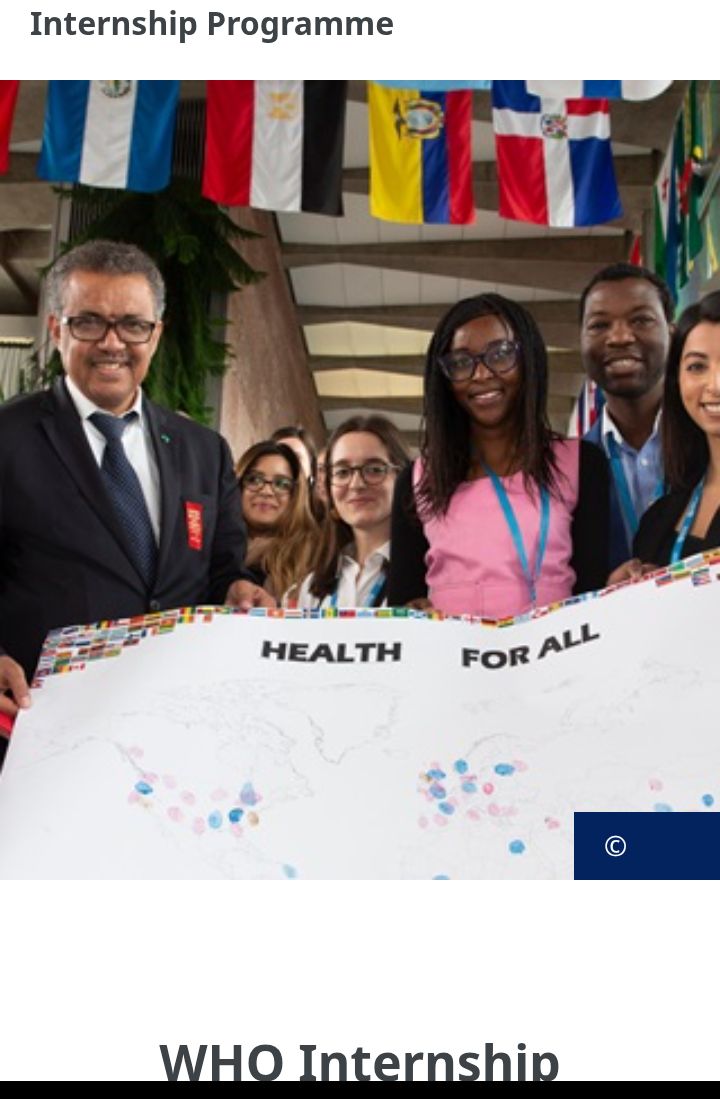
When I first came across the World Health Organization (WHO) Internship Programme, what caught my attention was not simply the name of the organization.
It was the possibility of actually seeing how international public health works from the inside.
I could study public health, medicine, social sciences, management or communications at university, but there is a big difference between learning about global health systems in a classroom and spending several weeks working alongside people involved in WHO programmes.
That is what makes the WHO Internship Programme particularly interesting for students and recent graduates who are trying to build a career in public health or related areas.
The programme is designed to give eligible students and recent graduates exposure to the technical and administrative work of WHO. Interns can be placed in different areas, including public health, medicine, social sciences, communications, external relations, human resources and other administrative functions.
One thing I would understand very early is that this is not one single internship position with one application deadline.
WHO posts different internship vacancies throughout the year, and each position can have its own requirements, location and closing date.
So if I were applying, I would not wait for someone to send me a link to “the WHO internship.”
I would regularly check the official WHO Careers internship vacancies and look for positions that actually match my background.
What is the WHO Internship Programme?
The WHO Internship Programme is intended to give students and recent graduates practical exposure to the work of the World Health Organization.
WHO describes its internship programme as part of its effort to develop a diverse pool of future leaders in public health.
That makes sense when you look at the kind of work involved.
Global health is not only about doctors and nurses.
Behind a major international health programme are researchers, epidemiologists, policy specialists, communication officers, programme managers, administrators, human resources professionals, data specialists and many other people.
That is why WHO internships can be available across both technical and administrative areas.
For me, one of the most useful things to understand is that I should not automatically assume I am unsuitable simply because my degree is not called “Public Health.”
The vacancy itself matters.
If the position is related to communications, external relations, administration or management, someone with an appropriate background in one of those areas may be considered.
The key is matching my actual academic background and experience with the requirements of the specific vacancy.
Why I would consider the WHO Internship Programme
The biggest attraction for me would be the opportunity to understand how international health organizations actually operate.
It is easy to read reports produced by WHO.
It is another thing to work within a WHO team and see how those reports, programmes and initiatives are developed.
As an intern, I could potentially gain exposure to technical programmes, administrative systems, international collaboration and the processes through which different stakeholders contribute to global health work.
The experience could also help me understand something that is difficult to learn from a university lecture:
How does a global health organization turn research and policy into actual programmes?
That question alone makes the internship valuable.
WHO Internship Programme eligibility requirements
Before I would spend time preparing an application, I would check the eligibility requirements carefully.
WHO has specific conditions for its internship programme, and satisfying the general conditions does not necessarily mean I will be selected for every vacancy.
The main requirements include age, education, previous university study, language ability, nationality and previous participation in the WHO Internship Programme.
Let’s look at them one by one.
1. I must be at least 20 years old
Applicants must be at least 20 years of age on the date of application.
This is one of those requirements I would check immediately because there is no point spending hours preparing an application if I don’t meet a basic eligibility condition.
2. My field of study needs to be relevant
This is another important part of the WHO internship requirements.
I would need to be enrolled in a university or equivalent institution leading to a formal qualification.
Eligible academic backgrounds can include fields connected to:
- public health;
- medicine;
- social sciences;
- management;
- administration;
- communications;
- external relations;
- and other areas relevant to WHO’s technical or administrative work.
The internship is therefore broader than many people initially assume.
A public-health student may fit naturally into a technical health position.
But a communications student could also find a WHO internship related to communication work.
Similarly, someone studying management or administration could potentially find an appropriate vacancy.
The important thing is to read the actual internship description rather than applying based only on the WHO name.
3. Recent graduates may also be eligible
One detail I would pay close attention to is that WHO’s internship programme is not restricted only to people currently sitting in a university classroom.
Applicants who have already completed a qualification may also be considered if they apply within 18 months of completing their formal qualification.
That gives recent graduates a window to apply.
So if I had just graduated, I would not automatically assume that I had missed my chance.
I would check the date I completed my qualification and compare it with the requirements of the internship vacancy.
4. I need three years of full-time university study
Before starting the internship, applicants must have completed at least three years of full-time studies at a university or equivalent institution, at bachelor’s level or equivalent.
This is an important distinction.
Being enrolled at university is not necessarily enough by itself.
I would check whether I have completed the required period of study before the internship begins.
5. English is not the only possible working language
WHO operates internationally, so language requirements can depend on the office where the internship is based.
Applicants must be fluent in at least one of the working languages of the office of assignment.
This means I would never assume that one language requirement applies to every WHO internship.
I would read the specific vacancy carefully.
The language requirement can matter just as much as my academic qualification.
6. I must hold a valid passport from a WHO Member State
Applicants must hold a valid passport of a WHO Member State.
This is another basic requirement I would verify before beginning the application.
7. I cannot have previously participated in the WHO Internship Programme
The programme is also not designed for people who have already completed a WHO internship.
Applicants must not have previously participated in the WHO Internship Programme.
WHO Internship Programme application process
This is probably the part I would pay the most attention to.
The application is not something I would send through a random email address.
WHO states that internship applications must be made through the specific internship vacancy notices posted on the WHO Careers website using its online recruitment system, known as Stellis.
There is no alternative route for submitting an internship application outside the Stellis system.
That means if I see someone offering to “submit my WHO internship application” through an unofficial email address, I would be extremely cautious.
The actual application needs to go through WHO’s recruitment system.
How I would search for a WHO internship
I would approach the search differently from a normal scholarship search.
Instead of searching for one programme and applying once, I would keep checking the available internship vacancies.
WHO internships can be available in different organizational locations, including:
- headquarters;
- regional offices;
- country offices;
- and other WHO locations.
They can also cover different areas of work.
That means two internship vacancies appearing around the same time could have completely different requirements.
One could be focused on public health research.
Another could be communications.
Another could involve administration or external relations.
So I would read each vacancy individually.
The application deadline can vary
This is one of the easiest ways to make a mistake.
There is not necessarily one universal deadline for every WHO internship.
Internship positions are posted continuously, and individual vacancies can have their own closing dates.
If I found a position I genuinely wanted, I would immediately record:
- the vacancy title;
- the closing date;
- location;
- required field of study;
- language requirements;
- duration;
- required qualifications;
- and any specific application instructions.
I would not assume that because a WHO internship was advertised recently, I still had several weeks to apply.
The vacancy notice is what matters.
What happens after applying
This is where expectations need to be realistic.
WHO internships are very competitive.
Only a small number of applicants are selected each year.
So submitting an application does not mean that I should expect an interview or offer.
WHO states that only successful candidates will be contacted.
That can make the waiting period frustrating because there may not be a detailed rejection message.
If I am not selected, however, I can apply for other WHO internship vacancies in the future, provided I still meet the eligibility requirements.
I would therefore treat each vacancy as a separate opportunity rather than assuming that one unsuccessful application means I am permanently out.
What WHO interns can receive
One of the questions I would ask before accepting a WHO internship is:
What exactly is covered financially?
The answer is important because the experience can vary significantly depending on the duty station.
WHO provides interns with medical and accident insurance coverage during the internship period.
However, coverage before the internship begins and after it ends, including travel to and from the duty station, remains the individual’s responsibility.
That distinction is important.
I would not assume that because WHO provides insurance during the internship, every cost associated with travelling to the internship location is automatically covered.
WHO living allowance for eligible interns
WHO also provides a living allowance to eligible selected interns who require financial support.
The exact amount should be checked in the relevant vacancy notice because the financial arrangements can depend on the position and current WHO policy.
There is also an important declaration involved.
Intern candidates must complete a Declaration of Interests form.
This includes declaring relevant financial support, such as:
- grants;
- bursaries;
- scholarships;
- and other forms of financial assistance.
WHO uses the information provided to assess eligibility for financial support.
So I would be completely transparent when completing this part of the process.
Lunch vouchers may be available
Depending on the duty station, interns may also receive lunch vouchers.
I would treat this as an additional benefit rather than something I would automatically expect everywhere because the availability can vary by location.
What is the internship duration?
WHO interns must be available to work full-time.
The internship can last for a minimum of six weeks and up to a maximum of 24 weeks, depending on the needs of the technical unit.
That means I would need to think realistically about my academic schedule before applying.
If I am still studying and my university semester overlaps with the proposed internship dates, I need to know whether I can actually commit to the full-time arrangement.
This is not the sort of opportunity I would apply for first and worry about my availability later.
Documents I may be asked to provide
WHO requires interns to provide proof of enrolment in a course of study or proof that they have completed their most recent qualification.
There is also a medical requirement.
Before starting the internship, selected interns must provide a completed WHO medical certificate of fitness for work form.
Another important requirement concerns conflicts of interest.
I would need to disclose circumstances that could create a potential conflict of interest related to the work I would be doing during the internship.
This includes relevant financial support.
One practical detail I would remember is that WHO specifically asks applicants not to send documents until they are requested.
That means I would not start emailing my passport, certificates and other personal documents to WHO offices simply because I found an internship vacancy.
I would follow the instructions in the recruitment process.
What to expect from a WHO internship
If I were selected, I would not expect to suddenly become a WHO staff member.
Interns have a different status.
WHO interns are not staff members of the organization and cannot represent WHO officially.
That distinction is important.
The internship is primarily a learning and professional-development experience.
I would expect to contribute to the work of my assigned team while learning about WHO systems, processes and programmes.
Can a WHO internship lead directly to a WHO job?
I would not enter the internship expecting an automatic job afterward.
There is no guarantee of employment simply because someone completed a WHO internship.
However, WHO states that interns and former interns are free to apply as external candidates for vacant positions that are open to external applicants and for which they are qualified.
So I would view the internship as professional experience rather than a guaranteed recruitment pathway.
That distinction would help me set realistic expectations.
My university may not be able to make special agreements with WHO
Another detail that surprised me when looking through the programme requirements is that WHO does not sign agreements proposed or required by a sponsor, university or equivalent institution.
If my university tells me that it needs a particular agreement before allowing me to participate, I would not assume WHO will automatically sign it.
I would check the relevant WHO rules first.
WHO recognises qualifications from accredited institutions
WHO also considers higher educational qualifications obtained from institutions accredited or recognised in the World Higher Education Database (WHED).
The database is maintained through the International Association of Universities and UNESCO.
This matters because I would want to be sure that my academic qualification meets the recognition requirements before relying on it for an application.
Some professional certificates may not appear in WHED and may require individual review.
What about a WHO internship in Geneva?
This is where I would be particularly careful with my budget.
Geneva sounds exciting.
Working at WHO headquarters and living in Switzerland could be an incredible experience.
But Geneva is also expensive.
WHO specifically warns prospective interns that although eligible interns may receive a living allowance, the cost of living in Geneva can be high and finding suitable accommodation can be difficult.
So if I received an internship offer in Geneva, I would not immediately calculate the living allowance as “free money.”
I would first work out my actual costs.
I would consider:
- accommodation;
- food;
- local transportation;
- travel to Switzerland;
- visa-related expenses where applicable;
- deposits;
- insurance outside the internship coverage period;
- and other personal expenses.
Accommodation would be one of the first things I would investigate.
The practical reality is that finding a reasonably priced place to stay in Geneva can be challenging.
What makes the WHO Internship Programme different?
For me, the strongest part of the WHO Internship Programme is its exposure.
I could be studying health policy, medicine, public health or another relevant discipline, but an international organization operates on a scale that is difficult to reproduce in a classroom.
I would get to see how people from different professional and cultural backgrounds work together around health issues.
That is particularly useful if I eventually want to work in:
- international development;
- public health;
- health policy;
- global health;
- humanitarian work;
- communications;
- international organizations;
- research;
- programme management;
- or related fields.
This is probably one of the practical lessons I would take from the application process.
Because WHO posts different internships, I would not simply apply to every vacancy with the word “internship” in the title.
I would look for a genuine match.
If a vacancy requires knowledge or experience I clearly do not have, I would not spend days trying to force my background into the position.
Instead, I would look for another vacancy where my education and experience make more sense.
That makes the application process much more manageable.
Before applying, I would read the complete internship vacancy.
I would look at the responsibilities first.
Then the required qualifications.
Then the preferred skills.
Then the location and duration.
Only after that would I work on my application.
The reason is simple.
I want my application to answer the actual needs of the team.
If the internship is heavily focused on communication, I would make my relevant communication experience easy to identify.
If it is research-oriented, I would make my research experience clear.
If it involves programme administration, I would highlight relevant organizational and administrative work.
I would not rewrite my entire history.
I would simply make the relevant parts impossible to miss.
WHO Internship Programme: What I would remember before applying
If I were preparing my application today, I would keep these points in front of me:
Age: I must be at least 20 years old at the time of application.
Education: I need to be enrolled in an appropriate university programme or, if already graduated, apply within the permitted 18-month period.
University study: I need to have completed at least three years of full-time university study before the internship begins.
Language: I need fluency in at least one working language of the office where I would be assigned.
Nationality: I need a valid passport from a WHO Member State.
Previous WHO internship: I must not have previously participated in the WHO Internship Programme.
Application: I must apply through the specific vacancy on the WHO Careers system using Stellis.
Duration: I need to be available full-time for between six and 24 weeks, depending on the position.
Insurance: WHO provides medical and accident insurance during the internship.
Financial support: Eligible interns may receive a living allowance, with the exact details stated in the relevant vacancy.
Documents: I should only provide supporting documents when WHO requests them.
Competition: The programme is highly competitive and only a limited number of candidates are selected.
My final view on the WHO Internship Programme
If I were a student or recent graduate trying to build a serious career in public health or an adjacent field, I would keep the WHO Internship Programme on my list.
But I would approach it differently from the way I would approach a normal scholarship.
There is no single form that I complete once and forget about.
The vacancies appear continuously, and each one has its own requirements and deadline.
So my strategy would be to monitor the WHO Careers internship vacancies regularly, identify positions that genuinely fit my background, and then build a focused application for each one.
I would also be realistic about the financial side.
An internship at WHO can provide valuable professional exposure, and eligible interns may receive financial support, but costs vary considerably by duty station. Geneva in particular requires careful budgeting because accommodation and everyday living expenses can be high.
Most importantly, I would remember that being selected is only the beginning.
The real value of the internship would come from what I actually learn while working with the team, the professional relationships I develop, the international perspective I gain and how I use that experience afterward.
For someone interested in global health, public health, international development, research, policy or health-related administration, that exposure can be difficult to reproduce elsewhere.
The application itself is straightforward once I understand where the vacancies are posted: I would find a suitable internship vacancy on the WHO Careers website, read its requirements carefully, and submit my application through Stellis.
I would not pay an agent to submit the application.
I would not send documents to random email addresses.
And I would not assume that every WHO internship has the same deadline or requirements.
I would work from the actual vacancy notice.
That is the approach I would take if I were applying for the WHO Internship Programme now.
Browse more opportunities to apply for on scholars Africa
NVIDIA Internship Program 2027: Paid Opportunities for Students and Recent Graduates
UNDP Digital, AI and Innovation Internship 2026 | Remote Paid Internship for International Students
UNICEF Paid Global Internship 2026 Application Guides. New applications
List of 7 Nestle Global Paid Opportunities, Details and Application processes.
CSIS Communications and Operations Internship 2026, Paid Full-Time Opportunity for Graduates
CSIS Communications and Operations Internship 2026, Paid Full-Time Opportunity for Graduates
Discover more from Scholars Africa
Subscribe to get the latest posts sent to your email.

About Scholars Africa Editorial Team
Scholars Africa Editorial Team is dedicated to researching and publishing verified scholarships, jobs, and global opportunities. Our content is built on extensive analysis of application trends, eligibility criteria, and selection patterns to help applicants succeed at every stage. Our team has reviewed hundreds of scholarship programs and application processes across multiple countries.
As the founder of Tech Futurist and Lead Research Specialist at Grow More Server Resources, I have spent my career building structured, evidence-based frameworks — most notably our proprietary D.I.G.I.T. methodology (Diagnose, Investigate, Gap Analysis, Integrate, Transform) — to help organizations move from ambiguity to actionable strategy. This same discipline of rigorous diagnosis and structured problem-solving is what draws me to the World Health Organization: global health challenges demand the same evidence-first, systems-level thinking I apply daily in digital infrastructure work, only at civilizational scale.
My academic foundation in History and Diplomacy sharpens this further, giving me a grounded understanding of how multilateral institutions negotiate, coordinate, and translate policy into action across diverse political and cultural contexts — precisely the terrain WHO operates in every day. Complementing this, my grassroots work with the ADC Youth Coalition and the Rivers Youth Media Team on civic governance sensitization has taught me how to communicate complex issues to real communities, not just institutions — a skill I believe is essential to WHO’s mission of translating global health policy into local impact.
I don’t come to this internship as a generalist — I come as someone who has already built and led a research-driven organization, who understands both the technical infrastructure and human communication sides of large-scale problem-solving, and who is trained to diagnose systemic gaps before proposing solutions. I want to bring that same rigor to WHO’s work, while learning from the world’s foremost public health institution how to apply it at global scale.