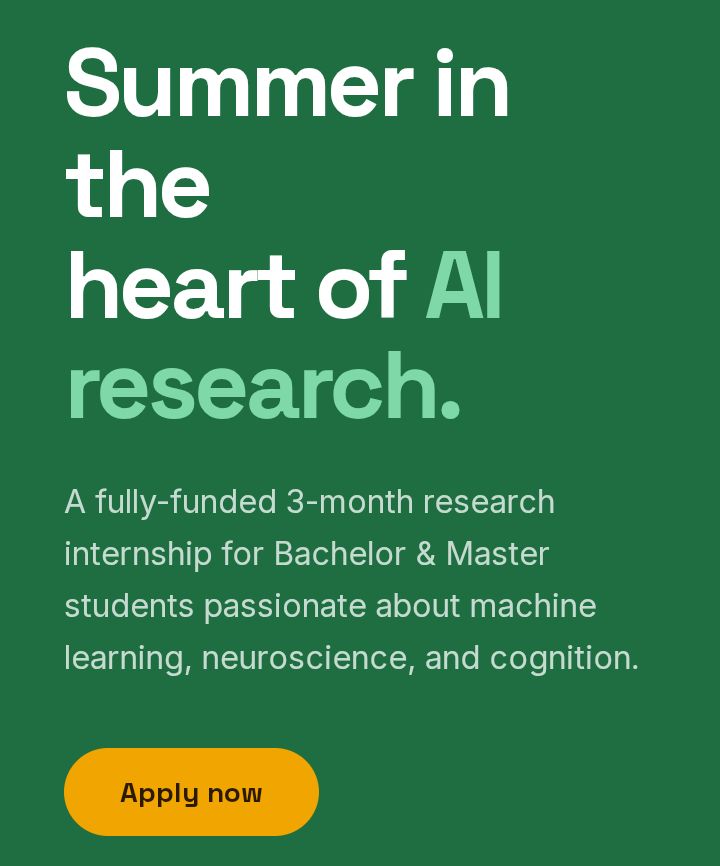
Are you a Bachelor’s or Master’s student interested in artificial intelligence, machine learning, neuroscience, or cognition? If you have been looking for an opportunity to gain hands-on research experience in Germany without having to worry about covering all the costs yourself, the CaCTüS Internship 2027 is worth exploring.
The CaCTüS Internship offers students the opportunity to spend three months working on research projects at the intersection of artificial intelligence and cognition.
The programme is organised by the Max Planck Institute for Biological Cybernetics, the Max Planck Institute for Intelligent Systems, and the Tübingen AI Center in Tübingen, Germany.
Up to 12 students will be selected for the 2027 internship cohort. Successful applicants will receive a paid internship, travel and accommodation assistance, access to leading research facilities, and the opportunity to work with scientists on research projects involving machine learning, electrical engineering, theoretical neuroscience, behavioural experiments, and data analysis.
One of the most interesting aspects of this programme is its commitment to supporting students who may have been held back by financial, regional, personal, or societal circumstances.
The organisers specifically encourage applications from students who are both from and currently living in low- and middle-income countries, particularly those whose backgrounds are underrepresented in the research community.
For students who want to build a research career but have not yet had access to international research opportunities, this could be a valuable starting point.
In this guide, I will walk through the CaCTüS Internship 2027, including its benefits, eligibility requirements, application timeline, and how to prepare a competitive application.
CaCTüS Internship 2027: Programme Overview
Before getting into the application process, here are the key details applicants should know.
| Programme Detail | Information |
| Programme Name | CaCTüS Internship |
| Internship Year | 2027 |
| Host Country | Germany |
| Host Location | Tübingen |
| Host Institutions | Max Planck Institute for Biological Cybernetics, Max Planck Institute for Intelligent Systems, and Tübingen AI Center |
| Duration | 3 months |
| Internship Start Date | 1 July 2027 |
| Internship End Date | 30 September 2027 |
| Number of Internships | Up to 12 |
| Funding | Paid internship with a full stipend for three months |
| Additional Support | Travel and accommodation assistance |
| Eligible Academic Levels | Bachelor’s and Master’s students |
| Fields of Interest | Machine learning, AI, neuroscience, cognition, electrical engineering, behavioural science, and data analysis |
| Application Opening Date | 21 October 2026 |
| Application Deadline | 16 November 2026 |
| Interview Period | January 2027 |
| Acceptance Notifications | February 2027 |
Important: The programme is highly limited, with only up to 12 internship places available. Applicants should therefore take the application seriously and prepare their materials well before the deadline.
What Is the CaCTüS Internship?
The CaCTüS Internship is a summer research programme designed for students who want to explore research at the intersection of artificial intelligence and cognition.
The programme brings together two rapidly developing areas of science: biological intelligence and artificial intelligence.
Biological intelligence explores how humans and other living organisms perceive, learn, behave, and make decisions. Artificial intelligence research examines how machines can learn, process information, and perform tasks that may require forms of intelligence.
At the intersection of these fields are challenging research questions about learning, cognition, behaviour, perception, and intelligent systems.
The CaCTüS Internship gives selected students an opportunity to contribute to research in these areas while working alongside scientists at leading research institutions.
Rather than simply attending lectures or completing a general training course, interns will work on research projects and gain experience in scientific investigation.
The programme is particularly relevant to students who are considering pursuing a Master’s degree, PhD, or long-term research career in artificial intelligence, neuroscience, or related fields.
Why the CaCTüS Internship Is Worth Considering
There are several reasons why this internship may be attractive to students from different academic and geographical backgrounds.
1. You receive a paid three-month research internship
One of the main benefits is that the internship is paid.
The programme provides a full stipend for the three-month period in Tübingen. This is important because international research opportunities can be difficult to access when students are expected to cover all their expenses themselves.
The programme also offers travel and accommodation assistance.
However, the announcement does not specify the exact stipend amount or the precise limits of the travel and accommodation support. Applicants should check the official programme information for details before making travel plans or financial commitments.
CSIS Communications and Operations Internship 2026, Paid Full-Time Opportunity for Graduates
2. You work with leading scientists
Successful applicants will have the opportunity to work with researchers at the Max Planck Institute for Biological Cybernetics, the Max Planck Institute for Intelligent Systems, and the Tübingen AI Center.
For students who have mostly experienced classroom learning, working directly with scientists can be an important step.
Research work may involve exploring a question, examining existing literature, analysing data, testing an approach, or contributing to a broader research project.
The exact tasks will depend on the research project and the supervising scientist.
3. You gain international research experience
Research experience can be useful when applying for graduate programmes, research assistantships, PhD positions, and other scientific opportunities.
An internship in Germany can also help students understand how research is conducted in an international academic environment.
This does not mean the internship automatically guarantees admission to a graduate programme or a future job. Its value comes from the experience, skills, research exposure, and professional connections you gain during the programme.
4. You become part of a research community
The CaCTüS programme includes cohort events, mentors, and a peer network. This means interns will have opportunities to connect with other students and researchers during their time in Tübingen.
For students who have been working independently or studying in institutions with limited research resources, joining a cohort of people with similar interests may be particularly valuable.
5. The programme encourages applicants from underrepresented backgrounds
The internship is designed to help young scientists who may face personal, financial, regional, or societal barriers to accessing research opportunities.
The organisers specifically encourage applications from students who are both from and currently living in low- and middle-income countries.
This is an important point for applicants who have assumed that international research internships are only accessible to students from well-funded universities or countries with established research networks.
The programme’s stated commitment to access and diversity means students should not automatically rule themselves out because they have not previously participated in an international research programme.
However, applicants must still meet the programme’s academic and research-related requirements and demonstrate a genuine interest in the subject areas.
Who Can Apply for the CaCTüS Internship 2027?
The programme is open to students at Bachelor’s and Master’s level who have a strong interest in research at the intersection of AI and cognition.
The announcement also mentions recently graduated students.
Applicants should carefully check the official application requirements to confirm how the programme defines recent graduates and whether there are any additional restrictions.
1. Bachelor’s and Master’s students
The programme is intended for students studying at Bachelor’s or Master’s level.
If you are currently enrolled in a university and interested in artificial intelligence, machine learning, neuroscience, or cognition, you may be a potential applicant.
The programme does not state that applicants must be enrolled in a particular university or country.
2. Students from relevant academic backgrounds
The internship welcomes students with interests or backgrounds in areas such as:
Machine learning
Artificial intelligence
Electrical engineering
Theoretical neuroscience
Behavioural science
Data analysis
Related research fields
The programme focuses on research questions that connect artificial intelligence and cognition.
Therefore, applicants should be able to explain how their academic background, research interests, or skills relate to this intersection.
For example, a student studying electrical engineering may be interested in computational models of perception. A machine learning student may want to understand how biological systems learn. A neuroscience student may be interested in using data analysis or computational techniques to study behaviour.
The important thing is to make the connection clear in your application.
3. Students from around the world
The CaCTüS Internship is open to students worldwide. The organisers particularly encourage applications from students who are both from and living in low- and middle-income countries.
This means applicants should review the programme’s official eligibility information rather than assume that the internship is restricted to students from Germany or Europe.
4. Applicants facing barriers to research opportunities
The programme is specifically designed to support young scientists who have been held back by personal, financial, regional, or societal constraints.
If you have had limited access to research facilities, funding, mentorship, or international academic opportunities, this may be relevant to your application.
Still, the strongest approach is to explain your circumstances clearly and honestly, where the application provides an appropriate opportunity to do so.
Avoid turning your application into a general statement about hardship. Instead, explain how your circumstances have shaped your academic journey, research interests, or access to opportunities.
What Research Areas Can Interns Explore?
The CaCTüS Internship covers several areas of research connected to machine learning, biological intelligence, and cognition. The programme announcement identifies the following fields:
Machine Learning and Artificial Intelligence
Machine learning is a major area of modern AI research.
Students interested in this field may want to explore how systems learn from data, identify patterns, make predictions, or develop representations of information.
Applicants should be prepared to explain what aspects of machine learning interest them and how those interests connect to research.
Neuroscience and Cognition
Neuroscience examines the nervous system and how it supports perception, learning, memory, behaviour, and other processes.
Cognition is concerned with processes such as thinking, learning, attention, decision-making, and problem-solving.
Students interested in understanding how biological systems process information may find this programme particularly relevant.
Electrical Engineering
Electrical engineering can connect with AI research through areas such as signal processing, computational systems, modelling, and data analysis.
Applicants from this background should identify the skills or academic experiences that are relevant to the programme’s research themes.
Behavioural Experiments
Behavioural research can involve studying how individuals or organisms respond to particular conditions, tasks, or stimuli.
Students interested in experimental research should consider how their previous academic work or practical experience connects to investigating behaviour.
Data Analysis
Data analysis is an important part of many scientific projects.
Applicants with experience analysing datasets, interpreting results, or using statistical and computational methods may be able to explain how those skills support their research interests.
The announcement does not provide a complete list of specific projects or guarantee that every intern will work in each of these areas. The actual project will depend on the research opportunities available and the placement process.
CaCTüS Internship 2027 Application Timeline
The programme has announced the following dates.
WHO Ethics Internship 2027 in Switzerland, Living Allowance, Lunch Vouchers and Application Guide
| Stage | Date |
| Application portal opens | 21 October 2026 |
| Application deadline | 16 November 2026 |
| Interviews | January 2027 |
| Acceptance notifications | February 2027 |
| Internship begins | 1 July 2027 |
| Internship ends | 30 September 2027 |
The application period is relatively short, so applicants should avoid waiting until the final few days to prepare their materials.
A useful approach is to begin preparing your application as soon as the portal opens.
That gives you time to review the application requirements, identify any missing information, and check that your academic and research interests are presented clearly.
How to Apply for the CaCTüS Internship 2027
The official programme page provides the starting point for learning about the internship and accessing the application portal. You can begin by visiting:
Official CaCTüS programme website:
https://projects.tuebingen.mpg.de/
The application process should be completed according to the instructions published by the organisers. Here is a practical way to approach it.
Step 1: Visit the official programme website
Start by visiting the CaCTüS programme website. Read the information provided about the internship, eligibility, funding, and application timeline.
Do not rely only on summaries or reposted announcements. The official website should be your main source for confirming the requirements.
Step 2: Check your eligibility
Before preparing your application, confirm that you meet the programme’s eligibility requirements.
Check your current academic level, academic background, and whether you qualify under the programme’s rules for current students or recent graduates.
If you are unsure about a requirement, look for clarification on the official page or contact the programme team using the contact details provided there.
Step 3: Review the application instructions
Once the application portal is available, carefully review the instructions. Make a list of the documents and information requested.
The announcement provided here does not specify the complete document checklist, so applicants should not assume that a CV, transcript, recommendation letter, statement of purpose, or other document is definitely required unless it appears in the official application instructions.
Step 4: Prepare your academic and research information
You should be ready to explain your academic background and your interest in the programme.
Think about the research questions that interest you. For example:
What attracts you to machine learning or artificial intelligence?
Are you interested in how biological systems learn?
Do you want to understand how cognition can be studied computationally?
What research skills have you developed during your studies?
What would you like to learn from a three-month research internship?
The purpose is not to pretend that you already know everything about the field. A strong application can show that you have a clear interest, a relevant foundation, and a willingness to learn through research.
Step 5: Submit your application before the deadline
The application deadline is 16 November 2026. Make sure your application is complete and submitted before the deadline specified by the organisers.
If the portal provides a confirmation message or email, keep it for your records. Do not assume that saving a draft means your application has been submitted.
How to Make Your CaCTüS Internship Application Competitive
The programme offers only up to 12 internship places, so applicants should focus on making their academic and research interests easy to understand. Here are several practical points to consider.
Explain why you are interested in AI and cognition
Avoid using a broad statement such as: “I am passionate about artificial intelligence and want to gain international experience.”
That sentence could apply to thousands of applicants. Instead, explain what specifically interests you about the relationship between AI and cognition.
You might be interested in how humans learn, how biological intelligence differs from artificial intelligence, how computational models can help investigate cognition, or how data can be used to study behaviour.
The most useful explanation is one that connects your interest to your academic background and the programme’s research areas.
Connect your academic background to the programme
You do not need to present yourself as an expert in every subject listed in the announcement. If you are studying machine learning, explain the relevant concepts or projects you have worked on.
If your background is in neuroscience, explain how your studies have introduced you to cognition, behaviour, or research methods.
If you are coming from electrical engineering or another related field, identify the parts of your training that connect to AI or scientific research.
The aim is to show a clear connection between what you have studied and what you hope to explore.
Be specific about your research interests
An application becomes more convincing when the applicant can identify a few research interests rather than simply listing many disciplines.
For instance, you might be interested in learning how computational methods can help researchers understand perception or decision-making.
You do not need to propose an entire research project unless the application asks for one. The point is to demonstrate that you have thought about the programme and understand its broad research direction.
Explain how the opportunity would help you develop
The programme is designed to support young scientists who may face barriers to accessing research opportunities. If this is relevant to your experience, explain it in a clear and specific way.
You could describe how access to research mentorship, scientific facilities, or an international research environment would help you develop your academic interests.
Avoid making claims that are not true or exaggerating your circumstances. Your application should reflect your actual background and goals.
Present your experience honestly
Applicants sometimes assume they need an impressive list of publications or research projects to apply for an internship.
The announcement does not state that publications are mandatory. If you have research experience, explain what you did and what you learned.
If you have not yet participated in a formal research project, focus on your relevant coursework, academic interests, technical skills, or independent learning. Do not invent research experience to make your application appear stronger.
What Happens After You Apply?
According to the programme timeline, interviews are expected to take place in January 2027. Acceptance notifications are expected in February 2027.
Applicants should monitor their email and any application portal they use.
If you are invited to an interview, prepare to discuss your academic background, research interests, and reasons for applying. It may also be useful to think about how you approach unfamiliar research questions.
A research internship is a learning experience. The organisers are looking for students who are interested in contributing to scientific work and developing their research abilities.
The announcement does not provide details about the interview format or specific questions, so applicants should rely on any instructions provided by the programme team.
Why Students From Low- and Middle-Income Countries Should Pay Attention
One of the distinctive features of the CaCTüS Internship is its stated commitment to supporting students who are underrepresented in the research community.
For many students in low- and middle-income countries, access to international research opportunities can be limited by several factors:
Limited funding for research travel
Fewer opportunities to work with international research groups
Limited access to specialised scientific facilities
Financial constraints
Regional or institutional barriers
Fewer opportunities for academic mentorship
The CaCTüS programme explicitly encourages applications from students who are both from and currently living in low- and middle-income countries.
That does not mean applicants from these countries are automatically selected. The programme still has a limited number of places and applicants must meet its requirements.
However, students who have not previously considered applying for a research internship in Germany may find this opportunity worth exploring.
Frequently Asked Questions About the CaCTüS Internship 2027
Is the CaCTüS Internship fully funded?
The programme describes the internship as paid and states that interns receive a full stipend for three months in Tübingen. It also offers travel and accommodation assistance.
The announcement does not specify the exact stipend amount or the complete terms of travel and accommodation support. Applicants should confirm these details on the official website.
Is the CaCTüS Internship open to international students?
Yes. The programme is open to students worldwide. The organisers particularly encourage applications from students who are both from and living in low- and middle-income countries.
Can Bachelor’s students apply?
Yes. The programme is open to students at Bachelor’s and Master’s level.
The announcement also mentions recently graduated students. Applicants should check the official eligibility information for the precise rules applying to recent graduates.
What is the duration of the internship?
The internship lasts three months. The 2027 cohort is scheduled to begin on 1 July 2027 and end on 30 September 2027.
Where will the internship take place?
The internship will take place in Tübingen, Germany, at research institutions connected with the Max Planck Institute for Biological Cybernetics, the Max Planck Institute for Intelligent Systems, and the Tübingen AI Center.
What fields are relevant to the internship?
The programme covers research areas connected to machine learning, artificial intelligence, electrical engineering, theoretical neuroscience, behavioural experiments, and data analysis.
How many internship positions are available?
The programme offers up to 12 internship places per year.
When is the application deadline?
The application deadline for the 2027 internship is 16 November 2026.
When will applicants be interviewed?
Interviews are expected to take place in January 2027.
When will successful applicants receive their results?
Acceptance notifications are expected in February 2027.
Do I need to have previous research experience?
The announcement does not state that previous formal research experience is mandatory.
Applicants should check the official application requirements and explain their academic interests, relevant skills, and motivation for research.
Does the programme provide travel and accommodation support?
Yes. The announcement lists travel support and accommodation assistance among the programme benefits.
Applicants should check the official programme information for the exact coverage and conditions.
Conclusion: Is the CaCTüS Internship Worth Applying For?
If you are a Bachelor’s or Master’s student interested in artificial intelligence, machine learning, neuroscience, cognition, or related research areas, the CaCTüS Internship 2027 is an opportunity worth considering.
It combines a paid three-month research internship with the chance to work alongside scientists at leading research institutions in Germany.
The programme is also notable for its commitment to supporting students who may have faced barriers to accessing international research opportunities.
With only up to 12 places available, applicants should take time to understand the programme, review the eligibility requirements, and prepare an application that clearly explains their academic background and research interests.
The application portal opens on 21 October 2026, and the deadline is 16 November 2026.
If this opportunity aligns with your academic interests, visit the official programme website, review the application instructions, and begin preparing your materials.
Official application and programme information:
https://projects.tuebingen.mpg.de/
Browse related internships program on scholars Africa website below
Disney Internships 2026–2027: How to Apply for Internship Opportunities at The Walt Disney Company
Bank of America Summer Internship 2026: Paid International Internship Opportunities for Students
NVIDIA Internship Program 2027: Paid Opportunities for Students and Recent Graduates
Nintendo Careers 2026: Latest Jobs, Paid Internships and Application Guide
Discover more from Scholars Africa
Subscribe to get the latest posts sent to your email.

About Scholars Africa Editorial Team
Scholars Africa Editorial Team is dedicated to researching and publishing verified scholarships, jobs, and global opportunities. Our content is built on extensive analysis of application trends, eligibility criteria, and selection patterns to help applicants succeed at every stage. Our team has reviewed hundreds of scholarship programs and application processes across multiple countries.