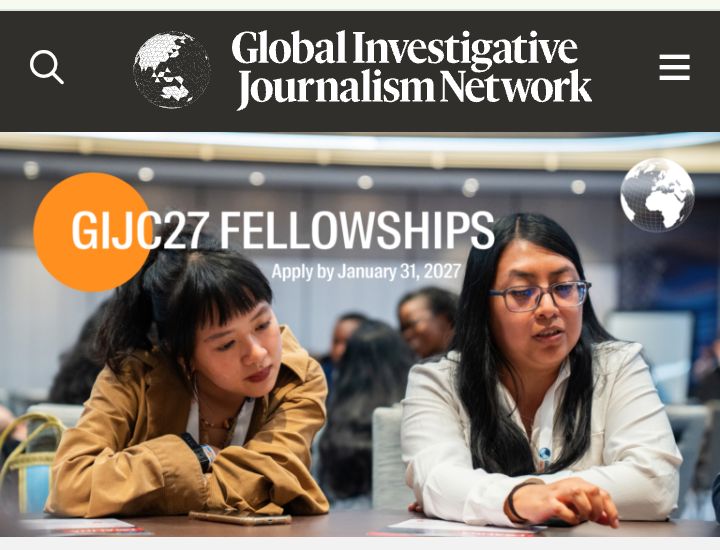
Are you a journalist looking to improve your investigative reporting skills, learn new techniques for uncovering hidden information, and connect with experienced journalists from around the world?
The Global Investigative Journalism Conference (GIJC27) Fellowship 2027 offers an opportunity to do exactly that.
The 15th Global Investigative Journalism Conference will take place in Rotterdam, the Netherlands, from 19 to 23 October 2027.
The event will bring together investigative journalists, data journalists, editors, researchers, and other media professionals to exchange knowledge, explore emerging reporting tools, and discuss how journalists can investigate complex issues in an increasingly challenging media environment.
Through its fellowship programme, the Global Investigative Journalism Network (GIJN) is offering financial support to selected journalists, particularly those from the Global South and historically underrepresented groups, who might otherwise struggle to cover the cost of attending an international journalism conference.
A full fellowship covers several major expenses, including round-trip airfare, four nights of hotel accommodation, conference registration, and specified meals and transportation arrangements.
However, it does not cover every expense, so applicants should understand the funding conditions before applying. The application deadline is 31 January 2027.
If you work in print, online, television, radio, documentary, video, or multimedia journalism, this is an opportunity worth considering, particularly if investigative reporting forms part of your work or you want to develop stronger investigative journalism skills.
In this guide, I explain the eligibility requirements, fellowship benefits, application process, documents and information to prepare, and practical ways to present a convincing application.
Official application announcement: https://gijn.org/stories/gijc2027-fellowship-application/
Global Investigative Journalism Conference Fellowship 2027: Overview
Here are the essential details to know before beginning your application.
Opportunity: Global Investigative Journalism Conference Fellowship 2027
Conference: 15th Global Investigative Journalism Conference (GIJC27)
Organiser: Global Investigative Journalism Network (GIJN)
Co-host: De Vereniging van Onderzoeksjournalisten (VVOJ), the Dutch-Flemish Association of Investigative Journalists
Location: Rotterdam, the Netherlands
Conference dates: 19–23 October 2027
Application deadline: 31 January 2027
Eligible applicants: Professional journalists working in print, online, television, video, radio, documentary, and multimedia journalism, including eligible freelance journalists
Priority groups: Journalists from the Global South and historically underrepresented groups
Experience in investigative journalism: An advantage
Conference language: English
Funding: Full fellowships, with partial fellowships potentially available
Main benefits: Round-trip airfare, four nights of accommodation, conference registration, specified meals, and airport-to-hotel transportation
Post-conference obligation: Produce a story related to the conference or deliver a presentation sharing the knowledge gained
Official information: https://gijn.org/stories/gijc2027-fellowship-application/
Important: The fellowship is competitive, and the number of awards available for 2027 has not yet been confirmed in the supplied announcement. Applicants should also check the official application form for any additional requirements.
What Is the Global Investigative Journalism Conference?
The Global Investigative Journalism Conference is an international gathering focused on investigative reporting and the techniques journalists use to uncover information in the public interest.
The 2027 edition, known as GIJC27, will be the 15th conference in the series.
It is being organised by the Global Investigative Journalism Network in partnership with VVOJ, an organisation that has supported investigative journalism in the Netherlands and Flanders since 2002.
The conference will be held at De Doelen International Congress Centre in Rotterdam, an established concert and congress venue in the city centre.
Unlike a general media event, GIJC27 is designed around the practical challenges of investigative journalism.
Participants will have opportunities to learn about reporting methods, explore new technology, discuss cross-border investigations, and exchange experiences with journalists working in different countries and media environments.
For journalists who want to strengthen their investigative work, the conference offers exposure to techniques and professional networks that may be difficult to access through ordinary newsroom assignments.
What Topics Will GIJC27 Cover?
According to the announcement, the conference will feature more than 150 expert panels, workshops, and other sessions. Topics will include:
Investigative journalism and digital research
Data journalism and data analysis
Artificial intelligence in journalism
Online investigation and verification techniques
Cross-border investigative collaboration
Satellite imagery and open-source research
Climate change investigations
Corruption and accountability reporting
Investigative reporting in environments with limited press freedom
Technology and modern warfare
Safety considerations for journalists
Tools and methods for exiled media professionals
The conference will also explore how journalists can use emerging technologies without compromising the accuracy, reliability, and integrity of their reporting.
For example, a journalist investigating environmental damage may benefit from learning how satellite imagery can help identify changes in land use.
A reporter working on corruption might find sessions on data analysis and document research particularly useful.
Similarly, journalists investigating the influence of artificial intelligence may gain new perspectives on verification, digital evidence, and the responsible use of emerging tools.
The most relevant sessions will depend on your reporting interests and the challenges you encounter in your own work.
Why Should Journalists Apply for the GIJC27 Fellowship?
Attending an international investigative journalism conference can be expensive, particularly for freelance journalists and reporters working for small independent media organisations.
Airfare, accommodation, registration fees, meals, and local transportation can quickly become unaffordable when a newsroom has limited training funds.
The GIJC27 fellowship is intended to reduce several of these financial barriers.
However, the opportunity is not simply a subsidised trip to the Netherlands. It is a professional development opportunity for journalists who can use what they learn to strengthen their reporting and share that knowledge with others.
1. Learn Practical Investigative Reporting Techniques
Investigative journalism often requires more than interviewing sources and writing a news report.
Depending on the subject, journalists may need to analyse datasets, examine public records, verify online information, trace relationships between individuals or organisations, and collaborate with reporters in other countries.
GIJC27 will provide opportunities to learn from journalists and specialists working with these methods.
Applicants should think about the specific reporting challenges they would like to address through the conference.
For example, if your work frequently involves public spending, you might be particularly interested in data analysis, document research, and methods for identifying inconsistencies in financial records.
If you cover environmental issues, sessions on satellite imagery and climate investigations could be more directly relevant to your reporting.
Having a clear sense of your interests can also help you explain why attending the conference would be valuable.
2. Connect With Journalists From Other Countries
The conference is expected to attract participants from more than 100 countries.
This international environment can create opportunities to exchange reporting experiences, identify shared investigative interests, and build professional relationships.
Cross-border collaboration is particularly important when a story involves activities spanning several countries.
For instance, investigations into financial networks, environmental crimes, migration, or international business may require journalists in different locations to examine separate parts of the same issue.
A journalist who develops useful professional relationships at GIJC27 may be better positioned to identify potential collaborators when a future investigation requires expertise or information from another country.
Networking should not be treated simply as collecting contacts. The more useful approach is to identify people whose experience, research interests, or professional expertise genuinely complement your work.
3. Learn How Technology Can Support Investigative Journalism
Technology is changing how journalists discover, verify, and analyse information.
GIJC27 will address areas such as artificial intelligence, digital investigations, satellite imagery, and data journalism.
These subjects can be particularly relevant to journalists who need to investigate large amounts of information or verify claims that are difficult to confirm through conventional reporting.
For example, digital tools may help reporters organise large document collections or identify patterns in datasets. Satellite imagery may help establish whether visible changes occurred at a particular location.
However, tools do not replace verification. Journalists still need to assess the reliability of evidence, understand the limitations of their methods, and corroborate important findings.
The conference offers an opportunity to learn about these approaches from people with practical experience.
4. Gain International Professional Exposure
Participating in a major international journalism conference can expose journalists to different reporting traditions, newsroom practices, and investigative methods.
This can be valuable for reporters who work in media environments where specialist training opportunities are limited.
The experience may also help participants identify new approaches to stories they have been investigating or subjects they hope to cover in the future.
The value of this exposure will ultimately depend on how participants apply what they learn after returning to their work.
5. Share Knowledge With Your Local Journalism Community
The GIJC27 fellowship includes a post-conference requirement.
Selected fellows must either produce a story directly related to the conference or deliver a presentation based on the knowledge they gain to colleagues or the wider journalism community.
This requirement is important because it means applicants should consider how the fellowship could benefit more than just themselves.
For example, a fellow who learns new digital verification techniques might organise a short training session for colleagues at their newsroom.
Another participant might apply a newly learned data journalism method to an investigation and publish a resulting story.
Before applying, think about which of these approaches would be realistic for you, given your reporting responsibilities, publication opportunities, and professional network.
You do not need to claim that you will transform an entire newsroom. A specific, achievable plan is more credible than an ambitious promise without a practical foundation.
Who Can Apply for the GIJC27 Fellowship?
The fellowship is aimed at professional journalists, including those working independently, who want to participate in the Global Investigative Journalism Conference.
According to the supplied announcement, eligible professional backgrounds include print, online, television, video, radio, documentary, and multimedia journalism.
Freelance journalists in developing or transitioning countries are also included. The programme particularly prioritises journalists from the Global South and historically underrepresented groups.
However, applicants must still meet the programme’s stated requirements and submit the requested information.
1. Professional Journalists
The fellowship is open to professional journalists working across several forms of media. These include:
Newspaper and magazine journalists
Online journalists and digital reporters
Television journalists
Radio journalists
Video journalists
Documentary journalists
Multimedia journalists
Eligible freelance journalists
If your work spans more than one format, describe your professional role accurately.
For example, a journalist who writes digital investigations and produces documentary videos can explain both aspects of their work.
The important point is to establish that you are engaged in journalism and can explain how the conference relates to your professional activities.
2. Journalists From Developing or Transitioning Countries
The announcement specifically identifies freelance journalists in developing or transitioning countries among the eligible groups.
It also states that the fellowship prioritises journalists from the Global South. Applicants should check the official list of eligible countries linked from the application announcement.
Do not assume that every country outside Europe and North America is automatically included. The official list and application instructions should guide your decision.
3. Journalists From Historically Underrepresented Groups
GIJN also seeks to support participation by journalists from historically underrepresented groups. If this applies to you, provide accurate information where the application requests it.
Explain your professional circumstances clearly and avoid making claims that are not supported by your actual experience.
The objective is to give the selection team the information it needs to assess your application under the programme’s stated priorities.
4. Applicants With Investigative or Data Journalism Experience
Experience in investigative or data journalism is identified as an advantage.
This does not mean you should invent investigative assignments or exaggerate the depth of your experience. Instead, identify relevant work you have actually completed.
Depending on your background, this might include reporting that involved examining public records, verifying claims, analysing data, investigating institutional decisions, tracking public expenditure, or working with multiple sources to establish facts.
If you have not yet published a major investigation, explain the relevant reporting experience you do have and why you want to develop your investigative skills.
The key is to present your background honestly and make the connection between your experience and the conference clear.
5. Applicants Must Have a Working Knowledge of English
GIJC27 sessions will be conducted in English, and the fellowship application must also be submitted in English.
Applicants should therefore be able to understand conference discussions and communicate with other participants in the working language.
Before submitting, check your application carefully for clarity, grammar, and spelling. If English is not your first language, focus on writing clearly rather than using unnecessarily complicated vocabulary.
Your application should communicate your professional experience and objectives without making the reader work to understand what you mean.
Can Applicants From Countries Outside the Eligible List Apply?
The supplied announcement addresses this situation directly.
It states that applicants who cannot afford the cost of attending the conference and come from a country outside the linked eligible-country list may still apply and provide additional information in the Additional Notes section.
This is an important distinction.
If your country does not appear on the list, do not automatically conclude that you should abandon the application. Read the official instructions and use the Additional Notes section as directed.
Explain your circumstances accurately, including why you need financial assistance to attend.
However, this provision should not be interpreted as a guarantee of eligibility or funding. The selection team will make decisions according to the programme’s rules and available resources.
What Does the GIJC27 Fellowship Cover?
The conference announcement lists several benefits for recipients of a full fellowship.
Understanding exactly what is covered is essential because the award does not pay every expense associated with international travel.
1. Round-Trip Airfare
A full fellowship includes round-trip airfare to Rotterdam, the Netherlands, or the nearest major airport.
This can significantly reduce the cost of attending the conference.
Applicants should read the official award instructions carefully to understand the arrangements for booking flights and any conditions attached to travel support.
Do not assume that you should purchase your own ticket before receiving instructions from the organisers.
2. Airport-to-Hotel Transportation
The full fellowship includes transportation between the airport and the conference hotel.
This helps cover the journey between the arrival airport and the accommodation provided under the programme.
The announcement does not state that all local transportation is covered, so applicants should not budget on the assumption that every journey within Rotterdam will be paid for.
3. Four Nights of Hotel Accommodation
Selected full fellows receive hotel accommodation for four nights.
This reduces one of the main expenses associated with travelling internationally for a professional conference.
However, the precise accommodation arrangements and check-in dates should be confirmed through the organisers’ instructions.
Applicants should not assume that additional nights before or after the covered period will be included.
4. Conference Registration Fee
The full fellowship covers the conference registration fee. This gives fellows access to the conference under the programme’s arrangements.
The registration benefit is particularly valuable for journalists whose organisations cannot afford to pay for international professional development.
5. Selected Meals
The full fellowship includes specified meals during the conference. These are:
Cocktail reception on the evening of 19 October 2027
Breakfast on conference days from 20–23 October 2027
Lunch on full conference days from 20–23 October 2027
Award ceremony dinner on the evening of 22 October 2027
These meals should help reduce food expenses during the covered activities.
However, the fellowship does not include a daily living allowance, so fellows will need to plan for other personal expenses.
6. Partial Fellowships May Also Be Available
The organisers state that they are working to secure funding for as many fellowships as possible.
Although the final number of awards for GIJC27 has not been determined in the supplied announcement, the organisers note that partial fellowships may be offered to some candidates.
The application form asks whether applicants would like to be considered for a partial fellowship.
If you are willing to accept partial support, read that question carefully and answer according to your actual circumstances.
Before accepting a partial award, make sure you understand which expenses would be covered and how much you would need to pay yourself.
Expenses Not Covered by the GIJC27 Fellowship
This is one of the most important sections to read before applying.
Although a full fellowship covers several major expenses, the supplied announcement explicitly identifies costs that remain the fellow’s responsibility. These include:
Visa fees: The fellowship does not cover visa application fees.
Per diem: No daily allowance is provided for personal expenses.
Transport to and from your home-country airport: The fellowship does not cover transportation between your home and the airport in your country.
Depending on your circumstances, you may also need to budget for other expenses not explicitly covered by the award.
For example, you may need to arrange transportation to your departure airport, cover personal purchases, or pay for additional accommodation if your travel dates fall outside the funded period.
Do not assume that a full fellowship means every expense is covered. If you are offered an award, review the travel and funding instructions before making financial commitments.
How to Apply for the Global Investigative Journalism Conference Fellowship 2027
The application deadline is 31 January 2027. The application announcement directs interested journalists to an online form.
You can begin by reading the official fellowship announcement here:
Official application information: https://gijn.org/stories/gijc2027-fellowship-application/
The following steps will help you prepare a clear, well-supported application.
Step 1: Read the Official Fellowship Announcement
Start with the official GIJN announcement rather than relying exclusively on summaries published by other websites.
Read the eligibility criteria, fellowship benefits, post-conference requirements, and instructions for applicants from countries outside the eligible list.
Pay particular attention to the difference between full and partial fellowships.
You should also review the official eligible-country list linked from the announcement.
This first step will help you establish whether the opportunity fits your professional background and financial circumstances.
Step 2: Confirm That Your Work Fits the Fellowship
Before completing the application, identify how your current journalism work relates to investigative reporting.
Consider the stories you have covered, the techniques you have used, and the professional skills you want to develop.
For example, perhaps you have investigated public expenditure, reported on environmental issues, examined government accountability, or used digital records to verify claims.
You may also have experience in traditional reporting and want to develop more advanced investigative techniques.
Whatever your situation, make sure you can explain the connection between your work and the conference.
Avoid presenting yourself as an experienced investigative journalist if your actual background is primarily in another area.
Honest explanations of your experience are more useful than inflated claims.
Step 3: Identify Your Main Learning Objectives
The conference covers a broad range of topics, but your application should explain which aspects are most relevant to you.
Choose a few areas that genuinely connect with your reporting interests. For instance:
A journalist covering corruption might prioritise data journalism, document analysis, and accountability reporting.
A reporter working on climate issues might focus on satellite imagery and environmental investigations.
A digital journalist might be particularly interested in online research, verification, and artificial intelligence.
A journalist working across borders might want to develop stronger collaboration methods.
These are examples, not required specialisations. The purpose is to show that you have thought about how the conference could improve your work.
Step 4: Prepare Details of Your Journalism Experience
Before filling out the form, organise information about your professional background.
Depending on what the form requests, this may include your current role, media organisation, freelance work, reporting interests, and relevant investigative or data journalism experience.
Think about specific assignments that demonstrate your skills. For each relevant story or project, be ready to explain:
What issue you investigated.
Why the issue mattered.
What your role was.
Which reporting methods you used.
What you produced or contributed.
What you learned from the experience.
You do not need to make every assignment sound extraordinary.
A clear explanation of a relevant reporting project is often more informative than a list of impressive-sounding responsibilities without supporting detail.
Use accurate descriptions and provide publication links or other supporting information where the application requests them.
Japan Youth Summit 2027: Fully Funded Youth Summit in Japan, Eligibility, Benefits and How to Apply
Step 5: Explain Why You Need the Fellowship
The fellowship is intended to help journalists participate in the conference, particularly those who would otherwise face financial barriers.
If the application asks about your need for support, explain your circumstances clearly and truthfully.
For example, if you work independently or for a small media organisation that cannot finance international training, describe that situation.
If your newsroom has limited professional development funding, explain the limitation.
Avoid making unsupported claims about your financial situation or presenting information that does not accurately reflect your circumstances.
The objective is to help the selection team understand why fellowship support would make a difference to your ability to attend.
Step 6: Explain What You Would Contribute to the Conference
An application should not focus exclusively on what you hope to receive. Consider what your professional experience could contribute to conversations with other journalists.
You may have experience reporting on a particular issue, working in a difficult media environment, covering underserved communities, or investigating problems that receive limited international attention.
Explain your background in a way that helps the selection team understand the perspective you would bring.
You do not need to claim expertise in every area covered by the conference. Focus on the experience you actually have and the subjects you understand well.
Step 7: Prepare a Realistic Post-Conference Plan
GIJC27 fellows must complete one of two post-conference activities:
- Produce a story directly related to the conference.
- Give a presentation sharing the knowledge gained at GIJC27 with colleagues or the wider journalism community.
This is a formal fellowship requirement, so applicants should consider it before submitting their applications.
If you intend to produce a story, identify a realistic reporting subject that connects with the skills you hope to develop.
For example, you might plan to apply data analysis techniques to a public-interest investigation or use digital verification methods to strengthen a story you are developing.
If a presentation is more practical, consider where you could share the knowledge.
Possible settings include your newsroom, a professional journalism association, a training session, or another relevant gathering of journalists.
These are examples of possible approaches, not official requirements for the format or subject of the presentation.
The official guidelines should determine what qualifies as an acceptable story or presentation.
Practical lesson: Do not promise to publish an investigation if you have no realistic access to the relevant information, sources, or publication platform. A modest, achievable plan is better than an ambitious promise that cannot be delivered.
Step 8: Complete the Online Application Form
Once you have prepared your information, open the application form linked from the official announcement.
Answer every question accurately and follow the instructions provided. Use clear language and avoid lengthy explanations where a direct response is sufficient.
If the form asks about your investigative experience, discuss relevant work rather than simply repeating your job title.
If it asks why you want to attend, explain the specific skills you hope to develop and how they connect with your reporting.
If it asks about your ability to cover attendance costs, provide an honest explanation of your financial circumstances.
Before moving to the next section, check that your answers address the actual questions.
Step 9: Use the Additional Notes Section if Necessary
The announcement specifically mentions the Additional Notes section for applicants who cannot afford to attend and are from countries outside the eligible-country list.
If this situation applies to you, follow the official instructions and use the section to explain your circumstances.
Keep the explanation relevant. For example, you may need to clarify your location, professional circumstances, or inability to fund international travel independently.
Do not use the section to repeat every answer already provided in the application.
Also, remember that permission to apply under this provision does not guarantee that you will be eligible for, or receive, a fellowship.
Step 10: Decide Whether to Accept Consideration for a Partial Fellowship
The application form asks whether you are interested in being considered for a partial fellowship.
Read the question carefully before answering. If you are open to partial funding, make sure you understand that you may need to cover some expenses yourself.
Calculate the costs that are not covered, including visa fees, travel to and from your home-country airport, personal expenses, and any other uncovered costs relevant to your circumstances.
If you could not attend without full support, consider that carefully before agreeing to a partial award.
Your answer should reflect what is financially realistic for you rather than what you think the selection team wants to hear.
Step 11: Review Your Application Before Submitting
Before submitting the form, review your responses carefully. Check the following:
Your professional information is accurate.
Your journalism experience is described clearly.
Your reasons for attending are specific.
Your learning objectives connect with your reporting work.
Your explanation of financial need is truthful.
Your post-conference plan is realistic.
Any required links or supporting details are correct.
Your application is written in English.
You have answered every required question.
Make sure your application presents a consistent account of your experience and objectives. If you provide links to published stories, test them to confirm that they open correctly.
If a story is behind a paywall or no longer available, follow the application instructions for providing any alternative evidence.
Step 12: Submit Before 31 January 2027
The official application deadline is 31 January 2027.
Submit your application before the deadline and allow enough time to correct any problems with the form. Do not wait until the final hours to begin writing your responses.
Because the organisers receive a high volume of applications, they state that they will not be able to update every applicant individually about the status of their application.
For that reason, carefully read the official guidelines and application form before submitting.
If you cannot find the answer to a question in the published materials, the announcement provides this contact email:
Fellowship enquiries: fellowships@gijn.org
Use this address for relevant questions that are not answered in the official guidance.
How to Write a Strong GIJC27 Fellowship Application
The fellowship announcement makes clear that competition is strong and applicants need to demonstrate that they will make good use of the training.
There is no guaranteed formula for selection. However, several practical approaches can help you communicate your qualifications and objectives more effectively.
1. Focus on Actual Reporting Experience
Your application should help the selection team understand what you do as a journalist.
Instead of describing yourself only as a passionate reporter, identify specific stories, projects, or assignments that demonstrate your experience.
For example, explain how you verified a disputed claim, analysed a set of public records, examined an institutional decision, or worked with multiple sources to establish facts.
Where relevant, explain the methods you used and the role you played.
If your work was collaborative, be precise about your contribution.
This gives the reader a clearer picture of your abilities.
2. Explain the Skills You Want to Develop
Do not simply say that you want to learn more about investigative journalism. Identify the particular skills or methods you want to improve.
Perhaps you need to become more confident working with data, verify digital evidence more effectively, or understand how to collaborate with reporters in other countries.
Explain why those skills matter to the reporting you do. This connection between your current work and your learning objectives helps make your application more specific.
3. Connect the Conference to a Real Reporting Challenge
A convincing application can explain how the conference would help address a challenge you have encountered in your work.
For example, you may have struggled to analyse a large collection of records, verify images circulating online, or investigate a subject involving information from multiple countries.
Describe the challenge accurately and identify the relevant conference topics that could help you address it.
Avoid claiming that attending a conference will automatically solve a complex reporting problem. Instead, explain how the training could improve your approach.
4. Demonstrate That You Understand the Fellowship Obligations
The post-conference story or presentation requirement is a central part of the fellowship.
Your application should reflect a realistic understanding of this responsibility.
Think about what you could produce after returning from Rotterdam and what resources you would need to complete it.
If you are planning a story, consider the availability of sources, records, and publication opportunities.
If you are planning a presentation, identify an audience that would benefit from the knowledge you expect to gain.
A realistic plan demonstrates that you have considered how to turn the conference experience into a useful outcome.
5. Be Specific About Financial Need
If you need financial support to attend, explain why.
A statement that you would appreciate a scholarship is not the same as an explanation of why you cannot cover the cost independently.
Where relevant, discuss your employment situation, available newsroom support, or other genuine financial constraints.
Do not exaggerate your circumstances. Also, remember that even a full fellowship does not cover visa fees, daily allowances, or transport to and from your home-country airport.
Your application and travel planning should reflect those limitations.
6. Keep Your Answers Clear and Direct
Applications are easier to evaluate when the answers address the questions directly.
Avoid repeating the same general statement in several sections. If a question asks about your experience, provide examples of your work.
If it asks about your motivation, explain your professional reasons for attending.
If it asks about your post-conference plans, describe the story or presentation you intend to produce. Use straightforward English and check your work before submitting.
What Should You Prepare Before Applying?
The official application form should determine the exact information and supporting materials required.
The supplied announcement does not provide a complete list of mandatory attachments, so applicants should not assume that a particular document is compulsory unless the form requests it.
Nevertheless, preparing the following information in advance can make the process easier.
Your Professional Biography
Prepare a concise summary of your journalism background.
Include your current role, the type of media work you do, and your main reporting interests. Make sure the information is accurate and consistent with the rest of your application.
Examples of Published Work
Identify a few relevant stories or investigations you have contributed to.
Where possible, select examples that demonstrate the skills you want to develop further.
For each example, be prepared to explain your role and the reporting methods involved. Only describe work you genuinely contributed to.
Your Learning Objectives
Write down the investigative techniques or reporting skills you want to improve. Choose objectives that connect directly with your work and the conference programme.
A focused list is more useful than saying that you want to learn everything about investigative journalism.
Your Post-Conference Activity
Consider whether producing a story or delivering a presentation would be the most realistic way to meet the fellowship requirement.
You do not need to finalise every detail before reading the application form, but you should understand the commitment involved.
Your Funding Requirements
Review the expenses covered by a full fellowship and those that remain your responsibility.
This will help you determine whether you can attend if you receive full or partial support.
Your English-Language Application
The application must be submitted in English. Draft your answers carefully and proofread them before submission. Clear, direct writing is more important than using complicated vocabulary.
What Happens After You Apply?
The conference announcement states that GIJN receives a high volume of fellowship applications and cannot provide individual status updates to every applicant.
This means you should not expect a personalised update simply because you have submitted the form.
After applying, keep a record of your submission if the system provides confirmation and monitor the official channels for relevant announcements.
If you have a question that is not answered in the application guidelines, you can contact the fellowship team at fellowships@gijn.org.
Avoid sending repeated messages asking for an update when the organisers have already explained that they cannot provide individual status reports.
If you receive an offer, read the award terms carefully.
Confirm which travel and accommodation arrangements are covered, what expenses you must pay yourself, and what post-conference activity you will be expected to complete.
Do not make non-refundable travel arrangements before receiving the necessary instructions from the organisers.
Frequently Asked Questions About the GIJC27 Fellowship
1. What is the Global Investigative Journalism Conference Fellowship 2027?
The GIJC27 Fellowship is a funding opportunity that enables selected journalists to attend the 15th Global Investigative Journalism Conference in Rotterdam, the Netherlands.
The conference will run from 19 to 23 October 2027 and will feature workshops, expert panels, and networking opportunities focused on investigative journalism.
2. What is the deadline for the GIJC27 Fellowship?
The application deadline is 31 January 2027.
Applicants should consult the official announcement and application form for any additional instructions.
3. Where will the 2027 Global Investigative Journalism Conference take place?
The conference will take place in Rotterdam, the Netherlands, at De Doelen International Congress Centre.
4. Who can apply for the fellowship?
The opportunity is aimed at professional journalists working in print, online, television, video, radio, documentary, and multimedia journalism, including eligible freelance journalists.
The organisers prioritise journalists from the Global South and historically underrepresented groups. Applicants should check the official eligibility criteria and country list.
5. Is investigative journalism experience compulsory?
The supplied announcement describes investigative or data journalism experience as an advantage.
Applicants should read the complete eligibility requirements and application instructions to determine whether their professional background qualifies.
6. Is the GIJC27 Fellowship fully funded?
Full fellowships cover round-trip airfare, transportation between the airport and conference hotel, four nights of hotel accommodation, conference registration, and specified meals.
However, the fellowship does not cover visa fees, a per diem, or transport to and from the applicant’s home-country airport.
Partial fellowships may also be available.
7. Can freelance journalists apply?
Yes. The announcement includes freelance journalists in developing or transitioning countries among the eligible groups.
Freelancers should explain their professional work and reporting experience clearly and check the official country eligibility information.
8. Can journalists from Africa apply?
The fellowship prioritises journalists from the Global South, and the announcement provides a route for applicants from countries outside the linked eligible-country list to apply under specified circumstances.
African journalists should consult the official country list and application instructions to establish which provisions apply to them.
If you cannot afford to attend and your country is not on the eligible list, follow the announcement’s guidance on providing additional information in the Additional Notes section.
9. Does the fellowship cover visa fees?
No. According to the supplied announcement, visa fees are not covered.
Applicants should account for this expense when considering whether they can attend.
10. Does the fellowship include a daily allowance?
No. The announcement states that the fellowship does not include a per diem.
Although specified meals are covered, applicants should plan for other personal expenses.
11. Are partial fellowships available?
The organisers state that they may offer partial fellowships to some candidates, depending on available funding.
The application form asks whether applicants wish to be considered for partial support.
The number and terms of partial awards for 2027 have not been confirmed in the supplied announcement.
12. What must fellows do after the conference?
Selected fellows must either produce a story directly related to GIJC27 or deliver a presentation sharing the knowledge gained with colleagues or the wider journalism community.
The official guidelines should be consulted for details about acceptable stories and presentations.
13. Will applicants receive individual updates about their applications?
The organisers state that they cannot provide individual status updates because of the high volume of applications.
Applicants should carefully review the application guidelines and use the published contact email for questions that are not answered in the available materials.
14. How can I apply for the GIJC27 Fellowship?
Read the official announcement and follow the application link provided by the Global Investigative Journalism Network.
Official application announcement: https://gijn.org/stories/gijc2027-fellowship-application/
15. What language should I use in the application?
The application must be submitted in English. Conference panels and workshops will also be conducted in English.
Conclusion: Apply for the Global Investigative Journalism Conference Fellowship 2027
The Global Investigative Journalism Conference Fellowship 2027 offers journalists an opportunity to strengthen their reporting skills, learn about emerging investigative methods, and connect with professionals from around the world.
For journalists who face financial barriers to international training, the full fellowship can make participation more accessible by covering several major travel and conference expenses.
However, applicants should understand both the benefits and the responsibilities.
The fellowship is competitive, the number of awards available for 2027 has not yet been confirmed in the supplied announcement, and some expenses remain the fellow’s responsibility.
Selected fellows must also complete a post-conference story or presentation, making it important to consider how the experience will contribute to their work after the event.
If you are interested, begin by checking the eligibility requirements and reviewing the official application form. Prepare examples of your journalism, identify the skills you want to develop, and think about how you would share what you learn with other journalists.
Keep your application focused on your actual experience and professional objectives. Explain why the conference matters to your work and what you realistically hope to accomplish with the knowledge gained.
Application deadline: 31 January 2027.
If investigative journalism is central to your professional development, GIJC27 could be a valuable opportunity to learn, collaborate, and bring new reporting techniques back to your newsroom or journalism community.
Browse related fellowship programs on scholars Africa website below
Eric Bleumink Fellowship 2027 in the Netherlands (Fully Funded Master’s Scholarship)
7 Nestlé Global Paid Opportunities 2026 for Graduates and Young Professionals
IATSS Forum 2027 in Japan: My Experience Applying for an 8-Week Leadership Development Program
Discover more from Scholars Africa
Subscribe to get the latest posts sent to your email.

About Scholars Africa Editorial Team
Scholars Africa Editorial Team is dedicated to researching and publishing verified scholarships, jobs, and global opportunities. Our content is built on extensive analysis of application trends, eligibility criteria, and selection patterns to help applicants succeed at every stage. Our team has reviewed hundreds of scholarship programs and application processes across multiple countries.