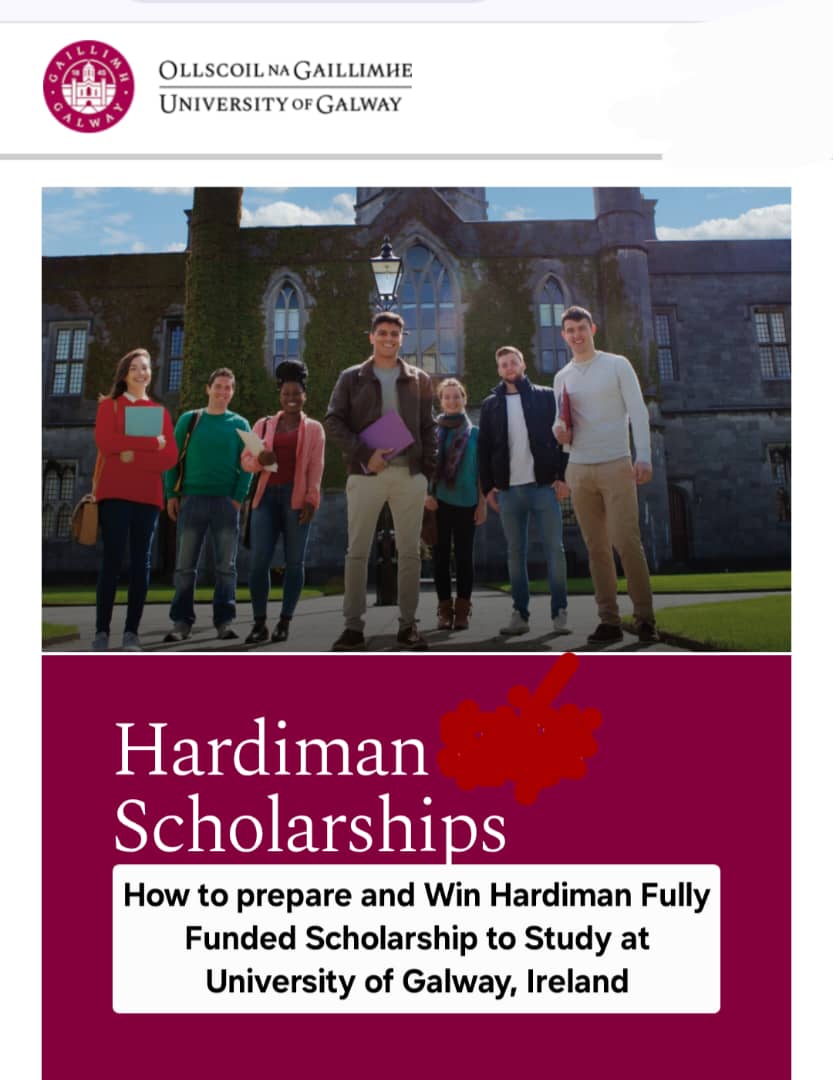
University of Galway Hardiman Scholarship 2027: Fully Funded PhD Scholarship in Ireland
Studying in Ireland can be an exciting opportunity, particularly for students who want to build a career in research. However, the cost of postgraduate education can be a major obstacle. Tuition fees, accommodation, food, transport, and other living expenses can quickly become overwhelming when you are studying far from home.
That is why fully funded doctoral scholarships deserve serious attention.
The Hardiman Scholarship at the University of Galway in Ireland is an opportunity worth exploring for academically strong candidates who want to pursue research at a respected Irish university.
The scholarship has been associated with doctoral research funding, and the published terms of particular scholarship calls may include a stipend and support towards tuition fees. The exact package, eligibility requirements, and application deadline must be confirmed for the relevant intake.
When I approach an opportunity like this, I do not look only at the phrase fully funded. I want to understand what the funding actually covers, whether my research interests fit the university’s priorities, whether I need a supervisor before applying, and what documents must be submitted before the deadline.
Those details matter because a strong academic record alone may not be enough to produce a competitive application.
In this guide, I explain what prospective applicants need to know about the Hardiman Scholarship, the potential benefits, the eligibility considerations, and the application process.
I also highlight the parts of the preparation process that deserve the most attention, particularly finding a suitable supervisor, developing a convincing research proposal, and arranging academic references.
About the University of Galway in Ireland
The University of Galway is a research-focused university located in Galway, a city on Ireland’s western coast. The institution offers programmes across several academic fields, including arts, business, law, medicine, science, engineering, and other areas of study.
For students considering doctoral research, the university’s research environment is an important part of the decision. A PhD is not simply another qualification to add to a CV.
It usually involves several years of independent investigation, regular engagement with academic supervisors, and the development of specialised knowledge in a particular field.
That makes it essential to look beyond the university’s reputation and ask a more practical question: Does the university have the expertise, research facilities, and academic supervision needed for the project I want to pursue?
For an international applicant, this question should come before investing too much time in a scholarship application.
A suitable research environment can influence the quality of your doctoral experience, the methods available to you, your access to academic networks, and the opportunities you may have to present or publish your findings.
Galway also offers an opportunity to experience life in Ireland while joining an international academic community. Nevertheless, prospective students should research accommodation availability, living costs, healthcare arrangements, and immigration requirements before making plans to relocate.
What Is the Hardiman Scholarship?
The Hardiman Scholarship is associated with doctoral research at the University of Galway. It is intended to support talented researchers undertaking PhD-level study and developing their academic or professional expertise.
The scholarship is particularly relevant to applicants who have performed strongly in their previous studies and can demonstrate the ability to undertake independent research.
Unlike a scholarship that simply reduces tuition fees, a doctoral funding package may also provide financial support for living expenses. This distinction matters because PhD students need time to concentrate on research, attend academic activities, analyse information, and complete their thesis.
The exact benefits of the Hardiman Scholarship depend on the applicable funding call. The original information supplied for this article mentions an annual stipend of €25,000 and tuition-fee coverage for up to four years.
Applicants should not assume that these figures or conditions apply to every intake. Check the official scholarship announcement for the relevant academic year to establish the current stipend, fee arrangements, duration, and any restrictions.
The scholarship is best approached as a competitive research funding opportunity rather than an automatic reward for having excellent grades.
A strong application needs to show that the candidate is academically prepared, that the proposed research is worthwhile, and that the project can be supported by an appropriate supervisor and research environment.
Hardiman Scholarship Benefits
The financial benefits are understandably one of the first things applicants want to know about. Before applying, however, I would separate the advertised benefits from the expenses that may still need to be budgeted for.
1. Annual Stipend for Living Expenses
The information provided for this scholarship describes a stipend of €25,000 per year.
If this amount is confirmed in the relevant call, it could help a successful doctoral researcher manage essential living costs while studying in Ireland. These might include accommodation, food, local transport, utilities, and other everyday expenses.
However, the stipend should not automatically be interpreted as money that will cover every possible cost. Actual expenses depend on where you live, whether you share accommodation, your personal circumstances, and how often you travel.
Before accepting an award, I would compare the confirmed annual stipend with a realistic monthly budget. Rent is likely to be one of the most important figures to investigate, followed by utilities, food, transport, insurance where applicable, and other unavoidable expenses.
Also confirm how the stipend is paid, whether payments are made throughout the year, and whether any additional conditions apply.
2. Tuition-Fee Support
The original scholarship description states that the award covers tuition fees.
For an international doctoral applicant, tuition support can be particularly important because international fees may represent a substantial financial commitment.
Nevertheless, it is essential to check exactly what the university means by tuition coverage in the relevant call. Applicants should confirm whether the award covers the full applicable fee, whether any difference between fee categories must be paid by the student, and whether there are additional university charges that fall outside the award.
Do not assume that a stipend and tuition support automatically cover travel, visa expenses, accommodation deposits, or every other cost associated with moving to Ireland.
3. Support for Doctoral Research
A funded PhD offers something beyond financial assistance: the opportunity to devote substantial time to research.
Doctoral study usually requires sustained attention to a specific question. Depending on the subject, the work may involve laboratory research, fieldwork, interviews, archival research, data analysis, computational methods, or a combination of approaches.
Funding can make it easier to concentrate on these responsibilities rather than spending excessive time searching for unrelated work to meet basic expenses.
Applicants should still investigate the academic resources available for their particular project. Research facilities, specialist equipment, data access, and opportunities for collaboration can differ considerably between departments.
4. An International Academic Environment
Studying at the University of Galway can provide opportunities to work with researchers and students from different backgrounds.
For doctoral students, this can be valuable when developing ideas, discussing research methods, attending seminars, and learning how other specialists approach similar questions.
The benefit is not simply being surrounded by international students. It is having opportunities to engage with people whose expertise may challenge your assumptions or help you improve your work.
5. The Opportunity to Build a Research Career
Completing a PhD can support future opportunities in academia, research institutions, public policy, industry, and other sectors that value advanced research skills.
However, a scholarship does not guarantee a job after graduation. The longer-term value of doctoral study depends on the quality of the research, the skills developed, the professional relationships built, and the needs of the sector in which a graduate hopes to work.
For that reason, I would consider the Hardiman Scholarship alongside the university’s research strengths and the career possibilities connected to the proposed doctoral subject.
Who Should Consider Applying for the Hardiman Scholarship?
The scholarship is worth investigating if you have a strong academic background and want to pursue doctoral research at the University of Galway.
It may be particularly relevant to applicants who:
Have achieved strong results in previous university studies.
Have a clearly defined research interest.
Can explain why the proposed research matters.
Have identified a suitable academic supervisor or research group.
Can demonstrate relevant research preparation.
Are ready to provide academic references and supporting documents.
Meet the admission and funding requirements for the relevant doctoral programme.
International students should pay particular attention to the official eligibility rules. The fact that a scholarship is promoted internationally does not necessarily mean every applicant, nationality, academic qualification, or research topic is eligible under every funding call.
Before preparing a full application, establish whether your intended programme and proposed start date are covered.
Hardiman Scholarship Eligibility Requirements
Eligibility is one of the first things I would check before spending time on a research proposal or contacting potential referees.
The information supplied for this article refers to excellent academic performance, English-language proficiency, research motivation, and the ability to contribute positively through research. These are useful areas to prepare for, but the formal requirements must come from the current scholarship call.
1. Strong Academic Performance
The original description refers to applicants with a first-class or upper-second-class academic background.
Your exact eligibility will depend on the qualification you hold, the grading system used by your university, and the requirements stated by the University of Galway.
If your degree uses a grading system different from Ireland’s, do not simply convert your result into a classification yourself and assume that it will be accepted.
Check the university’s guidance on international qualifications and, where necessary, ask the admissions team how your result will be assessed.
Prepare official academic transcripts and degree certificates. If your final certificate has not yet been issued, check whether the university accepts provisional documentation and what must be provided before enrolment.
Strong grades are important, but they are not a substitute for a well-developed research plan.
2. Eligibility for Doctoral Study
Because the Hardiman Scholarship is associated with PhD research, applicants should confirm that they meet the entry requirements for the relevant doctoral programme.
Depending on the programme and discipline, the university may expect an appropriate master’s qualification, a strong bachelor’s degree, relevant research experience, or other evidence of readiness for doctoral study.
The specific requirements can vary. Meeting the scholarship’s academic expectations does not necessarily mean that you automatically meet the admission requirements for every PhD programme.
It is therefore important to consider the doctoral admission process and the scholarship application together.
3. English-Language Proficiency
Applicants whose previous education does not meet the university’s applicable English-language requirements may need to provide evidence of proficiency.
Accepted evidence can depend on the programme, the applicant’s educational background, and the university’s rules. Do not assume that a particular test is compulsory for everyone, or that an exemption will automatically be granted because some previous courses were taught in English.
Check the current requirements for the exact programme you intend to enter. If a test is needed, allow enough time to book it, receive the result, and submit the documentation.
4. A Clear Interest in Research
A doctoral scholarship is not simply an award for students who enjoy studying. It supports people who are prepared to investigate a problem in depth.
Your application should communicate the question you want to explore, why it matters, and how you intend to investigate it.
For example, instead of saying that you are passionate about environmental sustainability, explain the specific environmental issue you want to examine, the population or system affected, and the type of evidence that could help answer your research question.
The same principle applies across disciplines. A convincing proposal makes the research problem clear without pretending that every aspect of the project has already been solved.
5. A Suitable Research Supervisor
The application instructions supplied for this opportunity indicate that supervisor involvement is an important part of the process.
Applicants should confirm the current supervisor requirements before starting the application. If the relevant call requires a prospective supervisor, finding one should be an early task rather than something left until the deadline is approaching.
A supervisor’s expertise needs to fit the proposed research. A professor may be highly respected but still not be the right person for your specific project.
Look for researchers whose publications, projects, and academic interests overlap with your proposed topic.
6. Academic References
The supplied information states that applicants must provide two academic references.
Confirm the number and format of references required in the current call. If two academic references are required, choose people who can discuss your academic ability, research preparation, reliability, and potential for doctoral work.
A referee who knows your work well may be able to provide more useful evidence than a senior academic who barely remembers you.
Also confirm whether referees must submit their forms directly to the university and whether the scholarship office must receive them by the same deadline as the main application.
7. Previous Hardiman Scholarship Recipients
The source information contains a statement about students who are currently registered or have previously received the Hardiman Scholarship. This wording is unclear and should not be treated as a reliable eligibility rule without checking the official guidance.
Applicants should read the current call carefully to determine whether existing students, previous award holders, or candidates applying for a second award are eligible.
If your circumstances do not fit the standard applicant profile, contact the university’s scholarship or doctoral admissions team before submitting an application.
How to Apply for the University of Galway Hardiman Scholarship
The application process should be approached as a series of connected tasks. Your research proposal, supervisor arrangements, academic references, supporting documents, and online application may all need to be completed within the same application window.
The exact procedure can change between calls, so follow the instructions published for your intended intake.
Step 1: Read the Official Scholarship Guidelines
Start by locating the current Hardiman Scholarship announcement and applicant guidance from the University of Galway.
Read the full instructions before completing the online form. Pay particular attention to:
Eligible doctoral programmes and research areas.
Academic entry requirements.
The funding package and duration.
Supervisor requirements.
Research proposal specifications.
Required academic references.
Supporting documents.
Application deadlines and submission procedures.
I would keep a simple checklist of every requirement and mark each item as confirmed, in progress, or completed.
This is more useful than relying on memory, especially when several people need to submit documents on your behalf.
Step 2: Identify Your Research Area
Before contacting a supervisor, narrow your research interest into a manageable subject.
A broad topic such as artificial intelligence, public health, climate change, education, or international development is not yet a complete doctoral proposal.
Try to identify a more specific question within that field. Think about the problem you want to investigate, the reason it matters, and the type of evidence you might need.
You do not need to know every detail of the project at the beginning. However, you should be able to explain your central idea clearly enough for an academic researcher to understand what you are proposing.
Step 3: Find a Suitable Supervisor
Once you have a research direction, explore the university’s departments, research centres, and academic staff profiles.
Look for researchers whose work is closely connected to your subject. Read some of their recent publications or research summaries rather than relying only on their job titles.
When you contact a potential supervisor, keep the message professional and specific. Briefly introduce yourself, explain your academic background, describe your proposed research, and state why you believe their expertise is relevant.
You can also attach a concise CV and a short research summary if appropriate.
Avoid sending the same vague email to many academics. A message that demonstrates a genuine understanding of a researcher’s work is more informative than one that simply asks whether they can help you obtain a scholarship.
Important: Contacting a potential supervisor does not guarantee acceptance or funding. If the current scholarship call requires a supervisor’s agreement or a completed supervisor form, make sure you understand precisely what is needed and by when.
Step 4: Prepare a Focused Research Proposal
The research proposal is one of the most important documents to prepare carefully.
It should show that you understand the issue you want to investigate and have a credible plan for studying it.
Depending on the university’s instructions, a proposal may need to cover:
The proposed research title.
The background to the problem.
The central research question or objectives.
Why the topic matters.
Relevant existing research.
The proposed methodology.
The expected contribution.
The feasibility of the project.
References to relevant academic literature.
Follow the university’s specified word limit and format rather than using a generic proposal template.
A proposal can lose clarity when it tries to cover too many questions at once. A narrower, well-explained research problem is often easier to assess than an ambitious project that does not explain how the work could realistically be completed.
Make sure your proposed methods match the question. If you intend to conduct interviews, explain broadly who would be interviewed and why. If your work depends on datasets, laboratory access, archives, or specialist equipment, consider how you would obtain access.
Your proposal should also be consistent with the research environment and supervisor you have identified.
Step 5: Arrange Your Academic References Early
If the current call requires two academic references, contact your referees well before the deadline.
Give them enough information to understand the opportunity and the work you intend to pursue. Useful supporting material may include your CV, academic transcript, research summary, and details of the scholarship.
Explain the submission procedure clearly. If referees must complete a specific form or send their references directly to the scholarship office, make sure they know how to do so.
Do not assume that asking a lecturer for a reference means the requirement has been completed. In some application systems, the applicant and referee have separate submission responsibilities.
Check the status of each reference before the deadline, while giving your referees reasonable time to complete their work.
Step 6: Prepare Your Supporting Documents
Create a folder for the documents required by the current application call.
Depending on your circumstances and the programme’s rules, the documents may include:
Academic transcripts.
Degree certificates.
Curriculum vitae or academic résumé.
Research proposal.
Evidence of English-language proficiency, where required.
Academic reference forms or referee details.
Identification or other supporting documents specified by the university.
This is a preparation list, not a guarantee that every item is required. Use the official checklist to determine what applies to you.
Check that scanned documents are readable, names are consistent across your records, and files are saved in the required formats.
If a document is not yet available, establish whether a provisional version is acceptable and when the final version must be submitted.
Step 7: Complete the Online Application
When you have checked the requirements and prepared your documents, complete the official application form.
Enter your personal, academic, and research details carefully. Use the same information that appears on your official documents, and review your research description for clarity and consistency.
Before submitting, check that the proposal, supervisor details, referee information, and uploaded documents agree with one another.
If the university requires a separate doctoral admission application in addition to the scholarship application, complete both processes according to the instructions. Do not assume that one automatically replaces the other.
Step 8: Confirm That Every Required Submission Is Complete
This is an easy stage to underestimate.
Some scholarship applications involve several people: the applicant, a prospective supervisor, and academic referees. Completing your own online form may not be enough if other required forms remain outstanding.
Before the deadline, confirm the status of every required component, including any supervisor form and references.
Keep confirmation emails or submission receipts where available. If the system indicates that a required document is missing, resolve the issue promptly and contact the relevant office if the instructions are unclear.
A strong application can still encounter avoidable problems if a required component is submitted late or in the wrong format.
Step 9: Monitor Your Email
After submitting, monitor the email account associated with your application.
Check your inbox and spam folder for messages from the university. Respond promptly if the admissions or scholarship team requests clarification or additional information.
Do not assume that an application has been approved simply because it was submitted successfully. Admission decisions, scholarship decisions, and any additional enrollment or immigration procedures may be separate stages.
How to Make a Hardiman Scholarship Application More Competitive
Meeting the minimum requirements establishes whether an application can be considered. It does not necessarily make that application competitive.
The following are practical areas to concentrate on while preparing.
Demonstrate a Clear Research Purpose
Explain what you want to investigate and why the question matters.
Avoid filling your proposal with broad statements about changing the world unless you can connect them to a specific research problem. Show how your project relates to existing knowledge and what you hope to discover.
Connect Your Previous Experience to the Proposed PhD
Your academic history should help the reader understand why you are prepared for the proposed work.
Relevant evidence might include a dissertation, research assistantship, laboratory experience, fieldwork, a substantial academic project, or professional work connected to your topic.
You do not necessarily need an extensive publication record to demonstrate research potential. What matters is presenting your existing experience accurately and explaining how it prepares you for the next stage.
Show Why the University Is a Suitable Place for the Project
Be specific about the academic fit.
Identify relevant research groups, facilities, projects, or publications where appropriate. Explain how the university’s expertise connects with your proposed work.
Avoid choosing the University of Galway solely because you found a scholarship advertisement. A convincing application should demonstrate that you have considered the research environment itself.
Make Your Proposal Feasible
A proposal should show ambition without ignoring practical constraints.
Consider whether the project can be completed within the expected doctoral period, whether the methods are appropriate, and whether you can access the information or resources required.
If the topic is too broad, narrow it. If the methods are unclear, explain them more carefully. If the project depends on access to a particular resource, consider how that access could be secured.
Keep Your Application Consistent
Your CV, research proposal, application form, and references should tell a coherent story about your preparation and goals.
For example, if your proposal focuses on a particular research area, explain any relevant academic or professional experience that helped you develop that interest.
Do not exaggerate your qualifications or research achievements. Accurate, specific evidence is more useful than unsupported claims.
Common Mistakes to Avoid When Applying
Waiting Too Long to Contact a Supervisor
If supervisor involvement is required, leaving this task until shortly before the deadline can create unnecessary pressure.
Academic staff may need time to assess whether your proposed project fits their expertise and whether they can support it.
Begin early enough to have a meaningful discussion and make adjustments where appropriate.
Sending a Generic Research Proposal
A proposal that could be submitted unchanged to any university may not demonstrate a strong fit with the programme or supervisor.
Tailor the research plan to the relevant academic context while keeping the underlying research question honest and achievable.
Choosing Referees Who Cannot Discuss Your Work
A referee’s title alone does not guarantee a useful reference.
Choose people who can provide meaningful evidence about your academic ability, research potential, or relevant experience. Give them sufficient time and information to prepare.
Assuming That “Fully Funded” Covers Every Expense
Always check the award’s actual terms.
Confirm tuition coverage, stipend arrangements, funding duration, and any costs that remain your responsibility. Travel, visa-related expenses, accommodation deposits, and other relocation costs may require separate budgeting unless the award explicitly covers them.
Ignoring the Difference Between Admission and Funding
Being academically eligible for a PhD does not necessarily mean you will receive a scholarship.
Check whether the university requires separate applications for doctoral admission and funding. Complete each required process and follow the relevant deadlines.
Trusting Old Scholarship Information
Scholarship terms can change between academic years.
A previous announcement may contain a different stipend, deadline, eligibility rule, or application procedure. Use older articles as background information only and rely on the official call for your application year.
How Much Is the Hardiman Scholarship Worth?
The source information supplied for this article refers to an annual stipend of €25,000, alongside tuition-fee coverage, for up to four years.
These figures should be treated as details to verify, not a guaranteed offer for every applicant or intake.
Before applying, check the current official announcement for:
The annual stipend amount.
Whether tuition fees are covered in full.
The expected duration of funding.
Any conditions attached to continued funding.
Whether additional fees or costs are excluded.
The eligibility criteria for international applicants.
Once the current funding package is confirmed, prepare a realistic budget for living in Galway. A stipend’s value depends partly on the cost of accommodation and other expenses during the period of study.
Is the Hardiman Scholarship Open to International Students?
International applicants should check the nationality and residency conditions in the official call for their intended intake.
The information provided for this article presents the scholarship as an opportunity for talented students from around the world. However, applicants should not assume that all nationalities and academic circumstances are eligible without consulting the formal rules.
If you are applying from outside Ireland, you should also research the student immigration process and the documentation required for study. Scholarship eligibility, university admission, and immigration permission are related but separate matters.
Can I Apply Without IELTS?
Do not assume that IELTS is either compulsory for every applicant or automatically waived.
English-language requirements depend on the university’s current rules, the programme, and the applicant’s previous education and accepted evidence of proficiency.
Check the official English-language requirements for your intended PhD programme. If you believe you qualify for an exemption, confirm it with the university rather than relying on a claim from an unofficial scholarship website.
Does the Hardiman Scholarship Require a Supervisor?
The application information supplied for this article indicates that supervisor involvement is part of the process.
However, applicants should confirm whether the current call requires a supervisor to agree to support the project, complete a form, or participate in another stage of the application.
If a supervisor is required, begin identifying suitable academics early. A strong match between the proposed research and the supervisor’s expertise can help establish whether the project is academically viable.
Is the Hardiman Scholarship Available for a Master’s Degree?
The information supplied here describes the Hardiman Scholarship as a doctoral research opportunity.
Students seeking funding for a master’s degree should not assume that this award covers master’s study. Instead, check the official scholarship description and explore other University of Galway scholarships that specifically support master’s students.
Always distinguish between funding for taught postgraduate programmes and funding for doctoral research.
When Is the Hardiman Scholarship Deadline?
The application deadline must be confirmed from the official announcement for the relevant intake.
Do not rely on an old deadline copied from a previous year’s scholarship page. Also check whether the supervisor form, academic references, doctoral admission application, and scholarship application have separate deadlines.
If several documents must be submitted by different people, work backwards from the earliest relevant deadline.
Where Can I Find the Official Hardiman Scholarship Information?
Start with the University of Galway’s official website:
University of Galway: University of Galway
Use the university’s official pages to locate the current Hardiman Scholarship announcement, doctoral admissions information, supervisor guidance, and funding terms.
If the information available online does not clearly answer a question about your eligibility, proposed research area, supervisor arrangements, or funding package, contact the relevant university office before submitting your application.
Final Summary: Is the Hardiman Scholarship Worth Exploring?
The Hardiman Scholarship is worth investigating if you have a strong academic background and want to pursue doctoral research at the University of Galway in Ireland.
The biggest lesson I would take from preparing an application is that a competitive doctoral scholarship application is built around research fit, not just grades.
Academic results matter, but applicants also need to demonstrate a clear research direction, prepare the required documents, identify appropriate academic support, and follow the application instructions carefully.
Start by confirming that your intended programme is eligible. Then check the current funding package, identify potential supervisors, and prepare a research proposal that explains what you want to investigate and why the work matters.
Give your referees sufficient time, follow the official application checklist, and confirm that every required component has been submitted before the deadline.
Most importantly, rely on the University of Galway’s current scholarship announcement for the final decision on eligibility, funding, and deadlines. That will help you plan your application around the actual terms of the award rather than assumptions based on older information.
For students hoping to pursue a funded PhD in Ireland, the Hardiman Scholarship is an opportunity worth researching carefully.
Visit the Hardiman Fully Funded Scholarship
See also more scholarships to apply
Eric Bleumink Fellowship 2027 in the Netherlands (Fully Funded Master’s Scholarship)
CDU Scholarships 2026 in Australia | Eligibility, Application Process and Key Dates
How to Apply for list of Scholarships in France without IELTS.
Everything You Need to Know about Australia Government RTP Scholarships and How to Apply.
Apply for UWA Global Excellence Scholarship, Steps by Steps Application Process for Scholars
How to apply for Dupaix International scholarship for Africa scholars
Discover more from Scholars Africa
Subscribe to get the latest posts sent to your email.

About Scholars Africa Editorial Team
Scholars Africa Editorial Team is dedicated to researching and publishing verified scholarships, jobs, and global opportunities. Our content is built on extensive analysis of application trends, eligibility criteria, and selection patterns to help applicants succeed at every stage. Our team has reviewed hundreds of scholarship programs and application processes across multiple countries.