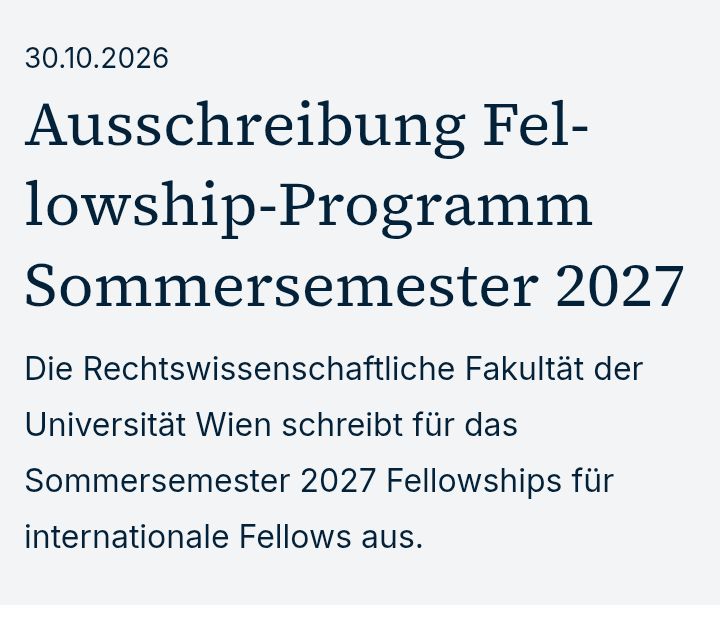
International researchers interested in advancing their legal research in Europe have an opportunity to apply for the University of Vienna Faculty of Law Fellowship Programme for the Summer Semester 2027.
The Faculty of Law at the University of Vienna is inviting applications from international academics, doctoral candidates and postdoctoral researchers who want to spend a research period at the university in Austria.
The programme is designed to strengthen international academic exchange, encourage collaboration between researchers and members of the faculty, and create opportunities for long-term research partnerships.
For the 2027 summer semester, the university will award two Senior Fellowships for professors and two Junior Fellowships for doctoral and postdoctoral researchers.
The financial support is €1,050 per month for Senior Fellows and €800 per month for Junior Fellows. Depending on the applicant’s academic position, the fellowship can last between two weeks and three months.
What makes this fellowship particularly interesting is that applicants do not need to be looking for a conventional employment opportunity in Austria. The programme is intended to support a temporary academic research stay, allowing selected fellows to work within the Faculty of Law, benefit from its research expertise and develop professional connections with scholars at the university.
However, there is one important requirement that applicants should understand before preparing their documents: you must secure a supervision agreement from an eligible academic at the University of Vienna’s Faculty of Law.
This is not a detail to leave until the final day. Your proposed research must fit the faculty’s research priorities, and you need an academic at the host institution who is willing to support your proposed fellowship.
In this guide, I will explain the fellowship categories, monthly funding, eligibility requirements, application documents and the steps I would take to prepare a competitive application.
1. University of Vienna Faculty of Law Fellowships 2027: Programme Overview
The Faculty of Law at the University of Vienna is offering four fellowships for international researchers during the Summer Semester 2027.
The programme is intended to bring researchers from universities outside Austria into an international academic environment where they can develop their research projects and collaborate with members of the faculty.
The fellowship welcomes both established academics and researchers at earlier stages of their careers.
Here are the important programme details:
| Programme Detail | Information |
| Programme Name | Faculty of Law Fellowship Programme |
| Host Institution | University of Vienna |
| Faculty | Faculty of Law |
| Host Country | Austria |
| Academic Period | Summer Semester 2027 |
| Total Fellowships | 4 |
| Senior Fellowships | 2 |
| Junior Fellowships | 2 |
| Senior Fellowship Funding | €1,050 per month |
| Junior Fellowship Funding | €800 per month |
| Senior Fellowship Duration | 2 weeks to 3 months |
| Postdoctoral Fellowship Duration | 2 weeks to 3 months |
| Doctoral Fellowship Duration | 1 month to 3 months |
| Eligible Applicants | International professors, doctoral candidates and postdoctoral researchers |
| Application Opens | 1 November 2026 |
| Application Deadline | 30 November 2026 |
| Selection Decision | December 2026 |
| Application Method | |
| Application Email | fellowships.law@univie.ac.at |
The programme is relatively small, with only four fellowships available. Applicants should therefore pay close attention to the research requirements and the documents requested by the university.
This is not a general scholarship that supports any research topic. Your proposed project must connect to one or more of the Faculty of Law’s research priorities.
2. What Is the University of Vienna Faculty of Law Fellowship?
The University of Vienna Faculty of Law Fellowship is an academic exchange programme that allows international researchers to spend a defined period working with the university’s legal research community.
The main objective is to encourage cooperation between international fellows and members of the Faculty of Law.
During the fellowship, selected researchers can advance their research projects, exchange ideas with academics, benefit from the faculty’s expertise and establish new scholarly relationships.
The programme also aims to strengthen international research networks and create opportunities for academic collaboration that can continue beyond the fellowship period.
For an international researcher, this kind of arrangement can be valuable because it provides access to an academic environment outside their home institution.
For example, a doctoral researcher working on international law may benefit from discussing their project with scholars whose expertise complements their research. A postdoctoral researcher may use the fellowship period to develop a particular aspect of a research project, exchange ideas or establish connections for future academic cooperation.
A professor may find the programme useful for strengthening existing research relationships, developing collaborative projects or exploring new academic perspectives.
The important point is that applicants should have a defined research purpose. The fellowship is intended to support academic work, not simply provide an opportunity to visit Austria.
3. Fellowship Categories and Available Funding
For the Summer Semester 2027, the Faculty of Law is offering two categories.
There are two Senior Fellowships for professors and two Junior Fellowships for doctoral and postdoctoral researchers.
The monthly financial support differs according to the category.
A. Senior Fellowship for Professors – €1,050 Per Month
Two Senior Fellowships are available for professors. Successful applicants in this category will receive financial support of €1,050 per month.
The duration of a Senior Fellowship can range from two weeks to three months.
This category is intended for established academics who have research expertise relevant to the Faculty of Law’s academic priorities.
If I were applying as a professor, I would pay particular attention to the relationship between my existing research profile and the expertise of the academic who would supervise or support my stay.
The application should make it clear why spending time at the University of Vienna would contribute to my research.
I would also identify specific areas where collaboration with members of the faculty could be useful. For example, this might involve developing a joint research idea, discussing a legal research problem or exploring a future academic partnership.
Senior applicants are also required to include their five most important publications in their CV.
This is important because the selection committee needs to understand the applicant’s academic standing and research contributions without having to work through an unnecessarily long publication list.
B. Junior Fellowship for Doctoral and Postdoctoral Researchers – €800 Per Month
Two Junior Fellowships are available for doctoral candidates and postdoctoral researchers.
Successful applicants will receive €800 per month. The fellowship duration depends on the applicant’s academic position:
Doctoral researchers: one month to three months.
Postdoctoral researchers: two weeks to three months.
This category provides an opportunity for early-career researchers to spend time at an international law faculty while advancing a research project.
For doctoral candidates, the fellowship could be useful for developing a dissertation chapter, examining a specific legal question, discussing research methods or obtaining academic feedback from scholars at the host institution.
For postdoctoral researchers, the research stay could support the development of an existing project, the preparation of academic publications or the establishment of new research collaborations.
Junior applicants should not assume that their applications will be assessed only on the basis of academic qualifications. The proposed research project and its relationship with the faculty’s expertise are central to the programme.
A doctoral candidate with a clearly defined research question and a suitable academic contact at the University of Vienna may be better positioned than someone who submits a general application without explaining why the university is the right host institution.
Important: The Fellowship Is Not an Employment Contract
The University of Vienna specifically states that receiving this fellowship does not establish an employment relationship with the university.
In other words, the financial support is provided as part of the fellowship arrangement, not as a salary under an employment contract.
Applicants should also avoid assuming that the monthly allowance automatically covers every expense associated with living in Austria.
The published announcement specifies the monthly funding amounts but does not describe the fellowship as a comprehensive package covering all travel, accommodation, insurance or relocation costs.
If you are budgeting for a research stay in Vienna, you should seek clarification from the university about any additional support and the practical arrangements.
4. Who Can Apply for the University of Vienna Law Fellowships?
The fellowship is open to researchers affiliated with universities outside Austria.
Applicants must also meet the university’s employment-history requirement: they must not have been employed by the University of Vienna at any time during the six months preceding the application.
There are three central eligibility conditions to consider.
Requirement 1: You Must Be a Researcher at a University Outside Austria
The programme is intended for international academic exchange. Applicants must be conducting research at a university outside Austria.
If you are based at a university in Nigeria, Ghana, Kenya, South Africa, India, the United States, the United Kingdom or another country outside Austria, this part of the requirement may be relevant to your circumstances.
However, applicants should make sure that their academic affiliation and research position are clearly presented in their CV and application.
Requirement 2: You Must Not Have Been Employed by the University of Vienna in the Previous Six Months
The university also restricts applications from people who have recently been employed by the University of Vienna.
To qualify, applicants must not have held employment at the University of Vienna during the six months before applying.
This is an important distinction: the requirement concerns employment with the University of Vienna, not simply whether you have previously visited the institution or attended an academic event there.
If you have a previous relationship with the university and are unsure whether it affects your eligibility, contact the fellowship organisers before submitting.
Requirement 3: Your Research Project Must Match the Faculty’s Research Priorities
This is one of the most important academic requirements. Applicants must propose a research project that can be assigned to one or more of the Faculty of Law’s research priorities.
The programme is not designed for every research subject simply because it has some connection to law. Your proposed project should have a clear academic relationship with the faculty’s work.
For example, a project examining an aspect of international law, legal institutions, human rights, comparative law or another relevant legal subject may be worth exploring if it aligns with the faculty’s actual research priorities.
However, applicants should not rely on these examples alone. They should review the faculty’s current research areas and identify the closest match for their proposed project.
The strongest approach is to explain the connection directly in the application letter.
Instead of writing that your research is generally related to law, identify the particular research question, explain why it matters and show how it connects to the expertise available at the Faculty of Law.
5. The Most Important Requirement: Securing a Supervisor at the University of Vienna
One requirement deserves special attention because it can determine whether your application is complete.
Applicants must obtain a supervision agreement from an eligible academic at the Faculty of Law.
The university accepts supervision commitments from the following categories of academics:
University professors.
Members of staff who hold a habilitation.
Associate professors.
Assistant professors.
The supervision agreement must be signed and submitted as part of the application.
It must also include a short explanation of why the applicant is particularly suitable for the fellowship.
This means that applicants should not simply choose a name from the university’s website and include it in their application. They need to establish academic contact and obtain the required agreement.
How I would approach a potential supervisor
If I were preparing an application, I would begin by studying the research areas and academic profiles of the Faculty of Law.
I would look for an academic whose expertise is genuinely connected to my proposed research.
For example, if my project examines a question in international environmental law, I would search for a faculty member whose research relates to the relevant legal field.
If my project focuses on constitutional law, human rights or another legal subject, I would identify an academic working in that area. The objective is to establish a credible academic connection.
What should I include in the first email?
I would keep the first message professional and focused. The email should introduce me, briefly explain my research project and identify why I am contacting that particular academic.
I would also mention that I am interested in applying for the Faculty of Law Fellowship for the Summer Semester 2027 and ask whether they would be willing to discuss the possibility of supporting my application.
It is useful to attach a short research summary and CV so the academic can quickly understand my background.
Do not send a generic message to several academics without checking their research interests. A carefully targeted email is more likely to generate a meaningful response.
Example email to a potential academic supervisor
The following is a sample message applicants can adapt to their actual research and academic circumstances.
Subject: Request for Academic Support – University of Vienna Faculty of Law Fellowship 2027
Dear Professor [Surname],
My name is [Your Name], and I am currently a [doctoral researcher/postdoctoral researcher/professor] at [Name of University], where my research focuses on [briefly describe your research area].
I am preparing an application for the University of Vienna Faculty of Law Fellowship Programme for the Summer Semester 2027. After reviewing your academic profile and research interests, I believe that your expertise in [specific research area] closely relates to my proposed project, titled “[Research Project Title].”
The project examines [brief explanation of the research question and its academic relevance]. I am particularly interested in exploring how this research could benefit from the academic environment and expertise available at the Faculty of Law.
I would be grateful if you would consider discussing the possibility of supporting my fellowship application through the required supervision agreement.
I have attached my CV and a brief description of my proposed research for your consideration.
Thank you for your time. I would appreciate the opportunity to discuss this further.
Kind regards,
[Your Name]
[Your Academic Position]
[Your University]
Why the supervision agreement matters
The supervision agreement is not simply an additional recommendation letter.
It establishes that a suitable academic at the host institution is willing to support the applicant’s research stay.
The required document must be signed and should include a short justification explaining why the applicant is particularly suitable for the fellowship.
East-West Center Graduate Degree Fellowship 2027: Study in the USA at the University of Hawaii
I would therefore make obtaining this agreement one of my first application tasks rather than waiting until the CV and application letter are finished.
6. Required Application Documents
A complete application must contain several documents.
The university has specified maximum page limits for the application letter and CV. Applicants should follow these limits carefully. The required documents are:
- Completed application form.
- Application letter of no more than three pages.
- Curriculum Vitae of no more than three pages.
- Recommendation letter where applicable to the applicant’s category.
- Signed supervision agreement from the Faculty of Law at the University of Vienna.
Let’s look at each document in more detail.
Document 1: Completed Application Form
Applicants must complete the official application form. Make sure that the information entered in the form is consistent with your CV and other documents.
Your academic position, university affiliation and proposed fellowship category should be clear. Before submitting, check that all required fields have been completed.
Document 2: Application Letter – Maximum Three Pages
The application letter is one of the most important parts of the application because it explains the research project and why the University of Vienna is an appropriate host institution. The letter must cover four main areas:
- Description of the proposed research project
Explain what you intend to investigate during the fellowship.
Your research description should identify the main question, the issue you want to address and the academic contribution you hope to make.
Avoid presenting an overly broad topic without a clear research direction. For example, writing “I want to research human rights” does not tell the selection committee enough.
A more focused description would identify a particular human rights question, the legal framework you intend to examine and the problem your research seeks to address.
The goal is to make the project understandable within the limited space available.
- Connection to the Faculty of Law’s research priorities
You must explain how your research relates to the faculty’s research interests.
This section should demonstrate that you have investigated the host institution rather than selecting the University of Vienna simply because it is located in Austria.
Identify the relevant research area and explain the relationship between your proposed project and the faculty’s academic work.
- Connection to the proposed supervisor’s expertise
Your application letter must also explain how the proposed supervisor’s academic expertise relates to your research.
This should be consistent with the supervision agreement.
For example, if the academic you approach specialises in a particular area of international law, explain how that expertise could support the development of your project.
Do not simply repeat the supervisor’s biography. Explain the academic connection.
- Why you selected the University of Vienna as your host institution
The university wants to understand why you want to conduct your research at the Faculty of Law. I would use this section to explain what the institution offers that is particularly relevant to my project.
This might include the expertise of a particular academic, the faculty’s research priorities, the possibility of interdisciplinary discussion or opportunities to establish international research collaborations.
The strongest explanation will be specific to the proposed research.
Document 3: Curriculum Vitae – Maximum Three Pages
Your CV must not exceed three pages. The required content differs slightly depending on the applicant’s academic category.
For senior fellows and postdoctoral researchers, the CV should include the five most important publications.
This is a useful way for the selection committee to understand the applicant’s research contributions without reviewing an extensive publication list.
I would select publications that demonstrate the strongest connection to the proposed project and the Faculty of Law’s research priorities.
For doctoral or predoctoral applicants, the announcement refers to a recommendation letter from the applicant’s supervisor.
The English announcement also separately states that PhD students must submit a recommendation letter from their current supervisor at their home university.
Because the wording distinguishes these requirements, doctoral applicants should confirm with the faculty whether one recommendation letter satisfies both references or whether any additional document is expected.
Document 4: Recommendation Letter for PhD Students
PhD students must additionally submit a recommendation letter from their current supervisor at their home university.
This letter should support the applicant’s academic suitability and proposed research stay. I would approach my supervisor early rather than waiting until the application deadline.
Give them enough information to understand the fellowship and the research project you intend to pursue. It is particularly helpful to provide:
The fellowship announcement.
Your proposed research summary.
Your current CV.
The application deadline.
Any relevant instructions for the recommendation letter.
A supervisor who understands the purpose of the fellowship will be in a better position to explain why the proposed research stay is academically valuable.
Document 5: Signed Supervision Agreement
The final required document is the supervision agreement from the Faculty of Law at the University of Vienna.
This must be signed by an eligible academic at the host faculty.
It should also contain a short explanation of why the applicant is particularly suitable for the fellowship.
Do not confuse this with the recommendation letter from your current supervisor at your home university. They serve different purposes:
The home-university recommendation supports your academic suitability.
The University of Vienna supervision agreement confirms that an eligible academic at the host institution is willing to support your fellowship.
Applicants should make sure that the correct document is included.
7. How to Write a Strong Research Proposal for the University of Vienna Fellowship
The application letter has a maximum length of three pages, so there is limited space to explain your research.
I would avoid treating it like a full doctoral dissertation proposal.
Instead, focus on presenting a clear research project that can realistically benefit from the proposed fellowship period. A useful structure would be:
1. Research title
Give the project a precise title that communicates the subject of your research.
Avoid titles that are so broad that the committee cannot immediately identify the legal issue being examined.
2. Background and research problem
Briefly explain the legal or academic problem you want to investigate.
Why is this issue important? What question remains unresolved? What makes the subject worth examining?
3. Research objectives
Identify what you intend to achieve during the fellowship.
For example, you might want to develop a particular argument, examine a legal framework, compare different approaches or prepare a section of a larger research project.
4. Relevance to the Faculty of Law
Identify the faculty’s research priority that best matches your project. This is where you demonstrate that you understand the academic environment you are applying to join.
5. Relevance of the proposed supervisor
Explain why the academic you have approached is a suitable person to support your research. Make the relationship between their expertise and your project clear.
6. Why Vienna?
Explain why the University of Vienna is the right host institution for your proposed research.
Focus on the academic reasons rather than general statements about wanting to visit Austria.
7. Expected outcome
Briefly explain what you hope to accomplish during the fellowship.
Possible outcomes may include advancing a research paper, developing a chapter, preparing a publication or establishing a foundation for future collaboration.
The expected outcome should be realistic for the proposed fellowship duration.
8. How to Make Your Application More Competitive
Because the university is offering only four fellowships, applicants should take time to establish a clear academic case.
The following points are particularly important.
Choose a research topic that genuinely fits the faculty
A common mistake in academic fellowship applications is assuming that a prestigious university will be interested in every research subject.
That is not how a targeted fellowship works. The University of Vienna is looking for research projects that connect to the Faculty of Law’s academic priorities.
Before approaching a supervisor, identify the relevant research area and explain why your project belongs there.
Contact the proposed supervisor early
The supervision agreement is mandatory. This means your application depends partly on establishing a relationship with an eligible academic at the host institution.
Do not leave this until the final week. An academic may need time to review your research summary, consider whether your project fits their expertise and decide whether they can support your application.
A short, targeted email accompanied by a CV and research summary is a sensible starting point.
Make the three-page application letter count
Three pages are not much space for explaining a research project, institutional fit and academic motivation.
I would prioritise clarity over unnecessary background information. The committee should be able to identify:
What you want to research.
Why the research matters.
How it connects to the Faculty of Law.
Why the proposed supervisor is suitable.
What you expect to achieve during the fellowship.
If these points are difficult to identify in your letter, revise it before submission.
Select your five most relevant publications if required
Senior fellows and postdoctoral researchers should include their five most important publications in their CV.
Do not automatically select the five most recent publications.
Choose those that best demonstrate your research expertise and support the academic case you are making in the application.
Request recommendation letters early
PhD applicants should arrange the required recommendation from their current supervisor at their home university.
Community Solutions Program 2027: Fully Funded U.S. Fellowship for Community Leaders
If you are uncertain about the distinction between the predoctoral recommendation mentioned in the document requirements and the additional PhD recommendation, ask the faculty for clarification.
It is better to resolve this before submitting than to discover that a required document is missing.
Choose a realistic fellowship duration
The programme allows different fellowship durations depending on academic position.
Senior fellows and postdoctoral researchers can request between two weeks and three months, while doctoral researchers can request between one month and three months.
I would choose a period that makes sense for the proposed research activities.
For example, if the purpose is to develop a particular research argument through discussions with a host academic, a shorter stay may be sufficient.
If the project requires more extensive academic exchange or several stages of work, a longer period may be more appropriate.
The important thing is to explain what you intend to accomplish during the requested period.
9. Application Deadline and Selection Process
Applications for the University of Vienna Faculty of Law Fellowship Programme for the Summer Semester 2027 are accepted from 1 November 2026 to 30 November 2026.
The deadline is inclusive, meaning applications can be submitted through 30 November.
The university expects to make the fellowship selection decisions in December 2026. Here is the application timeline:
| Stage | Date |
| Applications Open | 1 November 2026 |
| Application Deadline | 30 November 2026 |
| Selection Decisions | December 2026 |
| Fellowship Period | Summer Semester 2027 |
Since the programme requires a supervision agreement from a member of the Faculty of Law, applicants should not wait until the deadline to begin contacting potential supervisors.
The application process involves several people and documents, and obtaining the required academic endorsement may take time.
10. How to Apply for the University of Vienna Faculty of Law Fellowship 2027
Unlike some international scholarship programmes that use a central online portal, the application instructions for this fellowship specify submission by email.
Applications should be sent to:
fellowships.law@univie.ac.at
Here is the process I would follow.
Step 1: Review the official fellowship announcement
Start by reading the official University of Vienna announcement.
Make sure you understand the available fellowship categories, funding amounts, duration and eligibility conditions.
Official announcement:
https://juridicum.univie.ac.at/news-detailasnicht/ausschreibung-fellowship-programm-sommersemester-2027
Step 2: Identify your fellowship category
Determine whether you are applying as:
A professor seeking a Senior Fellowship.
A postdoctoral researcher seeking a Junior Fellowship.
A doctoral researcher seeking a Junior Fellowship.
Check the duration rules that apply to your category.
Step 3: Identify a suitable academic at the Faculty of Law
Review the faculty’s academic profiles and research areas.
Identify an eligible professor, habilitated member of staff, associate professor or assistant professor whose expertise connects to your proposed research.
Step 4: Contact the potential supervisor
Send a concise and personalised email introducing your research and explaining why you believe the academic’s expertise is relevant.
Attach your CV and a short description of your project. Ask whether they would consider supporting your fellowship application.
Step 5: Obtain the signed supervision agreement
If the academic agrees to support your application, arrange the required supervision agreement.
Make sure it is signed and includes the requested explanation of why you are particularly suitable for the fellowship.
Step 6: Prepare your application letter
Write a letter of no more than three pages.
Explain your proposed research, its connection to the faculty’s research priorities, the relevance of the proposed supervisor’s expertise and why you selected the University of Vienna.
Step 7: Prepare your CV and recommendation letter
Prepare a CV of no more than three pages. Senior fellows and postdoctoral researchers should include their five most important publications.
PhD students should arrange the required recommendation from their current supervisor at their home university and clarify any additional recommendation requirements with the faculty.
Step 8: Complete the application form
Fill in the official application form and check that all the information is accurate.
Make sure your application category, research details and academic affiliation are consistent across the documents.
Step 9: Check the complete application
Before sending the email, confirm that you have included:
Completed application form.
Application letter, maximum three pages.
CV, maximum three pages.
Relevant recommendation letter or letters.
Signed supervision agreement from the University of Vienna Faculty of Law.
Check that the documents open correctly and that no required attachment is missing.
Step 10: Email your application before the deadline
Send the complete application to:
fellowships.law@univie.ac.at
The deadline is 30 November 2026.
I would send the application early enough to deal with any unexpected email or attachment problems.
Keep a copy of the submitted documents and your sent email for reference.
11. Is the University of Vienna Fellowship Fully Funded?
This is an important question, especially for applicants travelling internationally. The fellowship provides financial support of:
€1,050 per month for Senior Fellows.
€800 per month for Junior Fellows.
However, the published announcement does not describe the programme as a fully funded scholarship covering all expenses.
CrossCulture Programme (CCP) Fellowship 2027: Funding, Eligibility and How to Apply
It does not specify that international airfare, accommodation, visa fees, health insurance or all living costs are separately covered.
Applicants should therefore avoid assuming that the monthly allowance represents a complete funding package.
Before accepting an offer, I would ask the university to clarify:
- Whether international travel expenses are covered separately.
- Whether accommodation is provided or must be arranged independently.
- Whether health insurance is required and who is responsible for its cost.
- How the monthly allowance is paid.
- Whether any additional financial support is available.
- Whether there are any administrative requirements for international fellows.
This is particularly important for applicants travelling from outside Europe, where international travel and accommodation can represent a significant part of the overall cost.
The fellowship is still a valuable academic funding opportunity, but applicants should prepare a realistic budget rather than treating the monthly allowance as a guaranteed full scholarship.
12. Frequently Asked Questions About the University of Vienna Fellowships 2027
Is the University of Vienna Faculty of Law Fellowship open to international applicants?
Yes. The programme is intended for international researchers affiliated with universities outside Austria.
How many fellowships are available?
Four fellowships are available for the Summer Semester 2027: two Senior Fellowships and two Junior Fellowships.
How much is the Senior Fellowship worth?
Senior Fellows receive financial support of €1,050 per month.
How much is the Junior Fellowship worth?
Junior Fellows receive financial support of €800 per month.
Can PhD students apply?
Yes. Doctoral researchers can apply for the Junior Fellowship. The duration for doctoral researchers is between one month and three months.
Can postdoctoral researchers apply?
Yes. Postdoctoral researchers are eligible for the Junior Fellowship. Their fellowship can last between two weeks and three months.
Can professors apply?
Yes. Professors can apply for the Senior Fellowship, which provides €1,050 per month for a period of two weeks to three months.
Can I apply if I am currently working at an Austrian university?
The announcement states that applicants must be researchers at a university outside Austria.
Applicants should therefore check their circumstances against this requirement before applying.
Can someone who previously worked at the University of Vienna apply?
Applicants must not have been employed by the University of Vienna at any time during the six months before applying.
If you have a previous employment relationship with the university and are uncertain about the timing or eligibility implications, contact the fellowship organisers.
Do I need a supervisor at the University of Vienna?
Yes. A supervision agreement from an eligible academic at the Faculty of Law is compulsory.
The agreement must be signed and include a short explanation of why the applicant is particularly suitable for the fellowship.
Can I apply without a recommendation letter?
The requirements depend on your academic category.
PhD students must submit a recommendation letter from their current supervisor at their home university. The announcement also refers to a supervisor’s recommendation for predoctoral applicants.
Senior fellows and postdoctoral researchers should include their five most important publications in their CV.
What is the maximum length of the application letter?
The application letter must not exceed three pages.
What is the maximum length of the CV?
The CV must not exceed three pages.
How do I submit my application?
Applications should be sent by email to:
fellowships.law@univie.ac.at
What is the application deadline?
The deadline is 30 November 2026.
When will the selection results be announced?
The university expects to make the selection decisions in December 2026.
Does the fellowship provide an employment contract?
No. The university explicitly states that the fellowship does not establish an employment relationship with the University of Vienna.
13. Summary: Should You Apply for the University of Vienna Law Fellowship?
The University of Vienna Faculty of Law Fellowship Programme 2027 is worth considering if you are a professor, doctoral candidate or postdoctoral researcher with a legal research project that aligns with the faculty’s academic priorities.
The programme offers a relatively short research stay in Austria, monthly financial support and the opportunity to develop academic relationships with researchers at an internationally recognised university.
For early-career researchers, it can provide an opportunity to discuss research ideas, develop academic work and build international connections.
For established professors, it offers a chance to strengthen research networks and explore opportunities for future collaboration.
However, I would not approach this as an ordinary scholarship application where submitting a CV and motivation letter is enough.
The supervision agreement is central to the process. You need to identify an appropriate academic at the Faculty of Law, establish a connection between your research and their expertise, and obtain their signed support.
Your three-page application letter must also explain why the University of Vienna is the right host institution for your research.
If I were preparing an application, I would begin with those two tasks: finding the correct academic contact and developing a focused research proposal that fits the faculty’s priorities. Once those are in place, preparing the CV, recommendation letter and application form becomes much more straightforward.
Remember that the programme offers only four fellowships, so applicants should pay attention to the quality and completeness of their submissions.
Application deadline: 30 November 2026.
Official Application Link and Contact Information
For the complete announcement, application form and further information, visit the official University of Vienna Faculty of Law website:
https://juridicum.univie.ac.at/news-detailasnicht/ausschreibung-fellowship-programm-sommersemester-2027
Application Email: fellowships.law@univie.ac.at
Application Period: 1 November – 30 November 2026
Expected Selection Decision: December 2026
Interested applicants should consult the official announcement and confirm any questions about the application documents, funding arrangements or eligibility directly with the Faculty of Law before submitting.
Browse related fellowship programs on scholars Africa website below
EWC Graduate Degree Fellowship: My Experience Studying at the University of Hawaii
Eric Bleumink Fellowship 2027 in the Netherlands (Fully Funded Master’s Scholarship)
Discover more from Scholars Africa
Subscribe to get the latest posts sent to your email.

About Scholars Africa Editorial Team
Scholars Africa Editorial Team is dedicated to researching and publishing verified scholarships, jobs, and global opportunities. Our content is built on extensive analysis of application trends, eligibility criteria, and selection patterns to help applicants succeed at every stage. Our team has reviewed hundreds of scholarship programs and application processes across multiple countries.