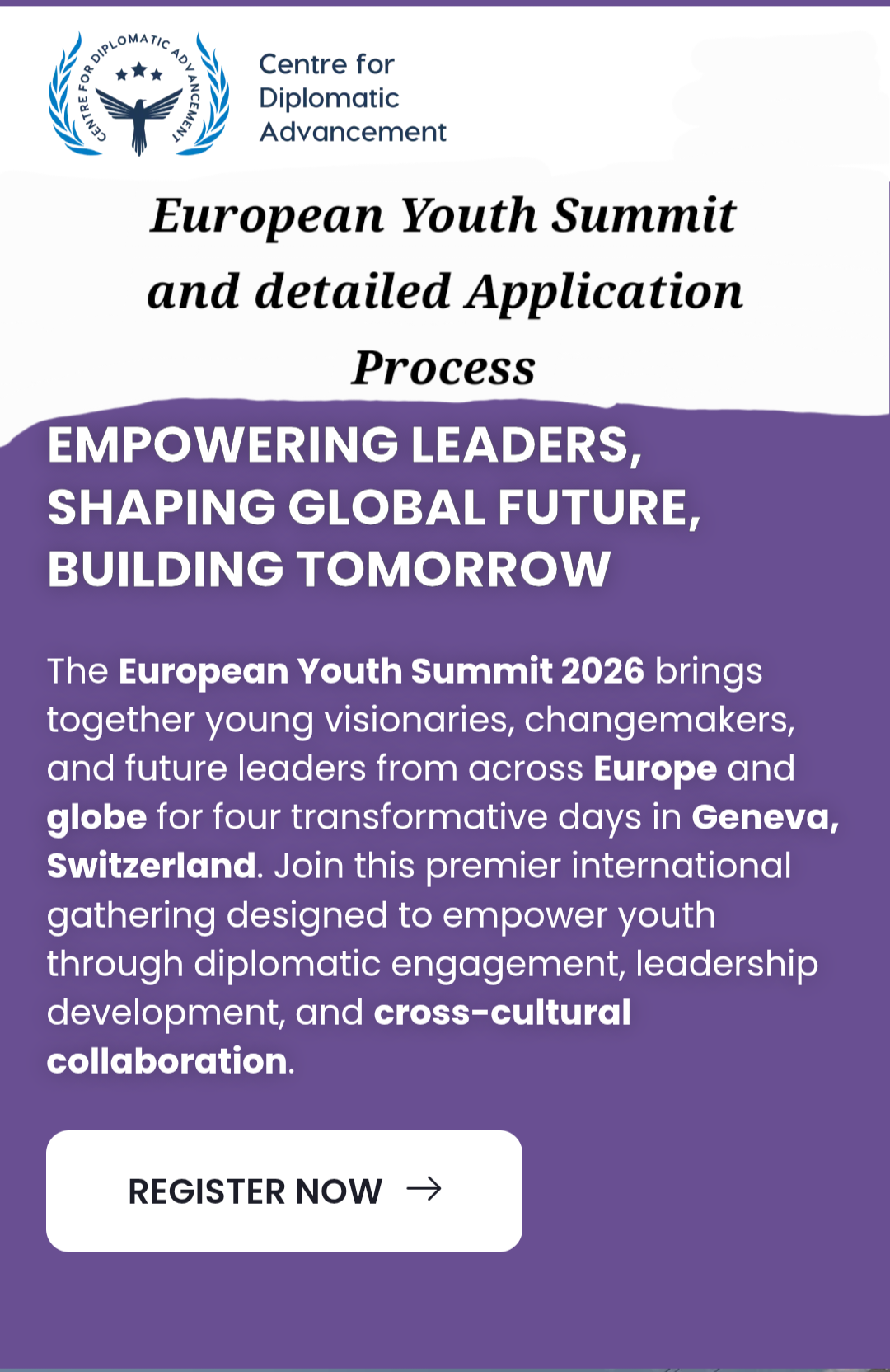
When I first came across the European Youth Summit, what caught my attention was not simply the fact that it was taking place in Switzerland.
It was the possibility of spending several days in a room with young people, professionals, innovators and people interested in international affairs from different parts of the world.
For an African student or young professional, opportunities like this can feel distant. Geneva is known for international organisations, diplomacy and global policy, so attending an international youth summit there can sound like something reserved for people who already have impressive careers or connections.
But that is not necessarily how these programmes work.
The European Youth Summit described in the 2026 call was open to applicants from around the world, including participants from Africa. The programme brought together young people for several days of discussions, networking, leadership activities and cross-cultural exchange.
If I were applying as an African participant, I would not approach the opportunity simply as a chance to travel to Switzerland.
I would look at it as an opportunity to build international relationships, learn how people from different countries think about global issues and become more confident participating in international conversations.
And I would prepare for the application accordingly. There is also an important practical issue that many applicants overlook.
Being accepted to an international summit and being able to travel to Switzerland are two different things.
So, if I were selected, I would need to think about the visa process, travel costs, accommodation, insurance, supporting documents and other practical arrangements separately from the summit application.
This guide explains how I would approach the European Youth Summit application as an African student, graduate or young professional, what the programme offers, who can apply, what makes the opportunity valuable and what I would prepare before submitting an application.
What Is the European Youth Summit?
The European Youth Summit is an international youth-focused gathering designed to bring participants together for dialogue, networking, leadership development, collaboration and discussions around global and European challenges.
For the 2026 edition described in the source material, the summit was scheduled to take place in Geneva, Switzerland, from 5 to 8 June 2026.
Geneva is a particularly interesting setting for an event like this. The city is strongly associated with international diplomacy and cooperation, with numerous international organisations and institutions operating there.
So, for me, attending a youth summit in Geneva would not simply mean attending sessions inside a conference venue.
The location itself would put me in an environment where international policy, diplomacy, humanitarian affairs and global cooperation are part of everyday professional life.
That context can make an international youth event feel very different from a typical student conference.
Why Should African Students Apply for the European Youth Summit?
If I were an African student considering this opportunity, my first question would probably be:
What do I actually gain from attending?
The answer is more than a certificate. The real value of a summit like this is the people I meet and the conversations I have.
Imagine arriving in Geneva and finding yourself in a room with participants from several countries.
Someone might be working on education in Africa. Another participant might be involved in climate action. Someone else might be working in technology, entrepreneurship, public policy or youth development.
A conversation during a workshop or networking session can sometimes lead to a relationship that lasts much longer than the four-day event itself. That is the part I would take seriously.
The Networking Opportunity Is One of the Biggest Attractions
I would not attend the summit with the goal of collecting as many LinkedIn connections as possible. That usually produces a long list of names and very few meaningful relationships.
Instead, I would try to have actual conversations. If I met someone whose work interested me, I would ask what they were working on.
If their work connected with something I was already doing, I would explain my own experience. That is how useful professional relationships begin.
For an African participant who has mostly built a network within their own university, city or country, being surrounded by people from different backgrounds can be eye-opening.
I could discover opportunities I had never heard about before. I could learn how another country approaches a problem that my own community is facing.
And I could also realise that many challenges that appear uniquely African are actually part of much larger global conversations.
What Happens at the European Youth Summit?
The summit is designed around engagement rather than simply listening to speeches. The programme described in the source includes areas such as:
Leadership development
Diplomatic engagement
Cross-cultural collaboration
Dialogue
Innovation
International relations
Policy discussions
Networking
Youth participation
The exact programme can vary by edition, so I would not assume that every session will be identical from one year to another.
But I would expect to spend the event moving between discussions, workshops, networking opportunities and other activities designed to encourage participants to exchange ideas.
Who Can Apply for the European Youth Summit?
According to the 2026 information provided, the opportunity was open internationally. That means applicants from Africa could apply alongside participants from Europe, Asia, North America, South America and other parts of the world.
The eligibility information also gave the programme a relatively broad age range.
Age requirement
Applicants were expected to be between 18 and 50 years old for the 2026 edition described in the source.
That is considerably broader than many youth programmes, which often stop at 30 or 35.
So, I would not automatically assume that being above my twenties makes me too old. If I fell within the stated age range, I would check the rest of the requirements before ruling myself out.
Does Nationality Matter?
The summit was described as being open to applicants of all nationalities. That means African applicants were eligible to apply.
Whether I was from Nigeria, Ghana, Kenya, Uganda, South Africa, Rwanda, Ethiopia or another African country, I would not assume that nationality prevented me from applying.
The international nature of the event is actually one of the reasons an African applicant could find it valuable. I would be bringing my own regional experience into a room filled with people from different parts of the world.
Do I Need a University Degree?
No specific educational level was required according to the information provided. The programme was described as being open to people at different educational levels, including:
Undergraduate students
Graduates
Master’s students
PhD students
Professionals
This is important because I would not reject myself simply because I was still an undergraduate.
At the same time, I would not assume that being a master’s or PhD student automatically makes my application stronger. My motivation and what I could contribute to the summit would still matter.
Do I Need Previous Experience?
Another attractive feature is that the opportunity was described as not requiring previous experience in a particular field. That means I could apply even if I had never attended an international summit before.
If I were a university student who had participated in a few campus activities, volunteered locally or worked on a small community project, I could still have something meaningful to say about my interests.
I would not invent international experience that I did not have. Instead, I would focus on what I had actually done and explain why I wanted to grow beyond that experience.
What Is the Main Purpose of the European Youth Summit?
The summit is built around bringing young people and professionals together to exchange ideas and discuss challenges affecting Europe and the wider world.
For me, that is where the opportunity becomes more interesting. I would not attend simply to listen to famous speakers. I would want to participate in the discussions.
Youth summits are most valuable when participants contribute their own experiences rather than waiting for somebody else to provide all the answers.
As an African participant, I could bring perspectives from my own community and country into discussions about issues such as education, employment, climate change, digital transformation, development, governance or social inclusion.
The African Perspective Can Actually Be Valuable
One thing I would remind myself before attending is that I do not need to pretend to be European to belong in a European youth summit.
I would bring my own perspective. Suppose I come from a community where young people struggle with access to quality education.
Another participant might come from a country where the challenge is very different. That contrast creates useful conversations.
Instead of simply saying, “We have the same problem,” I could explain how the problem looks from my side and listen to how another participant approaches it. That is the kind of cross-cultural learning that can make international programmes valuable.
What Are the Benefits of Attending?
The programme information highlights several potential benefits.
1. International Networking
I could meet young people, professionals, innovators and other participants from different countries. For me, the goal would be quality connections rather than simply collecting contacts.
2. International Certificate
Participants can receive an international certificate associated with the programme. I would value the certificate, but I would not make it the main reason for attending.
A certificate proves attendance. The conversations, skills and relationships I build during the event can potentially have much longer-term value.
3. Leadership Development
Leadership is not simply standing on a stage and giving a speech. A summit like this can expose me to different approaches to leadership, collaboration and problem-solving.
I might also discover weaknesses in the way I communicate or work with people from different backgrounds. That kind of self-awareness can be useful.
4. Workshops and Discussions
The programme includes opportunities connected with areas such as leadership, careers, European policy and international relations.
If those subjects are relevant to my academic or professional goals, the sessions could provide useful exposure to perspectives that I would not normally encounter at home.
5. Cross-Cultural Experience
This is one of the benefits I would personally take seriously. Being around participants from different countries forces me to communicate across differences in culture, education and experience.
Sometimes the most valuable lesson comes from a conversation outside the formal programme.
Geneva Is Part of the Experience
I would also acknowledge the importance of the location. Geneva is one of the world’s major centres for international diplomacy and cooperation.
Being physically present there can give an international event a different atmosphere.
For someone interested in international development, diplomacy, human rights, global policy or international organisations, Geneva is a particularly relevant place to visit.
But I would not make the mistake of treating the summit as a tourism opportunity first. The academic and professional purpose should remain the priority.
If I were selected, I would plan some time to explore Geneva, but I would make sure I was fully prepared for the summit itself.
How I Would Prepare My Application
If I were applying, I would start by understanding what the organisers actually want from participants.
The most useful question is not: “How can I make myself sound impressive?” It is: “What can I genuinely contribute to this international youth conversation?” That changes how I would write the application.
Step 1: Check My Eligibility
Before doing anything else, I would confirm that I meet the basic conditions. For the 2026 programme described in the source:
I needed to be within the stated 18–50 age range.
My nationality did not prevent me from applying.
No specific university degree was required.
Undergraduate, graduate, master’s and PhD applicants could apply.
Previous experience was not required.
If I met those conditions, I would move forward.
Step 2: Think About Why I Want to Attend
This is where I would spend more time than most applicants probably expect. I would not write: “I want to attend because I want to meet people from different countries.” That is true, but it is too generic. I would ask myself:
What do I actually want to learn?
Maybe I am interested in youth participation in policymaking. Maybe I am working on education access. Maybe I am interested in climate change.
Maybe I want to understand how young people from different countries approach entrepreneurship. Maybe I want to develop my ability to participate in international discussions. The strongest answer would come from something I actually care about.
Step 3: Explain What I Can Contribute
I would also think beyond what I could receive. What could I bring into the room? Perhaps I have worked with young people in my community.
Perhaps I have volunteered with an education project. Perhaps I have participated in environmental initiatives. Perhaps I have researched youth unemployment.
Perhaps I have built a small technology project. Perhaps I simply have a strong perspective on an issue affecting young people in my country. I would explain that experience honestly.
I would not inflate a small project into a national movement. Authenticity is more convincing than exaggerated claims.
Step 4: Make My African Perspective Clear
If I were applying from Africa, I would not hide that perspective. But I also would not reduce my entire application to “I am African.” I would explain what my background has taught me.
For example, if I grew up seeing young people struggle to access employment opportunities, I could explain how that shaped my interest in entrepreneurship or policy.
If I had worked with students in underserved communities, I could explain what I learned from that experience. The key is connecting my personal or professional experience to the wider conversation.
Step 5: Submit the Application Before the Deadline
For the 2026 edition described in the source, the application deadline was:
10 March 2026
The summit itself was scheduled for:
5–8 June 2026
Successful applicants were expected to be notified around:
30 March 2026
These dates are now in the past, so they should not be treated as current deadlines for a future edition. If another edition is announced, I would check the new application deadline directly rather than assuming the organisers will use the same dates.
What Happens After Applying?
The waiting period can be uncomfortable. I would not constantly refresh my email every hour. But I would make sure that the email address used in my application was active and that I regularly checked my inbox and spam folder.
For the 2026 cycle described here, successful applicants were expected to receive their notification around 30 March 2026.
If I received the acceptance email, that would be the point where the practical preparation begins. And this is where I would separate two things:
Being accepted to the summit does not automatically mean that every travel expense is covered. That distinction is extremely important.
The Visa Question: What Would I Need as an African Applicant?
If I were travelling from an African country to Geneva, I would immediately start thinking about the Swiss/Schengen visa process, where applicable.
The summit application and the visa application are separate processes. I would not wait until the last minute to begin preparing travel documents.
Depending on my nationality and circumstances, the visa process may require documentation such as:
Passport
Visa application form
Passport photographs
Proof of accommodation
Travel itinerary
Travel medical insurance
Proof of sufficient funds
Evidence explaining the purpose of travel
Summit invitation or acceptance documentation
Other supporting documents requested by the relevant Swiss authorities
The exact requirements depend on the applicant’s nationality and circumstances, so I would check the official Swiss authorities or the appropriate Swiss visa application channel for my country.
I would also make sure my passport was valid for the required period before making any major travel arrangements.
I Would Not Buy a Non-Refundable Flight Too Early
This is one of the practical lessons I would take seriously. If I received a summit acceptance email, I would still confirm my visa situation and travel requirements before committing large amounts of money to a non-refundable flight.
Being accepted to an event is not the same thing as having permission to enter Switzerland. I would plan the two processes separately.
First:
Summit acceptance.
Then:
Travel and visa preparation.
Then:
Actual travel.
That sequence would protect me from unnecessary financial risk.
What Would I Actually Do During the Summit?
If I were selected, I would arrive prepared to participate. I would not spend four days sitting quietly at the back of the room waiting for the event to finish.
Before travelling, I would read about the main themes of the summit and think about two or three subjects I could comfortably discuss. I would also prepare a simple introduction about myself.
Something like:
Who am I?
What do I study or work on?
What issue am I interested in?
What am I hoping to learn?
That is enough. I would not memorise a long speech.
How I Would Approach Networking
Networking can feel uncomfortable, especially for someone attending an international event for the first time. I would make it easier by setting a small target.
Instead of trying to meet everyone, I would aim to have a few meaningful conversations each day. If I met someone whose work interested me, I would ask:
What are you currently working on?
What brought you to the summit?
What issues are you interested in?
What opportunities are available in your field?
How does this issue look in your country?
Those questions naturally lead to conversations. At the end of the discussion, if we genuinely had something in common, I could exchange LinkedIn details or another professional contact.
The Four Days Can Pass Very Quickly
This is something I would keep in mind. At an international summit, it is easy to think: “I’ll network tomorrow.” Then tomorrow becomes the final day. I would therefore start participating from the beginning.
If there is a workshop, I would participate. If there is a discussion, I would contribute when I have something useful to say. If there is a networking session, I would not spend the entire time looking at my phone. The goal is to actually experience the event.
What I Would Bring With Me
If I were travelling internationally for the summit, my practical preparation would include:
Valid passport
Visa, where required
Summit acceptance/invitation documentation
Travel insurance
Flight information
Accommodation confirmation
Emergency contacts
Digital and printed copies of important documents
Phone charger and appropriate travel adapter
A simple professional outfit for formal sessions
Comfortable clothing for longer event days
Notebook or digital note-taking device
I would also keep copies of important documents in secure digital storage.
Is the European Youth Summit Fully Funded?
This is a point where I would be particularly careful.
The information provided highlights the benefits of attending the summit, but it does not establish that the 2026 event was a fully funded scholarship or that all participants received flights, accommodation, meals and visa expenses for free.
So I would not advertise the opportunity as “fully funded” unless the official announcement for a particular edition explicitly confirms that. For an African applicant, this distinction is important. I would calculate the potential cost of:
Visa
Flight
Accommodation
Travel insurance
Local transportation
Food
Personal expenses
before making a final travel commitment.
Why the Experience Could Still Be Valuable
Even when an international youth summit is not fully funded, it can still be valuable for the right participant. If my career interests are connected to:
International development
Diplomacy
Public policy
Youth leadership
Entrepreneurship
Human rights
International relations
Climate action
Education
Social innovation
then being exposed to people working in those areas can be useful. But I would make the decision based on the actual costs and benefits rather than assuming that an international event is automatically worth any amount of money.
My European Youth Summit Application Checklist
Before submitting an application, I would check:
Eligibility
I meet the stated age requirement.
My nationality is eligible.
I understand the education requirements.
I do not need previous international experience to apply.
Application
I understand why I want to attend.
I can explain what I would contribute.
I can discuss an issue that matters to me.
I have accurately described my experience.
My application contains no exaggerated claims.
I have checked every section before submitting.
If selected
I understand whether travel costs are covered.
I have checked the Swiss visa requirements applicable to me.
My passport is valid.
I have considered accommodation.
I have considered travel insurance.
I have planned my travel budget.
I have kept copies of my acceptance and travel documents.
Mistakes I Would Avoid
Applying Only Because It Is in Switzerland
Geneva is exciting, but Switzerland should not be the main reason for my application. I would apply because the programme fits my interests.
Making My Application Too Generic
“I want to change the world” is a nice sentence, but it does not tell the organisers much about me. I would explain what I actually care about and why.
Pretending to Have Experience I Don’t Have
I would never claim to have led an international organisation if I only participated in a university club. Small experiences can still be meaningful when explained properly.
Assuming the Event Covers Everything
I would check the funding conditions carefully. Acceptance does not automatically mean free flights, accommodation or visa fees.
Waiting Until Acceptance Before Checking My Passport
If my passport is about to expire, I do not want to discover that after receiving an invitation. I would check it early.
Ignoring the Visa Process
A summit invitation does not replace a visa where a visa is required. I would start checking the relevant requirements as soon as I had a realistic prospect of travelling.
Final Summary: Why I Would Consider Applying as an African
If I were an African student, graduate or young professional interested in international affairs, I would seriously consider an opportunity like the European Youth Summit.
Not because I expect four days in Geneva to transform my life overnight. That is not realistic. The real value is in the combination of international exposure, conversations, new perspectives, leadership development and relationships.
I could arrive in Geneva with one understanding of a global issue and leave with several new ways of looking at it. I could meet someone whose work inspires my next project.
I could discover an organisation I had never heard about. I could become more confident speaking to people from different countries. Or I might simply return home with a clearer understanding of the direction I want my career to take.
Those outcomes are difficult to measure on an application form, but they can be important over time. For me, the biggest lesson would be to treat the European Youth Summit as more than a travel opportunity.
The destination is Geneva, but the real opportunity is the people and conversations I encounter there. And if I were applying from Africa, I would not wait until I felt like I was already an international leader. I would apply because I am interested in becoming one.
Important date note
The dates in the original information refer to the 2026 edition: applications closed on 10 March 2026, successful applicants were expected to be notified around 30 March 2026, and the summit was scheduled for 5–8 June 2026.
Those dates have passed as of October 2026. For a future European Youth Summit edition, applicants should check the new official announcement for the current deadline, eligibility requirements, funding arrangements, venue and programme dates before applying.
To start your application for the European Youth Summit visit here
See some scholarships for African Scholars.
How to Apply and Increase Your Chances of Winning Chevening: Lessons From Previous African Scholars
How to Apply and Increase Your Chances of Winning Chevening: Lessons From Previous African Scholars
Commonwealth PhD Scholarships 2027: My Experience Applying for a Fully Funded PhD in the UK
The Wageningen University Scholarships and How to Apply Steps by Steps.
How To Apply for The SBW Berlin scholarship For Africans ; complete guides
Discover more from Scholars Africa
Subscribe to get the latest posts sent to your email.

About Scholars Africa Editorial Team
Scholars Africa Editorial Team is dedicated to researching and publishing verified scholarships, jobs, and global opportunities. Our content is built on extensive analysis of application trends, eligibility criteria, and selection patterns to help applicants succeed at every stage. Our team has reviewed hundreds of scholarship programs and application processes across multiple countries.