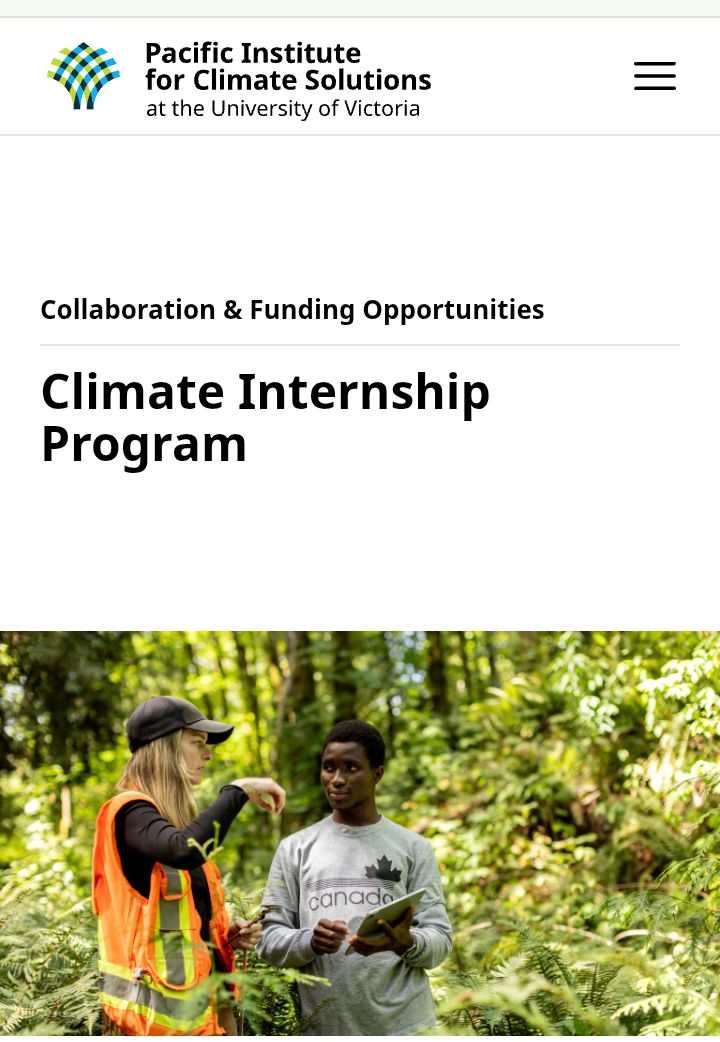
Are you an organisation in British Columbia working on climate change, environmental sustainability, climate resilience, or community-based climate action?
The Pacific Institute for Climate Solutions (PICS) Climate Internship Program is an opportunity to bring a university student into your organisation to support a climate-related project while receiving funding of up to $15,000.
The programme is designed to benefit both organisations and students. Eligible organisations can receive financial support to hire a student for a climate action project, while university students gain practical work experience, develop professional skills, and contribute to climate solutions in British Columbia.
Applications are now open for the 2026 funding round. The application deadline is November 20, 2026, at 4:00 p.m.
If I were preparing an application for an organisation, I would approach this as more than a request for internship funding. I would treat it as a short project proposal that must demonstrate a clear climate benefit, a meaningful role for a student, and a realistic plan for turning the intern’s work into something useful for a community or organisation.
In this guide, I’ll explain what the PICS Climate Internship Program offers, who can apply, what kinds of projects are suitable, how the application form works, and how organisations can prepare a convincing application.
PICS Climate Internship Program 2026: Overview
| Opportunity detail | Information |
| Programme name | PICS Climate Internship Program |
| Programme administrator | Pacific Institute for Climate Solutions (PICS) |
| Funding location | British Columbia, Canada |
| Funding amount | Up to $15,000 |
| Purpose | Support organisations to hire university students for climate action projects |
| Eligible student universities | UBC, SFU, UNBC, and UVic |
| Eligible applicants | Qualifying organisations in British Columbia |
| Application status | Open |
| Application deadline | November 20, 2026 |
| Deadline time | 4:00 p.m. |
| Suggested internship duration | 13–16 weeks |
| Internship fields | Climate-related fields |
| Student recruitment | Internship job opportunities are expected to be posted between February and April 2027 |
| Official application page | PICS Climate Internship Program |
Important: The funding application is intended for eligible organisations seeking support to hire an intern. It is not a direct scholarship application for students.
Students interested in internship opportunities should monitor the PICS Careers page for job postings expected between February and April 2027.
What Is the PICS Climate Internship Program?
The PICS Climate Internship Program helps organisations in British Columbia advance their climate goals by providing funding to hire a university student for a climate action project.
The student works with the organisation on a defined project, gaining experience in a climate-related field while contributing to work that can benefit the organisation, its community, or a wider sector.
The programme is supported by the Pacific Institute for Climate Solutions. Since 2024, PICS has delivered the Climate Internship Program with sponsorship from Coast Capital.
The funding is intended to help organisations bring additional capacity to climate action projects while creating early-career development opportunities for students.
For an organisation, this could mean having the support of a student to undertake research, develop resources, analyse climate-related information, assist with project implementation, or help communicate climate solutions.
For a student, it could mean gaining practical experience in a real working environment rather than limiting their learning to university coursework.
The programme prioritises projects that offer direct climate value, create a strong early-career learning opportunity, and have the potential to inspire further climate actions or policies.
Who Can Apply for PICS Climate Internship Funding?
The funding application is intended for eligible organisations in British Columbia. The programme identifies the following types of organisations as eligible to apply:
Registered non-profit organisations
First Nations and Indigenous organisations
Provincial government agencies
Crown corporations
Local governments
Cooperatives
Social enterprises
Private companies
This makes the programme relevant to organisations across different sectors, not only environmental charities or climate-focused non-profits.
A local government working on climate adaptation, a First Nations organisation developing a climate resilience initiative, a social enterprise improving sustainable transportation, or a private company working on climate solutions may all have projects worth assessing against the programme’s criteria.
However, eligibility to apply does not automatically mean that a project will receive funding. The application must still demonstrate the value of the proposed internship and its connection to climate action.
What if I am a university student?
If you are a student looking for an internship, the funding application is not the route you should use to apply for a job.
PICS states that internship opportunities will be posted on its Careers page between February and April 2027. The internships are only open to students at PICS universities:
University of British Columbia (UBC)
Simon Fraser University (SFU)
University of Northern British Columbia (UNBC)
University of Victoria (UVic)
Students at other universities should not assume that they are eligible for these particular internships.
If you attend one of the eligible universities, keep checking the Careers page during the expected recruitment period and review the requirements in each job posting.
What Types of Climate Projects Can Receive Funding?
PICS prioritises projects that demonstrate a clear connection to climate action and provide meaningful benefits to organisations or communities in British Columbia.
The application information identifies three main funding priorities.
1. Projects that provide direct climate value
The proposed project should have a clear climate-related purpose and benefit.
For example, an organisation may want to improve its climate adaptation planning, develop resources for communities facing climate risks, support sustainable transportation, or investigate ways to reduce environmental impacts.
These are illustrative examples. The programme does not guarantee funding for any particular project type, and applicants should explain how their own project fits the stated criteria. The important question is:
What climate-related problem will this project help address, and who will benefit from the work?
CSIS Communications and Operations Internship 2026, Paid Full-Time Opportunity for Graduates
An application that answers this question clearly gives reviewers a stronger understanding of why the project matters.
2. Projects that offer an excellent early-career opportunity
The programme also prioritises projects that help university students develop relevant professional skills and gain experience in a climate-related field.
This means the organisation should be able to explain what the intern will actually do.
A project that only describes a general need for extra staff may not make the student learning opportunity clear.
Instead, the application should outline specific responsibilities, activities, and deliverables that give the intern a meaningful role in the project.
For example, an intern might support research, analyse information, prepare resources, coordinate stakeholder engagement, or contribute to a climate action plan.
The responsibilities should be realistic for the proposed internship duration.
3. Projects that can inspire wider climate action
PICS also prioritises projects that may generate or inspire further climate actions or policies in other organisations or communities.
This is where knowledge mobilisation becomes important. An organisation should consider how the work completed by the intern will be shared, used, or applied after the internship.
Will the project produce a guide that other organisations can use? Could its findings inform future planning? Could the work be shared with community partners or other local decision-makers?
The stronger the connection between the intern’s work and its potential wider use, the easier it becomes to explain the project’s broader value.
How Much Funding Is Available?
The PICS Climate Internship Program offers eligible organisations funding of up to $15,000 to hire a student from one of the participating universities.
The application form asks organisations to provide:
The requested value of PICS funding
The estimated number of intern hours
The estimated hourly rate
The proposed internship duration
The proposed project dates
The suggested internship duration is 13–16 weeks. Applicants should develop a realistic budget based on the work they intend the intern to complete.
The programme information provided does not specify that every organisation will receive the maximum amount. The funding request should therefore be based on the proposed internship and the applicable programme funding conditions.
Before submitting, review the official guidance and FAQs to confirm how funding works, which costs are eligible, and what financial commitments the organisation must make.
PICS Climate Internship Program Application Deadline
Applications close on: November 20, 2026, at 4:00 p.m. This is the deadline for organisations applying for internship funding.
If I were preparing an application, I would aim to complete the project description, internship responsibilities, budget, and supporting information well before the deadline.
The application form allows applicants to save their progress and return later using the “Save and Resume” option.
That feature is useful, especially because the form contains several sections requiring thoughtful responses. You do not have to complete the entire form in one sitting.
However, saving a draft is not the same as submitting an application. Once all fields are complete and you are ready to submit, click the “Submit” button at the bottom of the form.
How to Apply for the PICS Climate Internship Program 2026
The application is completed through the official PICS Climate Internship Program form. Official application page: https://climatesolutions.ca/current-funding-opportunities/climate-internship-program/
Below is a practical walkthrough of the information organisations should prepare.
Step 1: Confirm that your organisation is eligible
Before writing the project proposal, check whether your organisation fits one of the eligible applicant categories.
The programme accepts applications from organisations such as registered non-profits, Indigenous organisations, government agencies, Crown corporations, local governments, cooperatives, social enterprises, and private companies.
If your organisation’s legal or operating status is not clear, review the official eligibility information or contact PICS before proceeding.
Step 2: Identify a climate-related project
The next task is to identify a project that needs an intern and aligns with the programme’s priorities.
A useful starting point is to define the climate-related problem your organisation wants to address. For example:
Is there a climate action plan that needs research or implementation support?
Is there a community climate resilience initiative that needs additional capacity?
Is there a need to analyse information or develop resources for climate decision-making?
Is there a climate-related project that could benefit from student research and practical work?
Could the proposed work support climate action beyond your organisation?
The project should be specific enough that you can explain what the intern will do and what the organisation expects to achieve.
Step 3: Define the project title and dates
The application asks for a project title and proposed project dates. Choose a title that tells the reader what the project is about.
A title such as “Climate Project” does not provide much information. A more descriptive title should indicate the project’s focus and intended purpose.
The application also asks for the proposed internship duration, with a suggested range of 13–16 weeks.
When selecting dates, make sure that the proposed timeline is realistic and consistent with the activities you intend the intern to complete.
Step 4: Prepare a clear project description
The application asks organisations to explain the purpose of the project and why it is valuable or needed.
This is a key part of the proposal. I would begin by answering these questions:
What problem are we trying to address?
Why does it matter to the organisation or community?
What will the intern contribute?
What work will be completed during the internship?
What outputs or deliverables will be produced?
The project description should make it possible for a reviewer to understand the purpose without needing to guess what the organisation has in mind.
Step 5: Identify the community or region that will benefit
The form asks applicants to identify the region or specific community intended to benefit from the project. This section has a limit of 300 characters.
Applicants should name the location or community clearly and explain where the project’s results will be used.
The programme’s definition of community is broad. It can include groups living in a common area or groups with common interests.
Do not simply state that the project will benefit “British Columbia.” Identify the specific region, community, sector, or group that the work is intended to serve, where possible.
Step 6: Identify partners and collaborators
The form asks applicants to identify any partners or collaborators and describe their engagement or contributions. This section has a limit of 500 characters.
If your project involves community organisations, local government, Indigenous partners, academic collaborators, or other stakeholders, explain what role they will play.
Be specific about their involvement. For example, a partner might contribute local knowledge, provide access to relevant information, participate in consultations, review project outputs, or help share the results.
Only describe partnerships that are real or genuinely planned. Do not list organisations simply to make the application appear more connected.
Step 7: Explain the project activities and timeline
The application asks for the key activities and timeline for the project and internship.
This section has a limit of 500 characters. A practical approach is to divide the proposed internship into stages. For example:
Initial research and project orientation
Data collection or stakeholder engagement
Analysis and development of resources
Review of draft outputs
Final delivery and knowledge sharing
The actual activities will depend on the project.
Make sure the timeline is achievable within the proposed internship duration. A 13–16-week internship should not be presented as if the student will complete a multi-year climate strategy independently.
Step 8: Identify the project deliverables
The application asks what products, results, or resources the project will produce. This section has a limit of 500 characters.
Deliverables should be concrete enough that the organisation can determine whether the intern’s work has been completed.
Depending on the project, deliverables might include a research report, a resource guide, a dataset, a communications resource, a project evaluation, or a set of recommendations.
These are examples, not prescribed deliverables.
Avoid vague descriptions such as “raise awareness” unless you explain what the intern will actually produce or how the awareness activity will be carried out.
Step 9: Explain the intended climate impact
The form asks what the project’s intended impact is and what will change or improve because of the project. This section has a limit of 500 characters.
The strongest response should connect the project outputs to a practical outcome.
For example, explain how the work could help the organisation make a decision, improve a programme, support a community, or strengthen climate-related planning.
Be realistic. An intern’s work may contribute to a larger climate initiative without solving the entire climate problem.
The application should explain the contribution the project is expected to make.
Step 10: Describe knowledge mobilisation activities
The form asks how the organisation will help magnify climate impacts through knowledge mobilisation. This section has a limit of 300 characters.
Knowledge mobilisation refers to how information, research, and project learning are shared and put to use.
Applicants should consider who needs to know about the project results and how those results will reach them. Potential activities may include:
Sharing findings with community partners
Presenting project outputs to relevant stakeholders
Publishing a practical resource
Providing a briefing to decision-makers
Sharing lessons with other organisations
Making project information accessible to a wider audience
The important thing is to choose activities that fit the project and the people who could benefit.
How to Complete the Internship Description Section
The internship description is another important part of the application.
PICS evaluates whether the project clearly defines the student’s role and responsibilities. The form identifies this criterion as Satisfactory or Not Satisfactory.
That means an organisation should not leave the intern’s role vague. The application asks for the following information.
Internship job title
Provide a clear job title that reflects the role. The title should be understandable to a student considering the position and should align with the work described in the application.
Intern responsibilities
The form asks applicants to identify three to five specific tasks or roles for the intern. This section has a limit of 600 characters.
I would write the responsibilities as specific activities rather than broad statements. For example, depending on the project, the intern might:
Conduct background research on a climate-related issue.
Analyse information relevant to the project.
Support community or stakeholder engagement.
Develop a project resource or report.
Help communicate findings and recommendations.
Use only the responsibilities that genuinely apply to your proposed project.
Intern supervision and support
The application asks how the organisation will oversee the intern and provide opportunities for learning, teamwork, and mentorship. This section has a limit of 500 characters.
Explain who will supervise the intern and how the student will receive guidance throughout the placement.
The organisation should be prepared to provide meaningful supervision, not simply assign tasks and expect the student to manage everything independently.
Consider how the intern will receive feedback, participate in team activities, and understand the purpose of the work.
Qualifications and skills sought
The form asks what qualifications and skills the organisation is seeking in its intern. This section has a limit of 300 characters. The qualifications should relate to the work.
For example, a research-focused project may need analytical or research skills, while a community engagement project may require communication, organisation, or collaboration skills.
Avoid making the qualifications unnecessarily restrictive. Identify the skills the student genuinely needs to contribute to the project.
Work arrangement and fieldwork
The application asks whether the intern is expected to work: In person, Remotely, Hybrid
It also asks whether the internship includes fieldwork. Applicants should indicate the actual arrangement they expect to provide.
If fieldwork is involved, make sure the proposed responsibilities, supervision, and project timeline are consistent with that work.
Justice, Equity, Diversity, Inclusion, and Reconciliation
The PICS application includes a section on justice, equity, diversity, and inclusion (JEDI), as well as reconciliation.
The application evaluates whether the project is rooted in these principles. This section asks organisations to describe:
- Steps they are taking to create an accessible, equitable, diverse, and inclusive work environment.
- How they plan to support reconciliation in the project’s design, implementation, or deliverables.
Both responses have a limit of 500 characters.
How to approach the JEDI question
Explain what your organisation is doing to create an accessible and inclusive environment for the intern.
Depending on your circumstances, this may include how you support participation, make information accessible, create a respectful working environment, or provide appropriate supervision.
Avoid simply listing values without explaining how they will be reflected in the internship.
How to approach the reconciliation question
The programme asks applicants to explain how reconciliation will be supported in the project. This is especially important for projects involving Indigenous communities, knowledge, land, or climate resilience.
Applicants should be thoughtful about how Indigenous partners or communities are involved, how their contributions are respected, and how the project is designed and implemented.
Do not treat reconciliation as a generic statement added at the end of the application. Explain the actual approach relevant to your project.
PICS also provides resources related to reconciliation, Indigenous knowledges and leadership, climate change, and climate justice. Applicants should review the resources made available through the programme.
PICS Climate Internship Application Form: Questions and Character Limits
The application form contains several sections. The following table summarises the information organisations are asked to provide.
| Application section | Information requested | Character limit |
| Applicant information | Applicant name, organisation, email, phone, organisation size, applicant type | Not specified in the supplied form |
| Project information | Project title, dates, duration, funding request, intern hours, hourly rate | Not specified |
| Community and partnerships | Benefiting region/community; partners and their contributions | 300 / 500 |
| Project description | Purpose and need; activities and timeline; deliverables | 700 / 500 / 500 |
| Project impacts | Intended impact; knowledge mobilisation activities | 500 / 300 |
| Internship description | Job title; responsibilities; supervision; qualifications; work arrangement; fieldwork | 600 / 500 / 300 |
| JEDI and reconciliation | Inclusive work environment; reconciliation in project design or implementation | 500 / 500 |
Note: The limits above reflect the application form content provided. Applicants should verify the current online form before preparing final responses.
How Applications Are Evaluated
PICS identifies several criteria that are used to evaluate applications.
| Evaluation criterion | What the application should demonstrate |
| Community and partnerships | The project provides direct climate value or benefits to communities or sectors |
| Project description | The project has a clear purpose, approach, and intended outputs |
| Project impacts and knowledge mobilisation | The project has potential for broader climate impacts through knowledge mobilisation |
| Internship description | The student’s role and responsibilities are clearly defined |
| JEDI and reconciliation | The project is rooted in principles of justice, equity, diversity, inclusion, and reconciliation |
The first three criteria use a 1–5 point scale, while the internship description is assessed as Satisfactory or Not Satisfactory. The JEDI and reconciliation criterion also uses a 1–5 point scale.
The application information provided does not include the full numerical weighting or the complete funding decision formula. Applicants should not assume that one section alone determines the outcome.
Instead, prepare a proposal in which the project purpose, climate value, student learning opportunity, community benefits, and intended outputs all support one another.
How to Make Your PICS Climate Internship Application Stronger
The programme’s evaluation criteria provide a useful guide for preparing your proposal. Here are some practical points I would keep in mind.
1. Make the climate value easy to understand
Explain the climate-related issue and how the proposed project will help address it.
Do not assume that the reviewer will automatically understand the connection between your organisation’s work and climate action.
Describe the problem, the proposed contribution, and the people or organisations expected to benefit.
2. Make the project achievable within the internship
The programme suggests an internship duration of 13–16 weeks. The proposed work should be realistic for that timeframe.
If the project is much larger, identify the specific part the intern will contribute to rather than presenting the entire initiative as the intern’s responsibility.
3. Give the intern a meaningful role
The student should have clearly defined responsibilities and opportunities to develop skills.
Explain what the intern will do, who will supervise them, and what they will learn from the experience.
This is not only a funding proposal for an organisation. It is also a student career development opportunity.
4. Identify the intended beneficiaries
Explain which community, region, organisation, or sector will benefit from the project. If partners are involved, describe their actual contributions.
A clear explanation of the intended beneficiaries helps show that the project is connected to real climate needs.
5. Describe outputs that can be used
The application asks for deliverables and intended impacts. Make sure the outputs are specific and useful.
A resource, report, analysis, or set of recommendations should have a clear audience or purpose.
6. Explain how project learning will be shared
Think beyond the final report. Explain how the organisation will share the project’s results with people who may use them.
This could involve partner organisations, local communities, decision-makers, or other groups working on related climate issues.
7. Address JEDI and reconciliation thoughtfully
Do not leave these questions until the last minute. The form specifically evaluates whether the project is rooted in these principles.
Prepare responses that describe how they will inform the project’s design, implementation, and work environment.
8. Review the application before submitting
Check the character limits and ensure that each response answers the question being asked.
The form allows applicants to save their progress and resume later. Use that feature to review the application carefully before submission.
What Happens After the Funding Application?
The supplied programme information confirms that applications are open and that the deadline is November 20, 2026, at 4:00 p.m.
It does not specify the date when funding decisions will be announced. Organisations should review the official FAQs and programme updates for information about:
How applications are evaluated
When applicants will be informed of funding decisions
What funded organisations must do
How funding is administered
When internship projects will take place
What responsibilities organisations have after receiving funding
The programme includes these topics in its FAQ section, so applicants should read the current guidance before submitting.
If an organisation is selected for funding, it should follow the instructions provided by PICS and make sure it can meet the requirements of the funded internship.
How University Students Can Find PICS Climate Internship Opportunities
If you are a student hoping to participate in the programme, your next step is to monitor the PICS Careers page.
PICS states that internship job opportunities are expected to be posted between February and April 2027.
The internships are only open to students at the following universities:
University of British Columbia
Simon Fraser University
University of Northern British Columbia
University of Victoria
What should students do now?
If you are studying at one of these universities, I would recommend taking the following steps:
First, check the PICS Careers page regularly.
The programme expects internship postings during February–April 2027. The specific opportunities may vary, so review the job descriptions when they become available.
Second, identify your relevant skills and experience.
Think about the climate-related work you have done through your studies, research, volunteering, or employment.
Third, read each job posting carefully.
The role may involve research, community engagement, climate planning, communications, data analysis, or another area. Apply only where your background and interests fit the stated requirements.
Fourth, prepare your application for the specific position.
Use the job description to understand what the organisation needs from the intern. Explain how your experience relates to those responsibilities.
Fifth, follow the instructions in the job posting.
The funding programme and the student recruitment process are different stages. The organisation applies for funding, and students apply for the internships when positions are advertised.
Students should not submit the organisation’s funding application as if it were an individual job application.
Frequently Asked Questions About the PICS Climate Internship Program
1. What is the PICS Climate Internship Program?
It is a programme that provides funding of up to $15,000 to eligible organisations in British Columbia to hire university students for climate action projects.
2. What is the deadline to apply?
The application deadline is November 20, 2026, at 4:00 p.m.
3. How much funding can an organisation receive?
Eligible organisations can apply for up to $15,000 in funding. The actual funding awarded depends on the programme’s assessment and funding conditions.
4. Who can apply for PICS internship funding?
Eligible applicants include registered non-profits, First Nations and Indigenous organisations, provincial government agencies, Crown corporations, local governments, cooperatives, social enterprises, and private companies in British Columbia.
5. Can students apply directly for the funding?
No. The funding application is for eligible organisations seeking to hire an intern. Students should look for internship job postings on the PICS Careers page.
6. Which universities are eligible?
The internships are open only to students at UBC, SFU, UNBC, and UVic.
7. How long is the internship?
The application form suggests an internship duration of 13–16 weeks.
8. What kinds of projects are eligible?
PICS prioritises projects that provide direct climate value or benefits to organisations and communities in British Columbia, offer an excellent early-career opportunity for a student, and have potential to inspire further climate actions or policies.
9. Can private companies apply?
Yes. Private companies are listed among the types of organisations that can apply for funding.
10. Can an Indigenous organisation apply?
Yes. First Nations and Indigenous organisations are listed as eligible applicants.
11. How are applications evaluated?
The application includes criteria related to community and partnerships, project purpose and outputs, project impacts and knowledge mobilisation, internship responsibilities, and JEDI and reconciliation.
12. Can I save my application and return later?
Yes. The application form includes a “Save and Resume” option. Once all fields are complete, applicants must click “Submit” to submit the application.
13. When will student internships be advertised?
PICS states that internship job opportunities will be posted between February and April 2027 on its Careers page.
14. Is the internship open to students outside British Columbia?
The programme information states that internships are only open to students at the four PICS universities: UBC, SFU, UNBC, and UVic.
Summary
The PICS Climate Internship Program is a useful opportunity for eligible organisations in British Columbia that need additional capacity to advance a climate action project.
With funding of up to $15,000, the programme can help an organisation bring a university student into a project while offering the student practical experience in a climate-related field.
The most important part of the application is to show that the proposed internship has a clear purpose. The organisation should explain the climate-related issue, identify who will benefit, define what the intern will do, and describe how the project’s outputs will be used or shared.
The deadline is November 20, 2026, at 4:00 p.m.
If you are an eligible organisation, review the official application form and FAQs, prepare your project information, and submit the application before the deadline.
If you are a student at UBC, SFU, UNBC, or UVic, monitor the PICS Careers page for internship opportunities expected between February and April 2027.
Official Application Link
Visit the official PICS Climate Internship Program page for application details, FAQs, and the funding application form:
Browse related internships and job opportunities on scholars Africa
WHO Ethics Internship 2027 in Switzerland, Living Allowance, Lunch Vouchers and Application Guide
CERN Short-Term Internship 2026 in Switzerland: What I Would Know Before Applying
Discover more from Scholars Africa
Subscribe to get the latest posts sent to your email.

About Scholars Africa Editorial Team
Scholars Africa Editorial Team is dedicated to researching and publishing verified scholarships, jobs, and global opportunities. Our content is built on extensive analysis of application trends, eligibility criteria, and selection patterns to help applicants succeed at every stage. Our team has reviewed hundreds of scholarship programs and application processes across multiple countries.