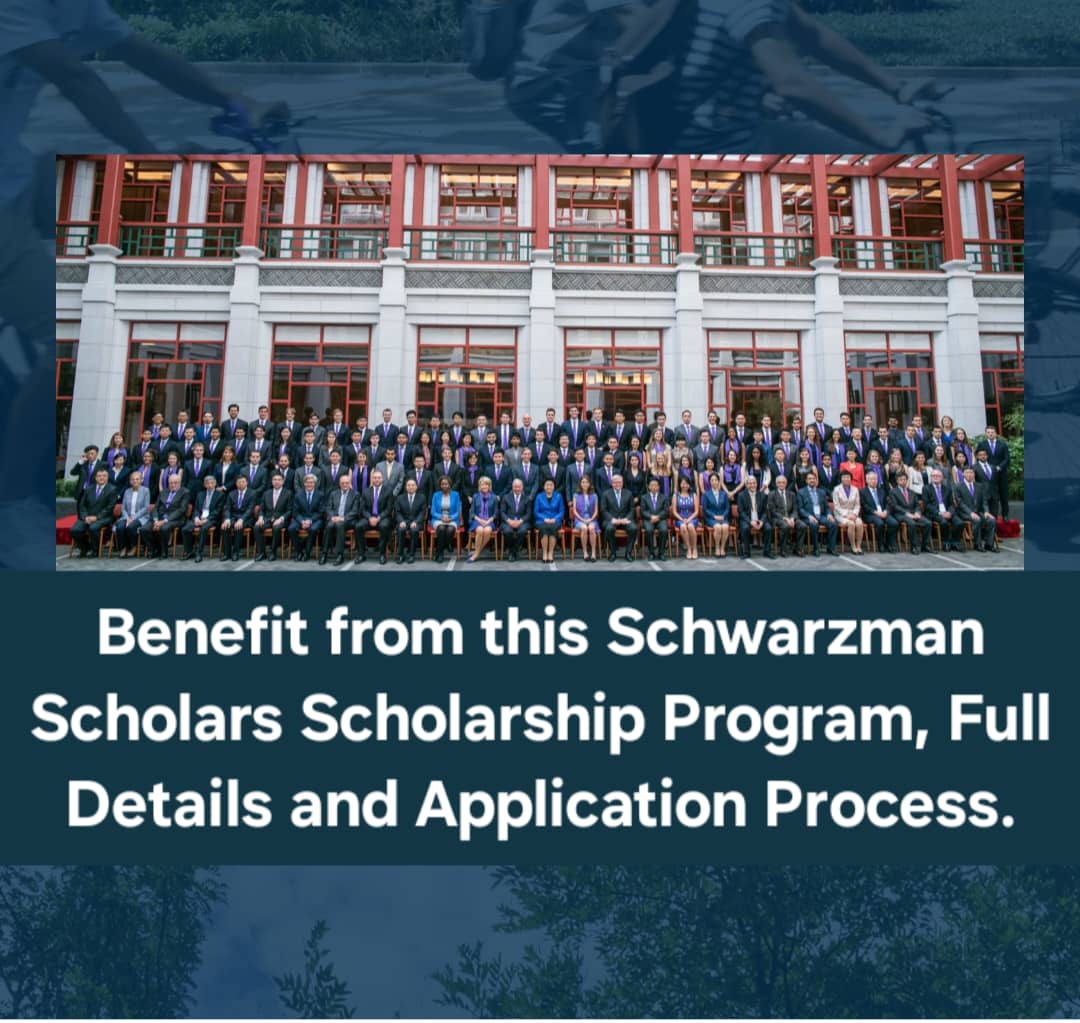
Schwarzman Scholars Program 2028–2029: Fully Funded Master’s Scholarship at Tsinghua University, China
If I were looking for a fully funded master’s scholarship that combines postgraduate education, international exposure, and leadership development, the Schwarzman Scholars Program would be one of the opportunities I would investigate carefully.
Based at Tsinghua University in Beijing, China, the Schwarzman Scholars Program brings together outstanding young people from different countries, academic backgrounds, and professional fields.
It is designed for people who want to understand China’s role in the world, develop their leadership abilities, and learn how to work across cultural and professional boundaries.
Unlike a scholarship that simply pays university tuition, Schwarzman Scholars offers a complete residential academic experience.
The programme covers tuition and fees, accommodation and meals, travel to and from Beijing, an in-country study tour, health insurance, and a stipend for personal expenses. Scholars also participate in academic activities, leadership development, mentorship, and discussions with experienced professionals and global leaders.
For applicants from Africa, Europe, Asia, North America, and other regions, the opportunity is open to eligible candidates from many academic disciplines.
You do not need to have studied international relations, politics, or economics as an undergraduate. What matters is whether you meet the eligibility requirements and can demonstrate academic ability, leadership potential, integrity, intellectual curiosity, and an interest in understanding different perspectives.
However, I would not approach this as an ordinary scholarship application. Schwarzman Scholars look beyond grades and certificates. Applicants must explain their leadership experiences, demonstrate how they think about important issues, and show why a year studying global affairs in China would contribute to their future plans.
The written application, recommendation letters, and short video introduction each provide a different opportunity to demonstrate these qualities.
Important application update: As of October 2026, applications for the 2027–2028 class have closed.
The next U.S. and Global application cycle is scheduled for April–September 2027, with the programme beginning in August 2028. Applicants with Chinese citizenship must follow the separate China application timetable.
In this guide, I’ll explain the programme’s benefits, eligibility requirements, application documents, selection process, and practical steps prospective applicants can take before the next application window opens.
Schwarzman Scholars Program 2028–2029: Quick Overview
Here are the key details to know before preparing an application.
Programme name: Schwarzman Scholars
Host university: Tsinghua University
Study location: Beijing, China
Study level: Master’s degree
Programme duration: One year
Academic focus: Global affairs, leadership, and China’s role in the world
Scholarship type: Fully funded
Eligible nationalities: Eligible applicants from countries around the world, subject to the programme’s citizenship and application-route rules
Age requirement: Applicants must be at least 18 but not yet 29 on 1 August of the year they enrol
Academic requirement: An undergraduate degree completed before the programme’s required date
Language requirement: English proficiency
Required application materials: CV or résumé, two essays, academic transcripts, three recommendation letters, and a short video introduction
Next U.S. and Global application period: April–September 2027
Next Chinese-citizenship application period: March–May 2027
Expected programme start: August 2028
Official website: Schwarzman Scholars
The official application website should always be checked for the latest deadlines, eligibility rules, and submission instructions. The programme operates separate application processes for U.S. and Global applicants and applicants with Chinese citizenship.
What Is the Schwarzman Scholars Program?
The Schwarzman Scholars Program is a fully funded, one-year master’s degree and leadership programme at Tsinghua University in Beijing.
It was established to help prepare young leaders for a world in which understanding China’s role in international affairs, business, technology, and global development is increasingly important.
The programme brings together scholars from different countries and professional backgrounds. Instead of concentrating exclusively on one academic subject, it combines the study of global affairs with leadership development, cultural learning, and opportunities to engage with experienced professionals.
The intention is to help scholars understand complex international issues from multiple perspectives and develop the knowledge and relationships needed to contribute to their chosen fields.
The programme is particularly relevant to applicants who are interested in international cooperation, public policy, economics, business, technology, diplomacy, global development, or other areas connected to international affairs.
However, an applicant does not need to have followed a traditional international relations career path. Students and young professionals from a wide range of academic backgrounds are eligible to apply if they meet the programme’s requirements and can explain how participation would support their leadership development.
Why Is the Programme Based in China?
China plays an important role in international trade, investment, technology, diplomacy, and global development.
Understanding the country requires more than reading international news or studying its economy from a distance. Living and studying in Beijing provides scholars with an opportunity to experience a different cultural and academic environment while examining China’s relationship with the wider world.
The programme is designed around this opportunity.
Scholars study global affairs, participate in cultural and academic activities, and engage with people whose experiences and perspectives may differ significantly from their own.
For someone who intends to work in international development, business, government, research, diplomacy, or another internationally connected field, this exposure can contribute to a more informed understanding of global challenges.
Is Schwarzman Scholars a Master’s Scholarship?
Yes. Schwarzman Scholars is a one-year master’s degree programme at Tsinghua University.
It is not simply a short leadership workshop or a non-degree fellowship. Scholars complete a structured academic programme focused on global affairs while participating in leadership development and cultural learning activities.
What Does the Schwarzman Scholars Scholarship Cover?
One of the most attractive features of the programme is the breadth of its financial support.
The official programme information lists several components of the comprehensive scholarship.
1. Tuition and University Fees
The scholarship covers tuition and programme fees.
This removes the need for selected scholars to pay the standard tuition costs associated with the funded programme themselves.
For applicants comparing postgraduate opportunities, it is worth distinguishing this comprehensive award from scholarships that provide only a partial tuition discount.
2. Accommodation and Meals
The scholarship includes room and board.
This is particularly important because accommodation and everyday living costs can make studying overseas expensive, even when tuition fees are covered.
Scholars live in the programme’s residential academic environment at Schwarzman College, where they can study and interact with other members of the international cohort.
3. Travel to and From Beijing
The comprehensive scholarship includes travel to and from Beijing.
Applicants should still follow the programme’s official travel arrangements and instructions rather than independently assuming that any particular booking or expense will be reimbursed.
4. An In-Country Study Tour
The programme includes an in-country study tour.
This provides an opportunity to learn about China beyond the classroom and engage with aspects of the country’s society, economy, culture, and development.
The experience complements the academic programme by giving scholars additional context for discussions about China’s role in global affairs.
5. Health Insurance
Health insurance is included in the scholarship package.
Applicants should review the programme’s current information to understand the arrangements and any instructions they need to follow before travelling.
6. A Stipend for Personal Expenses
The scholarship also provides a stipend for personal expenses.
This support helps scholars manage everyday personal costs during the programme.
The official website does not specify the stipend amount on the general programme overview, so I would not rely on an unverified figure copied from another scholarship website. Applicants should consult the official programme documentation for the latest financial details.
The full list of benefits is available on the official Schwarzman Scholars programme experience page.
Who Can Apply for the Schwarzman Scholars Program?
The programme welcomes eligible applicants from a wide range of academic and professional backgrounds. However, candidates must meet specific requirements relating to age, education, English proficiency, and citizenship or application route.
Before preparing an application, I would check each requirement against the official admissions information.
1. Applicants Must Have an Undergraduate Degree
Applicants must hold an undergraduate degree from an accredited college or university.
Students who are still completing their undergraduate studies may apply if they are on track to finish all degree requirements before the programme’s specified date.
For the 2028–2029 class, the official instructions state that applicants must have their undergraduate degree conferred by 1 August 2028.
This means applicants who are still at university should check their expected graduation date carefully.
If your university will not formally award your degree before the required date, you should not assume that completing your final examinations alone will satisfy the condition. Contact the programme if your university’s graduation arrangements create uncertainty.
2. Applicants Must Meet the Age Requirement
Candidates must be at least 18 but not yet 29 years old as of 1 August of the year in which they enrol.
For the 2028–2029 class, the relevant date is 1 August 2028.
I would calculate my age against that specific date rather than the date on which I submit the application.
Being within the required age range when the application opens is not necessarily sufficient if you fall outside the limit by the programme’s specified enrolment date.
3. Applicants Must Demonstrate English Proficiency
All teaching is conducted in English, so applicants must demonstrate strong English-language skills.
The programme accepts several forms of evidence, including approved English proficiency tests.
Some applicants may qualify for a waiver if they have completed at least two years of undergraduate study in an institution where English was the primary language of instruction or have studied in English for at least two years at master’s level or higher.
The official admissions page lists these English proficiency requirements:
TOEFL iBT: Minimum score of 100 out of 120
IELTS Academic: Minimum overall score of 7.0
Cambridge English: C1 Advanced or C2 Proficiency, with a minimum score of 185
Duolingo English Test: Minimum score of 130
Applicants should verify the current requirements and any applicable test exemptions before registering for an examination.
If I needed an English test, I would check the accepted test formats, score requirements, validity period, and submission procedure before paying for an examination.
I would also avoid assuming that being a citizen of an English-speaking country automatically grants an exemption.
The programme’s stated exemption rules concern the language of instruction in previous degree studies, so applicants should confirm how those rules apply to their circumstances.
4. Applicants From All Academic Disciplines Can Apply
One of the programme’s useful features is that it does not require applicants to have studied a particular undergraduate subject.
Candidates may come from fields such as:
Business and economics
Political science
International relations
Law
Engineering
Medicine and public health
Computer science and technology
Environmental studies
Education
Social sciences
Humanities
Journalism and communications
International development
This list is illustrative rather than a list of separate scholarship categories. The programme accepts applicants from different disciplines, provided they meet the requirements and can explain how Schwarzman Scholars would contribute to their leadership development.
For example, an engineering graduate interested in technology policy could explain how a deeper understanding of international affairs would support their future work. A public health graduate might connect their interests to international cooperation and health policy.
The important question is not simply what subject you studied. It is how the programme fits your experience, ambitions, and potential contribution to your field.
5. Applicants Must Demonstrate Leadership Potential
Leadership is central to the selection process.
The programme looks for candidates who can demonstrate leadership ability, integrity, academic strength, empathy, intercultural competence, open-mindedness, and an entrepreneurial spirit.
Leadership does not necessarily mean holding a senior corporate position or leading a large organisation.
Depending on the applicant’s experience, it might involve starting a community project, coordinating a student initiative, improving a process at work, organising a team, developing a social enterprise, or taking responsibility for a meaningful project.
What matters is the evidence behind the claim.
If I were describing a leadership experience, I would explain what the problem was, what responsibility I took, how I worked with other people, and what changed as a result.
A title alone tells the selection committee very little. A specific account of decisions, challenges, and results gives a clearer picture of the applicant’s abilities.
6. Applicants Must Meet the Citizenship and Application-Route Rules
Schwarzman Scholars has separate application processes for U.S. and Global applicants and applicants with Chinese citizenship.
For the U.S. and Global route, applicants generally must be non-Chinese citizens holding an ordinary passport from a country other than China. Additional nationality rules may apply to individuals born in China or whose parents were Chinese citizens at the time of their birth.
Applicants with Chinese citizenship, including those holding passports from the Chinese mainland, Hong Kong, Macau, or Taiwan, must follow the separate China application process.
This distinction is important because the application periods, eligibility checks, and selection schedules differ.
If your citizenship history is complicated, I would review the official instructions before investing time in the application. It is better to clarify eligibility at the beginning than to discover a problem after completing the essays and arranging recommendations.
Are African Students Eligible for Schwarzman Scholars?
Yes. Eligible applicants from African countries can apply through the appropriate U.S. and Global application process, subject to the programme’s citizenship, age, academic, and English-language requirements.
The programme aims to build a cohort representing different regions, industries, academic backgrounds, and professional experiences.
For African applicants, this means the application should communicate more than nationality or a general desire to study abroad. It should explain the applicant’s own leadership journey and how the programme fits their future plans.
For example, an applicant working in public health might discuss an experience coordinating a community health initiative.
A graduate involved in technology could explain a project addressing a practical problem in their community. Someone working in business or public policy might describe a challenge they have investigated and the role they hope to play in addressing it.
These are examples of possible experiences, not requirements imposed by the programme.
I would concentrate on explaining what I have actually done, what I learned, and how the experience shaped my understanding of leadership.
Applicants should also remember that the scholarship is not reserved for people whose work is limited to their home country. The programme is concerned with leadership potential and global understanding, so the relevant connection will depend on each applicant’s experience and goals.
What Qualities Do Schwarzman Scholars Look For?
The admissions committee evaluates candidates across several areas. Understanding these qualities helps applicants prepare a more coherent application.
Leadership Abilities
The programme looks for evidence that applicants can take responsibility, work with others, respond to challenges, and contribute to meaningful outcomes.
Leadership may come from professional work, volunteering, academic projects, entrepreneurship, or community involvement.
The strongest examples are specific. They explain the applicant’s actual contribution rather than giving a vague description of a group’s achievements.
Exemplary Character and Integrity
Integrity concerns how an applicant handles responsibility, decisions, and relationships with others.
An applicant can demonstrate this through a real experience involving accountability, ethical judgement, honesty, or difficult decisions.
I would not try to present myself as someone who has never made a mistake. A thoughtful explanation of how I handled a difficult situation and what I learned can provide a more realistic account of my character.
Academic Ability and Intellectual Curiosity
Applicants need to demonstrate that they can handle the programme’s academic demands.
Academic transcripts provide evidence of previous performance, but the application also offers opportunities to demonstrate how an applicant thinks, analyses problems, and engages with complex ideas.
I would make sure my application explains my interests clearly and demonstrates an ability to examine issues rather than simply state opinions.
Empathy and Intercultural Competence
Schwarzman Scholars bring together people with different nationalities, experiences, and perspectives.
The programme therefore values applicants who can listen carefully, work with people whose views differ from their own, and approach cultural differences thoughtfully.
A useful example might involve working with a diverse team, collaborating across communities, or learning from people affected by a problem you were trying to address.
The goal is not to claim that you understand every culture. It is to show that you are willing to listen, learn, and engage respectfully.
Open-Mindedness
Open-mindedness means being willing to examine assumptions and consider evidence that challenges your existing beliefs.
Applicants can demonstrate this through an experience in which they changed their approach after receiving feedback, learned from a different perspective, or revised their understanding of an issue.
Entrepreneurial Spirit
The programme values applicants who can recognise opportunities, develop ideas, and take action.
Entrepreneurial spirit is not limited to founding a business. It can also appear in community initiatives, research projects, workplace improvements, or efforts to solve a problem with limited resources.
The important element is initiative: identifying a need and taking meaningful steps to address it.
Required Documents for the Schwarzman Scholars Application
The application requires several supporting materials. Applicants should prepare them carefully and follow the official instructions for the relevant cycle.
For the U.S. and Global application, the main components include:
- An up-to-date résumé or CV
- A leadership essay
- A statement of purpose
- Academic transcripts
- Three letters of recommendation
- A short video introduction
The official admissions page lists a maximum of two pages for the résumé, a 750-word limit for the leadership essay, a 500-word limit for the statement of purpose, and a video introduction of no more than one minute.
1. Résumé or CV
Applicants must submit a current résumé or CV of no more than two pages.
This is not the place to include every activity from your entire academic and professional history. The goal is to present the information most relevant to your qualifications, achievements, leadership, and experience.
Depending on your background, your résumé might include:
Educational qualifications
Employment history
Leadership roles
Community projects
Volunteering
Entrepreneurship
Research
Awards and recognition
Relevant extracurricular activities
Other achievements that help explain your experience
If I were preparing the résumé, I would pay attention to the description of each role.
For example, instead of writing only that I was a project coordinator, I would explain what I coordinated, who was involved, and what the project achieved. If I have a measurable result, I would include it only if I can substantiate it.
I would also check that the dates, job titles, and achievements match the rest of my application.
2. Leadership Essay — 750 Words
The leadership essay is an opportunity to explain your leadership experience and potential.
The official word limit is 750 words.
I would begin by identifying a real experience that allows me to demonstrate leadership through decisions and actions.
A useful structure is:
Context: What was happening?
Challenge: What needed to change or be addressed?
Responsibility: What was your role?
Action: What did you actually do?
Outcome: What happened as a result?
Reflection: What did you learn about leadership?
These headings are a planning tool, not an official essay template.
The most important part is to make your own contribution clear. If you were part of a team, explain what the team accomplished and what you personally contributed.
I would also avoid turning the essay into a list of leadership positions. One or two carefully explained experiences may communicate more than several paragraphs that simply name organisations and titles.
The essay should sound like a thoughtful account of your own development, not a generic description of what makes a good leader.
3. Statement of Purpose — 500 Words
The statement of purpose has a maximum of 500 words.
It should explain why you want to join Schwarzman Scholars and how the programme fits your academic, professional, and leadership goals.
This essay should complement the leadership essay rather than repeat it.
If the leadership essay explains how you have handled responsibility, the statement of purpose can explain what you want to learn, why the programme is relevant to your goals, and how you expect to use the experience.
I would address questions such as:
Why is the study of global affairs relevant to my future plans?
What do I hope to understand about China and its role in the world?
Which experiences have shaped my interests?
How would the programme help me develop as a leader?
What contribution do I hope to make after completing the programme?
The best answers will depend on the applicant’s actual background. There is no need to invent an international career ambition if your genuine interest comes from a local or regional problem with wider implications.
I would make the connection between my past experience, the programme, and my future goals clear.
Important: The official application requires applicants to confirm that their written work was composed by them and that AI generators were not used to create submitted application materials. Therefore, use this article as general information about the process, not as text to copy into your essays. Your submitted essays must follow the programme’s own authorship rules.
4. Academic Transcripts
Applicants must submit academic transcripts for each degree-granting post-secondary institution attended.
The application instructions explain how to enter educational history and upload the required records. Applicants should follow the specific instructions for the relevant cycle.
Before applying, I would gather the correct transcript for each institution and check that the documents are legible.
I would also ensure that the degree information in the application matches the transcripts. If a grading system requires explanation, I would use the space provided by the application rather than assuming the committee will interpret it automatically.
If you are still completing your undergraduate degree, check the deadline for conferral and make sure you can meet the programme’s requirement.
5. Three Letters of Recommendation
The programme requires three recommendation letters.
The official guidance recommends choosing people who know the applicant well enough to discuss their intellectual abilities, leadership potential, personal characteristics, and character using specific examples.
The recommendation requirements include:
One academic recommendation from a professor who can discuss your academic abilities.
One leadership-focused recommendation from someone who can give examples of your leadership and potential.
One additional recommendation from a person who can provide further insight into your academic abilities, leadership, or character.
The third recommender may be an employer, mentor, academic, or another appropriate person, depending on the applicant’s background.
I would choose recommenders based on what they can genuinely say about my work, not simply their job titles or seniority.
A professor who has supervised your research may be able to discuss your analytical ability in detail. A manager who has watched you lead a project may be able to describe how you handle responsibility and work with colleagues.
I would contact recommenders early, explain the programme, and give them the information they need to understand the application.
The programme accepts recommendation letters submitted online. Applicants should follow the official instructions for entering recommender details and monitoring submission status.
6. One-Minute Video Introduction
Applicants must provide a short video introduction of no more than one minute.
The purpose is to allow the selection committee to hear the applicant introduce themselves in their own voice and style. The official instructions allow applicants to choose a style or setting that conveys their interests and personality.
I would keep the video simple and focus on introducing myself clearly.
Before recording, I would decide what I want the committee to understand about me, then practise enough to speak naturally without sounding as though I am reading a speech.
I would check the sound, lighting, framing, and video link. The official instructions require a shareable, unlisted YouTube or Vimeo link and warn applicants not to password-protect the video.
The video does not need elaborate editing or expensive equipment. The priority is to make sure the committee can see and hear you clearly.
How to Apply for the Schwarzman Scholars Program 2028–2029
The next U.S. and Global application cycle is scheduled to open in April 2027 and close in September 2027. The programme is expected to begin in August 2028. Applicants with Chinese citizenship follow a separate schedule.
Although the next application window is not yet open, there are several useful steps prospective applicants can take now.
Step 1: Check Your Eligibility
Start with the official Schwarzman Scholars admissions page.
Check the age requirement, undergraduate degree completion date, English proficiency rules, and citizenship or application-route requirements.
I would confirm these details before spending time preparing essays or contacting recommenders.
Step 2: Understand the Programme
Read about the curriculum, leadership development, residential experience, and scholarship benefits.
The official programme experience page explains what scholars study and what the comprehensive scholarship covers.
This research will help you decide whether the programme fits your goals and prepare you to explain your interest accurately.
Step 3: Identify Experiences That Demonstrate Leadership
Before the application opens, I would review my academic, professional, and community experiences.
I would identify examples that demonstrate responsibility, initiative, teamwork, problem-solving, or the ability to learn from people with different perspectives.
For each experience, I would make a few private notes about the challenge, my role, the action I took, and the outcome.
These notes can help me reflect on my experiences before writing my own application materials. They are not a substitute for the programme’s authorship requirements.
Step 4: Contact Potential Recommenders
Choose three people who can provide relevant, detailed recommendations.
I would contact them well before the application deadline, explain the programme and its requirements, and ask whether they would be comfortable supporting my application.
I would also check whether my university has an internal fellowship adviser or nomination process. The programme notes that some universities establish internal procedures or earlier deadlines for their students.
Step 5: Prepare Your Academic Records
Locate the transcripts for all degree-granting post-secondary institutions you have attended.
Check whether you need to request official copies and how long your institutions take to issue them.
If you are still studying, confirm when your undergraduate degree will be formally conferred.
Step 6: Check English Proficiency Requirements
If you need to submit an English test result, confirm which tests are accepted and whether you qualify for an exemption.
Do not register for an examination based on information from an old scholarship announcement. Requirements can change, and the official website should be your reference.
Step 7: Create an Application Account When the Window Opens
When the relevant application period opens, follow the instructions on the official application page.
The application must be completed in English and submitted electronically. Applicants can save their progress and return to the form before final submission.
I would use an email address that I can access throughout the selection process and check it regularly for application updates.
Step 8: Complete the Application Carefully
Prepare the résumé, two essays, transcripts, recommendation requests, and video introduction according to the official instructions.
Before submitting, check that the correct files have been uploaded and that all required sections are complete.
The programme states that submitted applications are final and cannot be reopened for further editing. That makes a careful final review especially important.
Step 9: Submit Before the Official Deadline
The application must be submitted by the deadline announced for the relevant cycle.
Do not assume that the closing date will be the same as a previous year. The next U.S. and Global application period is currently scheduled for April–September 2027, but applicants should check the official website for the exact closing date when the application opens.
I would aim to submit early enough to deal with a missing recommendation or technical issue rather than waiting until the final hours.
Step 10: Monitor Your Application Status
After submission, use the application status page to monitor your application and recommendation letters.
The official instructions explain that applicants can review their submitted materials and check the status of recommendation letters through the application system.
I would continue checking my email and application account until the selection process is complete.
How Does the Schwarzman Scholars Selection Process Work?
The selection process is designed to assess candidates’ academic ability, leadership potential, character, and suitability for the programme.
It involves an online application, supporting documents, application review, and interviews for selected candidates.
Stage 1: Online Application
Applicants complete the online form and submit the required materials in English.
The written components allow the committee to examine the applicant’s academic background, leadership experience, interests, and reasons for applying.
Stage 2: Review of Supporting Documents
The application is reviewed by a committee of leaders from business, government, and academia.
Candidates are assessed on their academic strength, achievements, leadership abilities, character, and potential to contribute to the programme’s mission.
A strong application should therefore present a coherent picture of the applicant. The CV, essays, academic records, and recommendations should complement one another.
Stage 3: Interview Invitation
A select group of applicants is invited to interviews.
For the 2027–2028 cycle, the programme described interviews taking place in late October and early November. Dates for the 2028–2029 cycle should be confirmed when the next official schedule is published.
The interview provides an opportunity for the panel to understand the applicant beyond the written application.
Stage 4: Interview With an International Panel
Interviews are conducted by an international panel of experienced leaders from different backgrounds.
Applicants may be asked to discuss their leadership experiences, academic interests, future plans, and perspectives on complex issues.
If I were invited to interview, I would revisit everything I had written in my application and make sure I could discuss it naturally.
I would also practise explaining my reasoning, listening carefully to questions, and responding thoughtfully when I did not know an answer.
The goal would not be to memorise impressive phrases. It would be to communicate clearly, demonstrate intellectual curiosity, and explain my experiences honestly.
Stage 5: Final Admissions Decision
Following the selection process, the programme determines which applicants will join the incoming cohort.
Because the scholarship is highly competitive, meeting the minimum eligibility requirements does not guarantee an interview or an offer.
I would treat every stage seriously while recognising that the final decision depends on the complete application and the programme’s selection process.
How Competitive Is the Schwarzman Scholars Program?
Schwarzman Scholars is highly selective. It attracts applicants with strong academic records, leadership experience, and achievements across a wide range of fields.
The programme does not publish a universal minimum GPA that guarantees eligibility or selection. Its FAQ explains that grading systems differ internationally and that academic performance is assessed in context.
Competitive applicants are generally expected to have demonstrated strong academic ability.
This means applicants should not rely on grades alone.
A high academic average may demonstrate intellectual ability, but the application also needs to communicate leadership potential, character, and the applicant’s reasons for wanting to join the programme.
Similarly, a person with substantial leadership experience should not overlook the academic requirements or assume that professional achievements compensate for missing eligibility conditions.
I would aim to present a balanced application that accurately explains both my academic preparation and my leadership experience.
What Can Make an Application More Convincing?
There is no formula that guarantees selection, but several practical considerations can help applicants prepare a clearer application.
Use Specific Examples
If you describe yourself as a leader, provide evidence.
Explain the problem you faced, the decision you made, the people you worked with, and the outcome. Avoid making broad claims that are not supported by actual experience.
Make Your Personal Contribution Clear
If you worked on a team project, distinguish between the team’s overall achievement and your individual role.
The committee needs to understand what you did, not only what the organisation accomplished.
Connect Your Experience to Your Goals
The statement of purpose should explain how Schwarzman Scholars fits your future plans.
I would make the connection between my previous experience, the programme’s focus on global affairs and China, and the contribution I hope to make in my field.
Choose Recommenders Who Know Your Work
A detailed recommendation from someone who has directly observed your work can provide useful evidence of your abilities.
I would choose recommenders who can give concrete examples rather than selecting people solely because they hold senior positions.
Follow the Instructions Exactly
Respect the word limits, document requirements, video duration, and submission procedure.
The official admissions team discourages applicants from submitting additional materials that are not requested, such as portfolios, writing samples, or extra recommendation letters. These materials will not be shared with the review committee.
Submitting extra documents is therefore not a reliable way to strengthen an application.
Common Mistakes to Avoid
1. Focusing Only on the Financial Benefits
The fully funded scholarship is a major benefit, but an application that discusses only the desire to study abroad may not adequately explain why the programme is relevant to the applicant.
I would explain the academic and leadership reasons for applying alongside the financial benefits.
2. Treating Leadership as a Job Title
Holding a position does not automatically demonstrate effective leadership.
Applicants should describe what they actually did, the decisions they made, and what they learned.
3. Repeating the Same Story in Both Essays
The leadership essay and statement of purpose serve different purposes.
The leadership essay should demonstrate leadership through experience. The statement of purpose should explain why the programme fits the applicant’s goals.
Some overlap may be natural, but I would make sure the essays provide complementary information rather than repeating the same story in different words.
4. Choosing Recommenders at the Last Minute
Recommendation letters require time and coordination.
A recommender may need to review the programme information, consider examples from their experience with you, and complete the online submission.
I would contact recommenders early and follow up respectfully before the deadline.
5. Ignoring the English Test Requirements
Applicants who need English proficiency scores should check the official requirements and any exemption rules before making plans.
Assuming that a previous test score or a particular educational background will automatically qualify can create unnecessary problems.
6. Uploading Unrequested Documents
The programme asks applicants to submit specific supporting materials and discourages additional documents that are not requested.
I would follow the official checklist rather than adding a portfolio or extra recommendation letters in the hope that more documents will improve the application.
7. Waiting Until the Deadline
The application includes several separate components, including three recommendation letters and a video introduction.
Waiting until the final days creates avoidable risks, particularly if a recommender has not submitted a letter or an uploaded document needs correction.
8. Using AI-Generated Application Essays
The official application requires applicants to affirm that their written work was composed by them and that AI generators were not used to create materials submitted as part of the application.
Applicants should take this rule seriously. Do not copy AI-generated essays into the application or use a prepared scholarship article as a substitute for your own writing.
The safest approach is to read the official requirements, reflect on your own experiences, and write the application materials yourself in accordance with the programme’s rules.
Schwarzman Scholars Application Deadline 2028–2029
The application schedule differs according to the applicant’s citizenship and application route.
U.S. and Global Applicants
The next application period is scheduled for April–September 2027.
The selection cycle is expected to take place between October and November 2027, and the programme is scheduled to begin in August 2028.
Applicants With Chinese Citizenship
Applicants with Chinese citizenship, including those using the China application route for the Chinese mainland, Hong Kong, Macau, or Taiwan, follow a separate timetable.
For the next cycle, the official schedule lists an application period of March–May 2027, with selection expected between June and July 2027. The programme is scheduled to begin in August 2028.
Has the 2027–2028 Application Closed?
Yes. As of October 2026, the U.S. and Global application window for the 2027–2028 class has closed.
Applicants preparing for the next cohort should follow the official website for updated dates and instructions rather than relying on the previous cycle’s deadline.
Frequently Asked Questions About Schwarzman Scholars
1. Is the Schwarzman Scholars Program fully funded?
Yes. The comprehensive scholarship includes tuition and fees, room and board, travel to and from Beijing, an in-country study tour, health insurance, and a stipend for personal expenses.
2. Where is the Schwarzman Scholars Program located?
The programme is based at Tsinghua University in Beijing, China.
3. How long does the programme last?
It is a one-year master’s degree and leadership programme.
4. Can African students apply?
Yes. Eligible African applicants can apply through the appropriate U.S. and Global application route, subject to the programme’s age, academic, English-language, and citizenship requirements.
5. Do I need to study international relations before applying?
No. The programme accepts applicants from a wide range of undergraduate disciplines. Applicants should explain how participating in Schwarzman Scholars will contribute to their leadership development within their chosen field.
6. What is the age limit?
Applicants must be at least 18 but not yet 29 years old on 1 August of the year they enrol. For the 2028–2029 class, the relevant date is 1 August 2028.
7. Is there a minimum GPA requirement?
The programme’s FAQ states that there is no universal minimum GPA or class-rank requirement because grading systems vary across countries and institutions. However, strong academic performance is an important part of the selection process.
8. Is IELTS required?
Applicants who need to demonstrate English proficiency can use an accepted test such as IELTS, TOEFL, Cambridge English, or the Duolingo English Test. Some applicants may qualify for an exemption based on their previous English-medium degree studies. Check the official admissions page for the current scores and exemption rules.
9. How many recommendation letters are required?
Three recommendation letters are required. Applicants should choose people who can discuss their academic abilities, leadership potential, and character with specific examples.
10. What essays are required?
The application requires a 750-word leadership essay and a 500-word statement of purpose. Applicants should follow the current official instructions and write their own application materials in accordance with the programme’s authorship rules.
11. Is a video introduction required?
Yes. The application requires a short video introduction of no more than one minute. The official instructions specify a shareable, unlisted YouTube or Vimeo link without password protection.
12. When will applications open for the 2028–2029 class?
The U.S. and Global application period is scheduled for April–September 2027. Applicants with Chinese citizenship follow the separate March–May 2027 schedule. Confirm the exact deadlines on the official website when the next application window opens.
13. Can I apply if I have not yet graduated?
You may apply if you are currently completing an undergraduate degree and are on track to satisfy the programme’s degree-completion requirement. For the 2028–2029 class, the degree must be conferred by 1 August 2028.
14. Where can I submit an application?
Applications are submitted online through the official Schwarzman Scholars application instructions page.
Final Conclusion
The Schwarzman Scholars Program offers more than financial support for postgraduate study. It combines a fully funded master’s degree at Tsinghua University with leadership development, cultural learning, and opportunities to engage with global affairs from within China.
For the 2028–2029 cohort, the next U.S. and Global application period is scheduled to open in April 2027. Applicants with Chinese citizenship will follow the separate application timetable.
If I were preparing for the next cycle, I would use the months before applications open to check my eligibility, gather academic records, reflect on meaningful leadership experiences, and identify three recommenders who know my work well.
I would also read the programme’s official instructions closely, particularly the requirements for the essays, video introduction, and recommendation letters.
The central task is to present an honest, coherent account of who you are, what you have done, what you hope to learn, and how the programme fits your future direction.
Official links:
- Schwarzman Scholars Admissions
- Application Instructions
- Programme Experience and Scholarship Benefits
- Frequently Asked Questions
If you are interested in this scholarship and wish to start your application right now visit the official application portal for the Schwarzman Scholars.
Other scholarships opportunities to apply for today.
Apply for Research Opportunities, The Norway Mobility Scholarship 2027 in Norway (Fully Funded)
Apply for Research Opportunities, The Norway Mobility Scholarship 2027 in Norway (Fully Funded)
Apply for SEARCA Research Scholarship Program 2026–2027: A Funding for Master’s and PhD Students
The Complete Application Guide to Swedish Scholarships for Africans in 2026.
How to Apply for the CSC Scholarship, The complete guides
See the Lists of Scholarships in University of Leicester, And Their Application Steps
Fully Funded University of Cologne Humanities Scholarship, Details and Application Process
Discover more from Scholars Africa
Subscribe to get the latest posts sent to your email.

About Scholars Africa Editorial Team
Scholars Africa Editorial Team is dedicated to researching and publishing verified scholarships, jobs, and global opportunities. Our content is built on extensive analysis of application trends, eligibility criteria, and selection patterns to help applicants succeed at every stage. Our team has reviewed hundreds of scholarship programs and application processes across multiple countries.