Are you interested in journalism, international media, digital storytelling, or broadcasting? Would you like to develop your reporting skills with an international broadcaster while learning how modern journalism works across television, digital platforms, data, and artificial intelligence?
The DW Traineeship 2028–2029 could be an opportunity worth exploring.
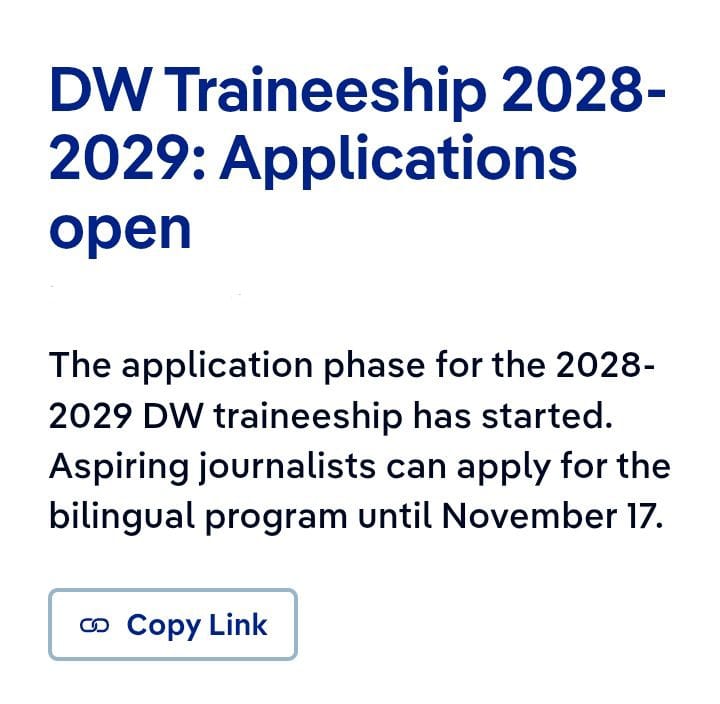
Deutsche Welle (DW), Germany’s international broadcaster, has opened applications for its 18-month international journalism traineeship.
The programme is designed for people who want to develop their journalistic skills, understand the changing media landscape, and prepare for careers in international journalism.
For the 2028 intake, DW plans to select just 12 trainees. Successful applicants will participate in a bilingual journalism programme that combines professional training, seminars, workshops, and exposure to DW’s editorial operations.
The traineeship is scheduled to begin in January 2028 and end in June 2029. Applications opened on October 13, 2026, and the stated deadline is November 17, 2026.
One detail applicants should pay attention to is that registering on the application portal is not the end of the process. After registration, candidates receive an email containing mandatory application tasks. Those tasks must be completed and uploaded to the applicant’s profile before the deadline.
This is where planning becomes important. If you intend to apply, you need to understand the programme, prepare your application carefully, and leave enough time to complete every required task.
In this guide, I explain the DW Traineeship 2028–2029, including its benefits, eligibility requirements, application dates, selection process, and practical steps for preparing a strong application.
1. What Is the DW Traineeship 2028–2029?
The DW Traineeship is an 18-month journalism training programme offered by Deutsche Welle, Germany’s international broadcaster.
It is designed for aspiring journalists who want to build professional reporting skills and understand how journalism operates in an international media organisation.
The programme combines practical and theoretical learning. Trainees explore different journalistic formats and techniques, with training covering areas such as television presentation, multimedia storytelling, data journalism, and the use of artificial intelligence tools in journalism.
Training activities take place through seminars and workshops at DW’s editorial offices in Bonn and Berlin, alongside exposure to its regional bureaus around the world.
This broad approach is important because journalism today involves more than writing articles or presenting television news. Reporters may need to verify information, interpret data, produce video, develop stories for digital platforms, and communicate with audiences across different countries.
The DW Traineeship aims to prepare participants for this changing professional environment.
Key details about the DW Traineeship 2028–2029
| Programme detail | Information |
| Programme name | DW International Journalism Traineeship |
| Organisation | Deutsche Welle (DW) |
| Country | Germany |
| Programme duration | 18 months |
| Start date | January 2028 |
| End date | June 2029 |
| Application opening date | October 13, 2026 |
| Application deadline | November 17, 2026 |
| Application deadline time | 12:00 CET, as stated in the announcement |
| Number of available places | 12 |
| Programme format | Bilingual journalism traineeship |
| Training areas | Television moderation, multimedia storytelling, data journalism, AI tools, and other journalistic skills |
| Locations mentioned | Bonn and Berlin, with exposure to DW regional bureaus |
| Age limit | No age limit |
| Compensation | Paid traineeship; the supplied announcement does not state the exact salary |
| Application method | Online only |
| Official application portal | DW Jobs |
Important deadline note: The announcement gives the application period as October 13, 2026, at 12 p.m. CEST through November 17, 2026, at 12 p.m. CET. Because daylight-saving arrangements differ between those dates, applicants should follow the deadline displayed on DW’s official application portal and avoid waiting until the final hours.
2. Why Consider the DW Journalism Traineeship?
The DW Traineeship is particularly interesting for applicants who want structured journalism training in an international media environment.
Rather than concentrating on only one type of reporting, the programme covers several areas of modern journalism.
Practical journalism training
The programme includes training in a range of journalistic skills. These include television moderation, multimedia storytelling, data journalism, and working with AI tools.
This combination can help trainees understand how a story might be researched, developed, presented, and adapted for different audiences and platforms.
For someone who wants to work in broadcast or digital journalism, exposure to these different formats can be valuable.
Experience with an international broadcaster
DW operates internationally, and the traineeship offers exposure to its editorial offices and regional bureaus.
Working in an international media environment can help aspiring journalists understand how news organisations approach stories that cross national borders.
It can also expose participants to different editorial perspectives, professional expectations, and reporting methods.
Training in emerging journalistic techniques
The programme specifically mentions data journalism and AI tools.
These areas are increasingly relevant to journalism, where reporters may need to interpret datasets, investigate patterns, verify digital material, and understand how new technologies affect information production.
Applicants do not need to assume that they must already be experts in every emerging tool. Instead, they should carefully review the programme’s stated requirements and be ready to demonstrate their curiosity, critical thinking, and ability to learn.
A structured 18-month programme
The traineeship lasts 18 months, from January 2028 to June 2029. That gives participants a longer period for professional development than a short workshop or brief internship.
The programme is intended for people who want to develop journalism as a profession, so applicants should consider whether they are prepared to commit to the full training period.
A paid traineeship
DW describes the programme as paid.
However, the announcement supplied for this article does not state the exact monthly salary, net pay, housing allowance, relocation support, or other financial benefits.
Applicants should consult DW’s official information for the compensation terms and any additional conditions before making financial or relocation plans.
It is important not to confuse a paid traineeship with a fully funded scholarship. The announcement confirms that the programme is paid, but it does not provide enough information to conclude that every cost associated with participating will be covered.
3. Who Is the DW Traineeship Looking For?
DW is looking for inquisitive, open-minded, and critical-thinking individuals who are interested in journalism and want to help shape its future.
Applicants may already have a journalism background. However, DW also welcomes people who are passionate about moving into journalism from other fields, including law, economics, science, technology, and information technology.
This makes the programme relevant to more than traditional journalism graduates.
For example, someone with a science background may be interested in explaining complex scientific developments to the public.
An applicant with an economics background may want to report on international markets, public spending, or economic policy. Someone with IT experience may be interested in digital investigations, data-driven reporting, or the relationship between technology and society.
These are examples of possible professional interests, not guaranteed training specialisations or separate eligibility categories.
The key is to demonstrate a genuine interest in journalism and the ability to think critically about information.
Do you need a journalism degree?
The supplied announcement does not state that a journalism degree is compulsory.
It specifically notes that DW is interested in candidates with journalism backgrounds as well as people seeking to switch from fields such as law, economics, science, and technology or IT.
Nevertheless, applicants should review the official eligibility information and FAQ to confirm whether any educational, experience, language, or other conditions apply to the 2028 intake.
Do not assume that the absence of a stated journalism-degree requirement means there are no other entry requirements.
Is there an age limit?
No. The announcement explicitly states that there is no age limit for the traineeship.
This means applicants should not rule themselves out simply because they believe they are too old for an early-career journalism programme.
They must still meet the programme’s other requirements and demonstrate that they are suitable for the training.
Can applicants from outside Germany apply?
The programme is described as an international traineeship for people from around the world.
Applicants living outside Germany should consult the official application information for the precise nationality, residence, language, and other eligibility requirements.
They should also investigate any visa or relocation arrangements that may apply to them. The supplied announcement does not confirm whether DW provides visa assistance, relocation funding, or accommodation.
4. What Skills Can You Develop During the DW Traineeship?
The programme covers several areas of journalism. Understanding them can help you decide whether the traineeship matches your professional goals.
Television moderation
Television moderation involves presenting information clearly, asking questions, communicating with audiences, and maintaining composure in front of a camera.
It requires more than speaking confidently. A presenter must understand the subject, communicate accurately, and respond appropriately to the demands of a broadcast.
If you are interested in presenting news or conducting interviews, this training area may be especially relevant.
Multimedia storytelling
Multimedia storytelling combines different ways of communicating a story, potentially including text, photography, audio, video, graphics, and interactive elements.
Modern news audiences consume information through many channels. Journalists therefore need to understand how to adapt a story without losing its accuracy or meaning.
An applicant interested in digital journalism should think about how they communicate information to different audiences and why a particular format may be appropriate for a particular story.
Data journalism
Data journalism uses data to investigate issues, identify patterns, test claims, and explain developments.
Depending on the story, it may involve gathering information, cleaning datasets, interpreting statistics, checking sources, and presenting findings in an understandable way.
Applicants with backgrounds in economics, mathematics, science, or IT may find this area particularly interesting, although it is not limited to people with technical degrees.
If you have experience analysing information, explain what you have done and what you would like to learn next.
Artificial intelligence in journalism
DW also identifies working with AI tools as part of the programme.
Artificial intelligence is changing how journalists research, organise, and produce information. It also creates important questions about accuracy, bias, transparency, privacy, and accountability.
A critical approach is essential. Using a new tool does not remove the journalist’s responsibility to verify facts, protect sources, and follow editorial standards.
Applicants interested in this area should demonstrate curiosity about technology while recognising that journalistic accuracy and public trust remain central.
Reporting across different subjects
DW is looking for people from a range of backgrounds, including law, economics, science, and technology.
This suggests that subject knowledge can be relevant when it supports a candidate’s interest in journalism.
For instance, a science graduate might be well placed to explore how scientific findings are communicated to the public, while someone with a legal background might be interested in courts, legislation, or human rights reporting.
However, the application should focus on the candidate’s suitability for journalism rather than simply listing academic qualifications.
5. Application Dates and Important Deadlines
Applicants should keep the following dates in mind.
| Event | Date |
| Applications open | October 13, 2026, at 12:00 CEST |
| Application deadline | November 17, 2026, at 12:00 CET |
| Traineeship begins | January 2028 |
| Traineeship ends | June 2029 |
The application window is limited, and the selection process involves more than registering on the portal.
DW specifically warns that the application tasks may take time to complete. Candidates are encouraged to plan ahead and ensure that every required task is submitted before the deadline.
What should you do before the deadline?
First, open the official application portal and read the information available for the 2028 international traineeship.
Second, register during the application period and check your email for the confirmation message containing the application tasks.
Third, complete all required tasks and upload them to your application profile.
Finally, check that your profile contains everything required before the deadline.
Registration alone does not constitute a complete application. DW states that the mandatory tasks must be uploaded to the applicant’s profile before the closing time.
The announcement also states that applications must be submitted online. Documents sent by email will not be processed.
6. How to Apply for the DW Traineeship 2028–2029: Step-by-Step Guide
The following walkthrough follows the application process described in DW’s announcement.
Step 1: Visit the official DW Jobs website
Start by opening DW’s official recruitment website. Look for the international journalism traineeship for the 2028 intake. Confirm that you are viewing the correct programme and application cycle.
Do not rely on old advertisements or third-party posts when checking the deadline and application requirements.
The official portal is the authoritative source for the current application process.
Step 2: Read the programme information carefully
Before registering, read the programme description and the available frequently asked questions.
Pay attention to the eligibility conditions, language arrangements, application tasks, and selection stages.
This step matters because the supplied announcement does not list every individual requirement or reproduce the full application tasks.
If DW specifies particular documents, formats, word limits, or technical requirements, follow those instructions rather than relying on a generic application checklist.
Step 3: Register in the application portal
Once the application window is open, register through the official portal.
Use an email address you can access regularly. You will need to receive and review the confirmation email containing the application tasks.
Check your inbox after registering. If the message does not appear, check your spam or junk folder and review the portal’s instructions for assistance.
Do not assume that you can complete the process without receiving or accessing the required tasks.
Step 4: Review the mandatory application tasks
DW states that candidates receive several application tasks after registering.
These tasks are mandatory for a valid application and must be uploaded to the applicant’s profile before the deadline.
The announcement warns that they may be time-consuming.
This is one of the most important details in the application process. Do not leave all the tasks until the last day.
Read every instruction before beginning. Identify what each task asks you to do, what format is required, and whether you need to research, write, record, or prepare other material.
The supplied announcement does not reproduce the exact tasks, so applicants should obtain the task list directly from DW rather than rely on unofficial descriptions of previous recruitment rounds.
Step 5: Prepare your application materials carefully
Work through each task methodically.
If a task asks you to explain an idea, make sure you answer the actual question rather than writing a general statement about your passion for journalism.
If you are asked to develop a story idea, think about the issue, the evidence available, the people affected, and why the story matters to the intended audience.
If the task involves a journalistic format, follow the specified format and technical requirements.
These are general preparation principles, not a claim about the exact content of DW’s 2028 tasks. The official instructions determine what you must submit.
Step 6: Demonstrate curiosity and critical thinking
DW explicitly identifies inquisitiveness, open-mindedness, and critical thinking as qualities it seeks.
Your application should therefore demonstrate how you approach information, not just how enthusiastic you are about journalism.
For example, if you propose a story, consider the following questions:
What is the central issue?
Why does it matter now?
Who is affected?
What evidence supports the story?
Which perspectives need to be included?
What information still needs verification?
What assumptions should be challenged?
A well-developed idea usually becomes clearer when you can explain what you know, what remains uncertain, and how you would investigate the issue.
Avoid making dramatic claims without evidence. Journalists need to be able to distinguish between verified facts, allegations, interpretations, and unanswered questions.
Step 7: Complete the online assessment
The announcement identifies an online assessment as part of the selection process.
Applicants should review any instructions supplied by DW and prepare a suitable environment in which to complete the assessment.
Check the stated time limits, technical requirements, permitted materials, and submission rules.
If the assessment has a fixed completion window, plan around it rather than assuming you can return to it at any time.
The announcement does not specify the assessment’s exact questions or format. Candidates should therefore avoid relying on unverified claims about what will appear.
Afreximbank Internship Opportunities 2026: $1,500 Monthly Support, Eligibility and How to Apply
Step 8: Upload every required task to your profile
Before submitting, return to your application profile and check that every mandatory task has been uploaded successfully.
Confirm that the files open correctly and that you have followed any specified file-format requirements. Do not assume that saving a file on your computer means it has been submitted.
Where the portal provides a confirmation message or submission status, check it and retain a record for your reference.
Step 9: Submit before the deadline
The deadline is November 17, 2026, at 12:00 CET, according to the announcement.
Because the deadline is strict and the application tasks can be time-consuming, aim to complete the process well in advance.
DW states that it cannot process applications sent by email. Sending materials separately will not replace the required online submission.
Step 10: Monitor your email and application portal
After submitting, monitor your email for any communication from DW and follow any further instructions.
The selection process has several stages, and applicants should be prepared for additional assessment steps if invited.
DW also states that, because of the high volume of applications, it cannot respond to individual enquiries about application status during the selection process.
For that reason, avoid sending repeated status requests. Check the official information and wait for communication through the stated channels.
7. Understanding DW’s Multi-Stage Selection Process
DW describes its selection process as demanding and identifies three application phases.
The supplied announcement specifically mentions mandatory application tasks, creative ideas, and an online assessment.
It does not provide a complete breakdown of every phase or explain exactly how candidates progress from one stage to the next. Applicants should consult the official FAQ for the full details.
Why the selection process matters
DW plans to select 12 trainees for the 2028 intake. With a limited number of places, applicants should treat every mandatory task as an important part of their application.
The goal should not be to produce the longest response or the most dramatic story idea. Instead, focus on answering the instructions accurately, presenting original thinking, and demonstrating the qualities DW says it values.
Prepare for the assessment rather than guessing the questions
It is tempting to search for previous applicants’ accounts and try to predict the exact questions.
While public experiences may provide context, the tasks and assessment arrangements can change between recruitment cycles.
A better preparation strategy is to practise the underlying skills: analysing information, developing story ideas, checking evidence, writing clearly, and explaining why an issue matters.
These skills are relevant to journalism regardless of the exact format of an assessment.
8. How to Develop a Strong Journalism Story Idea
DW says applicants will be required to submit creative ideas. The exact assignment should be taken from the official application tasks, but there are useful ways to prepare for a journalism-focused exercise.
Start with a specific question
A broad subject is not yet a strong story.
For example, “technology in Africa” is a large topic. A more focused starting point would be a question about how a particular technology affects a defined group, what evidence is available, and what remains unclear.
The purpose is not to make every story narrow. It is to identify a clear angle that can be investigated.
Explain why the story matters
A useful story idea should have a reason to exist beyond the fact that the subject is interesting.
Ask why an audience should care, what the story helps them understand, and whether there is a timely development or overlooked perspective worth investigating.
Avoid claiming that a story is important simply because it affects millions of people. Explain the actual consequences or questions involved.
Identify the evidence you would need
Journalism requires verification. Think about the documents, data, expert knowledge, interviews, or direct observations that could support your reporting.
Consider whether the evidence is accessible and how you would check its reliability.
If an idea depends on a statistic, identify the original source rather than repeating a number from an unverified social media post.
Include more than one perspective
Stories often become stronger when they examine how an issue affects different people.
Consider whose experiences are missing, who has relevant expertise, and whether the people or institutions involved should be given a fair opportunity to respond.
This does not mean treating every claim as equally credible. It means gathering relevant evidence and representing the issue accurately.
Think about the intended audience and format
A story for television may need a different structure from a data-led digital article or a multimedia feature.
DW’s training includes several formats, so it is useful to understand how the choice of format can affect the way a story is communicated.
However, if an application task specifies a particular format, follow that instruction instead of substituting the format you prefer.
Be honest about what you do not know
A credible story proposal distinguishes between established facts and questions that require investigation. You do not need to pretend that every part of a story is already resolved.
Showing that you recognise uncertainties, verification challenges, and possible alternative explanations can demonstrate critical thinking.
9. How Applicants from Law, Economics, Science, and IT Can Prepare
DW specifically welcomes people who are interested in switching to journalism from fields such as law, economics, science, and technology or IT.
If you come from one of these backgrounds, your previous training may help you identify subjects that need clear and accurate reporting.
The challenge is to explain how your knowledge connects to journalism.
Applicants with a law background
Legal training can involve interpreting documents, distinguishing evidence from assertions, and understanding how laws and institutions operate.
If you want to enter journalism, consider how these skills could support reporting on legal issues, public institutions, human rights, or policy.
Do not assume that a law qualification alone demonstrates journalistic ability. Explain your interest in communicating information accurately to an audience.
Applicants with an economics background
Economics can provide a foundation for understanding markets, employment, public spending, trade, inequality, and economic policy.
If these issues interest you, think about how you would explain them to readers or viewers who do not have specialist knowledge.
A strong journalism approach makes complicated issues understandable without distorting the evidence.
Applicants with a science background
Science graduates may be interested in reporting on health research, environmental change, technology, or scientific developments.
The ability to understand technical material can be valuable, but journalism also requires clear communication and careful verification.
Consider how you would explain a finding, communicate uncertainty, and distinguish between an early research result and an established scientific conclusion.
Open Remote Jobs For Graduates and Students; 45 Best Portal to Get Hired Quickly.
Applicants with a technology or IT background
Technology professionals may be interested in digital investigations, data journalism, AI, cybersecurity, or the social effects of emerging technologies.
If this describes you, identify the journalistic questions that interest you.
Technical expertise can help you understand a subject, but a journalism application should also show that you are interested in reporting, investigation, storytelling, and communicating with the public.
10. What Should International Applicants Consider Before Applying?
The programme is described as international, but candidates outside Germany should check several practical issues before accepting a place.
Language arrangements
DW describes the traineeship as bilingual.
Applicants should read the official requirements to confirm the relevant languages, expected proficiency, and any language assessments for the 2028 intake.
Do not assume that English alone is sufficient simply because the programme is international.
Visa and immigration requirements
If you live outside Germany, you may need to investigate the immigration arrangements applicable to your circumstances.
The supplied announcement does not specify visa sponsorship, visa fee coverage, or relocation support.
Contact DW through its official recruitment channels if you need clarification on arrangements that are not explained in the programme information.
Relocation and accommodation
Training is associated with DW’s editorial offices in Bonn and Berlin, and the programme begins in January 2028.
Applicants should confirm where they are expected to be based, whether travel between locations is required, and what relocation or accommodation support—if any—is available.
Do not make financial commitments based on an assumption that the employer will cover every cost.
Compensation and living expenses
The traineeship is paid, but the announcement supplied here does not specify the amount.
Before making a final decision, confirm the compensation details and consider how they relate to rent, food, transport, insurance, and other living expenses.
The precise budget will depend on your circumstances and the terms DW provides.
11. Common Mistakes to Avoid When Applying for the DW Traineeship
Registering without completing the tasks
DW makes clear that registration alone is not enough.
The mandatory tasks must be completed and uploaded to your profile before the deadline. Keep track of each task and confirm that all submissions are complete.
Waiting until the final day
The application tasks may take considerable time.
Leaving everything until the last day increases the risk of technical problems, incomplete work, or missed deadlines.
Begin early enough to review your work and correct any mistakes.
Sending application documents by email
DW states that applications must be made online and that documents sent by email will not be processed.
Use the official application portal and follow the required submission procedure.
Submitting generic story ideas
A general statement about wanting to report on important issues does not demonstrate a developed idea.
Focus on a clear question, a reason the story matters, the evidence needed, and the perspectives you would investigate.
Assuming technical expertise is enough
Applicants from law, economics, science, or IT may bring valuable subject knowledge.
However, the traineeship is a journalism programme. Explain your interest in reporting and how you would communicate information responsibly to an audience.
Guessing the application requirements
The public announcement does not reproduce every application task or assessment detail.
Use the official application materials rather than relying on speculation or outdated information from previous years.
Requesting repeated status updates
DW says it cannot respond to individual application-status enquiries during the selection process because of the high volume of applications.
Follow the official communication process and check your email and application profile.
12. DW Traineeship 2028–2029: Frequently Asked Questions
Is the DW Traineeship 2028–2029 open now?
According to the announcement published on October 13, 2026, applications opened on that date and close on November 17, 2026, at 12:00 CET.
What is the deadline for the DW Traineeship 2028?
The stated deadline is November 17, 2026, at 12:00 CET. Check the official portal for the deadline displayed for the 2028 intake.
When does the traineeship begin?
The programme is scheduled to start in January 2028.
When does the traineeship end?
The scheduled end date is June 2029.
How long is the DW Traineeship?
The programme lasts 18 months.
How many trainees will be selected?
DW plans to select 12 trainees for the programme.
Is the DW Traineeship paid?
Yes. DW describes it as a paid journalism traineeship. The supplied announcement does not specify the exact salary or all additional financial benefits.
Is the DW Traineeship fully funded?
The programme is paid, but the supplied announcement does not establish that all living, travel, accommodation, visa, and relocation expenses are covered. Applicants should confirm the full terms directly with DW.
Is there an age limit?
No. The announcement states that there is no age limit.
Must I have a journalism degree?
The supplied announcement does not state that a journalism degree is compulsory. DW also welcomes applicants who are interested in moving into journalism from fields such as law, economics, science, and technology or IT.
Applicants should nevertheless check the official eligibility requirements for the 2028 intake.
Can I apply if I have no journalism experience?
The announcement welcomes people with different educational and professional backgrounds, including those who want to switch to journalism.
However, it does not provide a complete account of all experience requirements. Check the official programme information to determine whether your background meets the criteria.
Can international applicants apply?
The programme is described as an international traineeship for people from around the world. Applicants should consult the official information for any nationality, language, residence, or other eligibility conditions.
What languages are required?
The traineeship is described as bilingual, but the supplied announcement does not specify the full language requirements. Check the official application page and FAQ.
What are the application tasks?
After registering, candidates receive a confirmation email containing several mandatory application tasks. The exact tasks should be obtained from the official application portal.
Is there an online assessment?
Yes. The announcement identifies an online assessment as part of the multi-stage selection process.
Can I submit my application by email?
No. DW states that applications must be submitted online through the official portal. Application documents sent by email will not be processed.
Will DW respond to individual questions about my application status?
The announcement says DW cannot respond to individual status enquiries during the selection process because of the high volume of applications.
Where can I apply?
Applicants should visit DW’s official recruitment website and locate the international traineeship for the 2028 intake.
13. Conclusion: How to Approach Your DW Traineeship Application
The DW Traineeship 2028–2029 is an opportunity for aspiring journalists and career changers who want to develop their skills in an international media environment.
The programme offers 18 months of paid journalism training, with exposure to television moderation, multimedia storytelling, data journalism, and AI tools. DW plans to select 12 trainees, and the selection process includes mandatory application tasks, creative ideas, and an online assessment.
If I were preparing an application, I would concentrate on three things.
First, I would understand the instructions before starting. I would register through the official portal, read every task carefully, and keep track of what must be uploaded.
Second, I would focus on the quality of my thinking. I would develop ideas that are specific, relevant, and capable of being investigated. I would distinguish verified facts from assumptions and explain why a story matters to its intended audience.
Third, I would leave enough time to complete the application properly. Since DW warns that the tasks may be time-consuming, I would avoid waiting until the deadline to finish them.
The application deadline is November 17, 2026, at 12:00 CET. The traineeship is scheduled to begin in January 2028 and end in June 2029.
If journalism is the career you want to pursue, start by reading the official requirements and checking whether your background fits the programme. Then complete every mandatory task and submit your application through the official portal before the deadline.
Apply for the DW Traineeship 2028–2029
Official application portal: DW Jobs
Programme information: DW Traineeship 2028
Use the official links below to review the application requirements, read the FAQs, and access the application portal.
Browse related Job opportunities to apply for on Scholars Africa website below
The Best Time to Apply for UNESCO Jobs, the Steps to Apply and their Requirements
Types of UN Jobs And How Young Scholars Can Apply For Open Job Vacancies
Discover more from Scholars Africa
Subscribe to get the latest posts sent to your email.

About Scholars Africa Editorial Team
Scholars Africa Editorial Team is dedicated to researching and publishing verified scholarships, jobs, and global opportunities. Our content is built on extensive analysis of application trends, eligibility criteria, and selection patterns to help applicants succeed at every stage. Our team has reviewed hundreds of scholarship programs and application processes across multiple countries.