Artificial intelligence is becoming part of almost everything we do, from education and healthcare to business, agriculture, public services and the way people find jobs.
Yet, despite how frequently AI is discussed, many people still do not fully understand how it works, what it can do or how to use it responsibly.
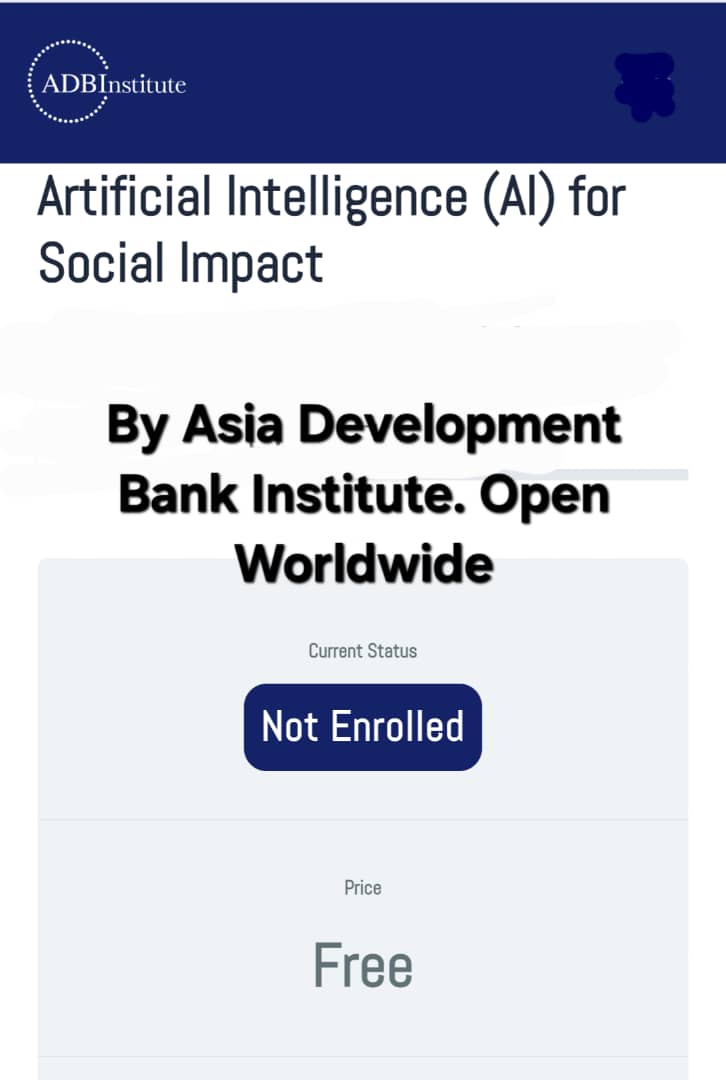
That is one reason I would pay attention to the Artificial Intelligence (AI) for Social Impact course offered by the Asian Development Bank Institute (ADBI).
It provides an opportunity to explore the basics of artificial intelligence through online learning without the financial commitment of an expensive training programme.
The course is particularly worth considering if you are a student, graduate, teacher, working professional, policymaker or someone who simply wants to understand AI better. You do not necessarily need an advanced technology background to begin learning about the subject.
One of the biggest attractions is its flexible learning format. Instead of having to attend a physical classroom, eligible learners can study online and work through the course materials at their own pace. The course is designed to introduce learners to AI and its potential applications in addressing social challenges.
For anyone trying to build useful digital knowledge without spending money on a lengthy training programme, this is an opportunity worth exploring.
In this guide, I will explain what the ADBI Artificial Intelligence for Social Impact course is about, what learners can expect, who can take it, its potential benefits and how to access the course through the official learning platform.
What Is the ADBI Artificial Intelligence for Social Impact Course?
The Artificial Intelligence for Social Impact course is an online learning opportunity associated with the Asian Development Bank Institute.
The course introduces learners to artificial intelligence and explores how AI can be applied to real-world challenges. Rather than focusing exclusively on technical programming, the learning experience is intended to help participants understand AI concepts and consider their practical implications for society.
This makes it relevant to people who want to understand the technology without necessarily becoming software developers or data scientists.
For example, a university student might want to understand how AI is changing employment opportunities. A teacher might be interested in how it can support learning. Someone working in public administration might want to understand how AI could affect the delivery of public services.
These are different professional interests, but they all benefit from a basic understanding of the technology.
What I find particularly useful about an introductory course like this is that it can help learners move beyond simply hearing about AI on social media. Instead, they can begin to understand what artificial intelligence means, where it may be useful and why responsible implementation matters.
The course is known as Artificial Intelligence (AI) for Social Impact. Prospective learners should use the official ADBI learning platform to confirm its current availability, content, certificate arrangements and enrolment conditions.
Is the ADBI Artificial Intelligence Course Free?
According to the opportunity information provided, the course is offered free of charge.
That means interested learners can explore the training without paying a course tuition fee, making it attractive to students and professionals who want to improve their knowledge on a limited budget.
However, I would always confirm the current terms on the official learning platform before registering. Course availability, certificate arrangements and platform policies can change.
It is also important to distinguish between a free online course and a scholarship that provides financial support for university studies.
This is an online learning course, not a university degree scholarship. It does not, by itself, provide tuition funding for a bachelor’s degree, master’s degree or PhD, and learners should not assume that it includes a stipend, travel allowance or employment placement.
Its value lies in the knowledge gained and, where the current course terms provide for it, the certificate awarded after successful completion.
Why Should I Take a Free Artificial Intelligence Course in 2026?
AI is increasingly relevant across many professional fields. Understanding the technology can help people ask better questions about how it is used, recognise its limitations and identify situations where it may be useful.
I would consider a course like this for several practical reasons.
1. To Understand the Basics of Artificial Intelligence
Artificial intelligence can seem complicated when explanations are filled with technical terminology.
A beginner-friendly course can help learners understand the basic concepts before exploring more specialised subjects.
Rather than immediately trying to learn programming, machine learning mathematics or complex algorithms, I would begin by understanding what AI is, how AI systems are used and what they can and cannot do.
That foundation can make later learning easier.
2. To Understand AI’s Impact on Jobs and Careers
Many people are wondering how AI will affect their future careers.
Some tasks are becoming easier to automate, while other jobs are changing as workers begin using AI tools to support their activities.
The effects differ between industries, employers and occupations. It would be misleading to claim that every job will disappear or that learning one short course will guarantee employment.
However, understanding AI can help learners make more informed decisions about the skills they want to develop.
For example, a communications student might explore how AI supports research and drafting. A business graduate might investigate how organisations use AI to analyse information. A public policy student might consider the opportunities and risks associated with automated decision-making.
The aim is not simply to follow a trend. It is to understand how the technology relates to the work you may want to do.
3. To Explore How AI Can Address Social Problems
The social impact focus is an important part of this course.
AI is not only used in commercial products. It can also be explored in areas such as healthcare, education, environmental management, agriculture and public administration.
For instance, AI-supported tools may help researchers analyse large amounts of information, assist with certain medical processes or improve the way organisations identify patterns in environmental data.
However, these applications also raise questions about fairness, privacy, accountability and the quality of the information used to train AI systems.
A course that considers social impact can help learners think about both the possible benefits and the risks.
4. To Build Knowledge Without Paying for an Expensive Programme
Professional AI training can range from free introductory materials to expensive specialist programmes.
For someone who is unsure whether AI is relevant to their interests, a free introductory course offers a low-cost way to begin.
I would use the experience to identify which subjects interest me most. After completing an introductory course, I might decide to explore data analysis, AI ethics, machine learning, digital transformation or another specialised field.
There is no need to commit to an expensive programme before understanding what you want to learn.
5. To Add Relevant Learning to My CV
If the course provides a certificate upon successful completion under its current terms, learners may be able to include it in the professional development or training section of their CV.
That can demonstrate an interest in continuous learning.
However, I would be realistic about what the certificate represents. Completing an introductory course is not the same as earning a professional AI qualification or gaining advanced technical experience.
The certificate is most useful when it reflects knowledge that I can explain and apply.
What Will I Learn in the Artificial Intelligence for Social Impact Course?
The course information describes introductory learning about artificial intelligence and its practical applications.
The exact module structure should be checked on the official ADBI learning platform, but learners can use the following topics as a general guide to the kinds of concepts associated with an introductory AI course.
Understanding What Artificial Intelligence Means
One of the first things I would want to understand is what people mean when they talk about artificial intelligence.
AI is a broad field involving computer systems designed to perform tasks that typically require capabilities associated with human intelligence. Depending on the system, these tasks may include recognising patterns, processing language, generating content or making predictions.
Understanding this broad definition helps distinguish between different AI applications rather than treating every automated tool as the same technology.
How AI Systems Work
AI systems differ in how they are developed and used.
Some systems identify patterns in data. Others process language, recognise images or generate text and other content.
An introductory course can help learners develop a basic understanding of these capabilities without requiring them to build a model themselves.
I would pay attention to the examples used in the lessons because practical demonstrations can make unfamiliar concepts easier to understand.
How AI Is Used in Different Industries
AI applications vary considerably across sectors.
In healthcare, certain systems may support the analysis of medical information. In education, AI tools may assist with learning activities. In agriculture, data-driven systems can help analyse crop conditions or environmental patterns.
In public services, AI may be explored for tasks such as analysing information or supporting administrative processes.
These examples do not mean that every AI application is accurate, appropriate or suitable for every situation. Their value depends on the system, the quality of the data, the people using it and the safeguards in place.
AI and Social Impact
The social impact perspective encourages learners to consider how technology affects people and communities.
For example, an AI system used to support public services may be efficient in some circumstances, but it could also produce unfair outcomes if its data or design does not adequately account for different groups.
I would consider this one of the most important parts of learning about AI. Understanding how a tool works is useful, but understanding who benefits, who may be excluded and what risks need to be managed is equally important.
Responsible and Ethical Use of AI
AI systems can raise concerns about privacy, bias, transparency, accountability and misinformation.
A responsible approach involves asking questions such as:
What information does the system use?
Could its output disadvantage particular groups?
Is the information it provides accurate?
Who is accountable when an AI-supported decision causes harm?
Is sensitive information being handled appropriately?
When should a human review the result?
These questions are relevant even to people who never intend to become AI developers.
Anyone using AI tools in education, business, research or public service can benefit from thinking carefully about the consequences of their use.
Who Can Take the ADBI Artificial Intelligence Course?
The opportunity information describes the course as open to learners worldwide.
Because it is an online learning course rather than a conventional university scholarship, the main practical considerations are whether enrolment is currently available, whether you meet the platform’s requirements and whether you can access the learning materials.
The following groups may find the course useful.
University Students
Students from different academic backgrounds may benefit from understanding AI.
You do not necessarily need to study computer science to be interested in artificial intelligence. Students in business, economics, education, agriculture, health, public administration and the social sciences may also encounter AI in their future careers.
I would see an introductory course as a way to build knowledge alongside my main degree, rather than as a replacement for formal academic training.
Recent Graduates
Recent graduates may be interested in learning about AI while preparing for employment or considering further study.
The course could help them identify areas where digital knowledge intersects with their academic background.
For example, someone with a background in environmental science might want to explore AI applications in climate research, while a business graduate might be interested in data-driven decision-making.
Teachers and Educators
Educators may want to understand how AI affects teaching, learning and educational administration.
A basic understanding of the technology can help teachers evaluate potential uses while remaining aware of concerns such as inaccurate information, student privacy and overreliance on automated tools.
Working Professionals
Professionals who want to understand emerging technologies may find an introductory course useful.
The knowledge may help them participate more confidently in workplace discussions about AI and identify tasks where further training could be valuable.
Policymakers and Development Practitioners
People working in public policy, international development and community programmes may be interested in how AI affects service delivery and social outcomes.
The social impact focus may be particularly relevant to learners who want to understand the relationship between technology, public needs and responsible decision-making.
Beginners With No Technical Background
You do not need to assume that AI is only for programmers.
A beginner can start by learning the terminology, understanding common applications and exploring the social questions associated with the technology.
If the course is available to you and its entry requirements match your circumstances, it may be a useful starting point.
Do I Need Programming Skills to Join?
The opportunity information presents the course as an introductory learning experience, rather than a specialised programming programme.
That suggests it may be suitable for learners who want to understand AI concepts without first learning to write code.
However, I would check the official course description to confirm the expected background and any prerequisites.
If your longer-term goal is to build AI systems or work as a machine learning engineer, you may eventually need additional training in programming, mathematics, statistics and data science.
For someone who simply wants to understand AI and its social applications, an introductory course may be a more appropriate place to begin.
How Long Does the Course Take to Complete?
The opportunity information describes the course as relatively short and self-paced, with the total time depending on the learner.
A self-paced course can be useful because it allows you to organise learning around work, university classes or other responsibilities.
Rather than assuming that every learner will finish in the same number of hours, I would check the estimated course duration displayed on the official platform.
I would also allow time for watching the lessons, reading the learning materials, reviewing unfamiliar concepts and completing any required quizzes.
The goal should be to understand the material, not simply to rush through the course to obtain a certificate.
Is the ADBI Artificial Intelligence Course Online?
Yes, the opportunity information describes the course as an online learning experience.
That means learners can access it remotely through the designated learning platform, subject to the platform’s current requirements and availability.
For someone studying from Nigeria or another country outside Hungary or Asia, an online course can be convenient because it does not require international travel or relocation.
Before registering, I would check whether I needed to create an account, whether the course was available immediately and whether the platform allowed me to save my progress.
I would also make sure I had a reliable way to access the lessons. A phone may be sufficient for some learning activities, while a computer can be more comfortable for reading materials or completing assessments.
Will I Receive a Certificate After Completing the Course?
The opportunity information states that learners can receive a certificate after completing the course and its required assessments.
Because certificate arrangements can change, I would verify the current terms on the official course page before enrolling.
I would also check what completion requires. If the course includes quizzes or other assessments, I would make sure I understood the passing requirements and whether every section needed to be completed.
How Can I Use the Certificate?
If a certificate is issued, I could add it to the training or professional development section of my CV.
I could also mention it on my professional profile, provided I accurately described the course and the organisation that offered it.
For example, the certificate could show that I had completed introductory learning on AI and its social applications.
I would not present it as a university degree, professional licence or advanced technical qualification if it was not one.
The most valuable outcome is the combination of the certificate and the knowledge I can explain during an interview or use in a practical situation.
How to Apply for the Free ADBI Artificial Intelligence Course
If you are interested in taking the course, the first step is to find the official course page and confirm that enrolment is currently available.
Here is how I would approach the process.
Step 1: Visit the Official ADBI Learning Platform
I would begin with the Asian Development Bank Institute’s official website and follow its links to the learning platform.
I would avoid registering through unfamiliar websites that use similar course names but do not clearly identify the provider.
Step 2: Find the Course
On the official platform, I would search for the exact title:
Artificial Intelligence (AI) for Social Impact
I would read the course description and check the learning objectives, estimated duration, enrolment conditions and certificate information.
This would help me confirm that I had found the intended course rather than another AI programme.
Step 3: Create an Account or Sign In
If the platform required an account, I would follow the registration instructions and provide the information requested.
If I already had an account, I would sign in using my existing details.
I would use an email address that I could access regularly so I would not miss account notifications or course-related updates.
Step 4: Review the Course Content
Before starting, I would look through the available course information.
I would check whether the learning materials included videos, reading resources, quizzes or other activities.
I would also confirm whether the course could be completed entirely online and whether there were any requirements that could affect my ability to finish it.
Step 5: Enrol in the Course
If enrolment was open and the course was free under the current terms, I would follow the platform’s enrolment instructions.
I would make sure I was not accidentally registering for a different course or a paid programme.
Step 6: Complete the Lessons
Once enrolled, I would work through the lessons in the order recommended by the course.
I would take brief notes on unfamiliar terms and practical examples, particularly those relating to AI applications in society.
If the course allowed me to pause and resume, I would use that flexibility to study around my other commitments.
Step 7: Complete the Required Quizzes or Assessments
If the course included quizzes or other completion requirements, I would read the questions carefully and make sure I understood the material.
I would revisit the relevant lesson if I was unsure about an answer rather than guess my way through the assessment.
Step 8: Confirm Course Completion and Access the Certificate
After completing the required activities, I would check the platform for confirmation of completion and follow its instructions for obtaining the certificate, if one was included.
I would save a copy for my records and make sure the certificate displayed the correct course title and my name.
Important: The steps above describe a practical way to approach online enrolment. The exact buttons, account requirements and certificate process may differ on the current ADBI platform.
How Can I Make the Most of a Short AI Course?
A short course can introduce useful ideas, but its value depends partly on what you do with the information afterwards. I would focus on three things.
First, I would identify the AI applications most relevant to my own field. That would make the concepts easier to connect with situations I might encounter in education, research, business or public service.
Second, I would practise evaluating AI-generated information. I would check important claims against reliable sources rather than assume an AI tool was always correct.
Third, I would use the course to identify what I wanted to learn next. Someone interested in responsible AI might explore ethics and governance, while a learner interested in building systems might move on to programming and machine learning.
This approach would allow me to treat the introductory course as a starting point rather than the end of my learning.
Is This Course a Scholarship?
No. The ADBI Artificial Intelligence for Social Impact course should not be confused with a conventional scholarship.
A scholarship normally provides financial support for an educational programme, which may include tuition fees, living expenses or other eligible costs.
This opportunity is described as a free online course. Its main benefits are access to learning materials and, subject to the current course conditions, a certificate of completion.
It does not automatically provide university admission, a monthly stipend, travel funding or a job offer.
If you are looking for financial support to study for a bachelor’s degree, master’s degree or PhD, you will need to search for scholarship programmes that specifically fund those qualifications.
Frequently Asked Questions About the ADBI Artificial Intelligence Course
1. What is the ADBI Artificial Intelligence for Social Impact course?
It is an online learning course associated with the Asian Development Bank Institute that introduces artificial intelligence and explores its applications in addressing social challenges.
2. Is the course free?
The opportunity information describes the course as free. Check the official course page to confirm the current enrolment and certificate terms.
3. Can people from any country apply?
The opportunity information describes it as open to learners worldwide. Prospective participants should confirm the current enrolment conditions on the official platform.
4. Can Nigerian students take the course?
Nigerian learners can check the official course page for enrolment availability and any current eligibility conditions. As an online course, it does not inherently require travel to another country.
5. Do I need a university degree?
The supplied opportunity information does not identify a specific university degree as a requirement. Check the official course description for any prerequisites.
6. Do I need programming skills?
The course is presented as an introductory learning opportunity. However, prospective learners should confirm the expected background on the official course page.
7. How long does it take to complete?
The opportunity information describes the course as short and self-paced. The official platform should provide the current estimated duration.
8. Will I receive a certificate?
The supplied information states that a certificate is available upon completion. Confirm the current certificate requirements and issuance process before enrolling.
9. Can I take the course on my phone?
The course is described as an online learning opportunity. A smartphone may be sufficient if it can access the platform and its learning materials, although a computer may be more convenient for some activities.
10. Is this course a university scholarship?
No. It is an online course, not a scholarship that funds a university degree.
11. Will completing the course guarantee a job?
No. Completing a short course does not guarantee employment. The course may help learners develop introductory knowledge, but employers consider a range of qualifications, experience and skills.
12. Where can I find the course?
Start from the Asian Development Bank Institute’s official website and follow its links to the learning platform. Search for the exact title, Artificial Intelligence (AI) for Social Impact, and confirm that you have selected the correct course.
Final Summary: A Free Way to Start Learning About Artificial Intelligence
For anyone who wants to understand artificial intelligence without immediately committing to an expensive training programme, the ADBI Artificial Intelligence for Social Impact course is worth exploring.
Its appeal is straightforward: it offers an introduction to an increasingly relevant subject, with a focus on how AI can be used in ways that affect people and communities.
I would approach it with a clear purpose. Rather than taking the course only to collect another certificate, I would use the lessons to understand the basic concepts, explore practical applications and think more carefully about the benefits and risks of AI.
After completing the course, I would identify which areas interested me most and decide whether further learning in AI ethics, data analysis, digital policy or technical development made sense for my goals.
The certificate, if provided under the current course terms, can be a useful addition to a learning record. But the more important result is being able to explain what I learned and how it relates to my interests.
Ready to get started? Visit the official Asian Development Bank Institute website, find the Artificial Intelligence (AI) for Social Impact course and check the current enrolment details.
If registration is open and the course meets your learning needs, it could be a practical first step towards understanding artificial intelligence and its role in society.
Visit Asia Development Bank Institute E-learning to start.
More scholarships to explore
Apply for Research Opportunities, The Norway Mobility Scholarship 2027 in Norway (Fully Funded)
Apply for SEARCA Research Scholarship Program 2026–2027: A Funding for Master and PhD Students
See the Lists of Scholarships in University of Leicester, And Their Application Steps
Want to Study in Canada? Here is how to apply for the Education Exchange Development program
How to Apply for the CSC Scholarship, The complete guides
Discover more from Scholars Africa
Subscribe to get the latest posts sent to your email.

About Scholars Africa Editorial Team
Scholars Africa Editorial Team is dedicated to researching and publishing verified scholarships, jobs, and global opportunities. Our content is built on extensive analysis of application trends, eligibility criteria, and selection patterns to help applicants succeed at every stage. Our team has reviewed hundreds of scholarship programs and application processes across multiple countries.
This is a great work
More importantly it is impactful to the world
I have BSC in biomedical engineering with second class upper and will like to further education