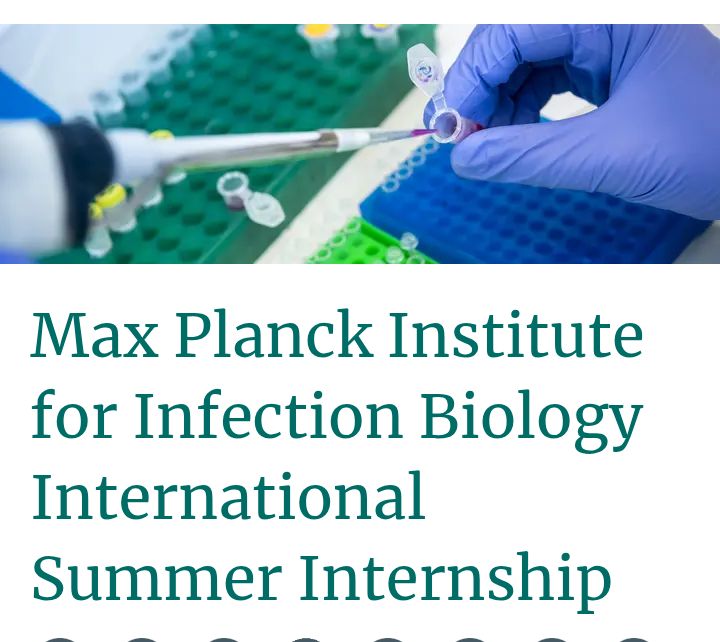
Are you a bachelor’s or master’s student interested in gaining international research experience in Germany?
The Max Planck Institute for Infection Biology International Summer Internship 2027 (MPIIB-ISI) is an opportunity worth considering, particularly if you have a strong interest in biology, medicine, biochemistry, epidemiology, or another related scientific discipline but have faced challenges accessing high-quality research education.
The programme will run from September 1 to November 30, 2027, offering selected international students three months of practical research experience at the Max Planck Institute for Infection Biology in Berlin.
Unlike many research internships that focus mainly on providing laboratory experience, the MPIIB-ISI programme has another important objective: supporting talented students whose academic development has been restricted by personal, financial, regional, or societal circumstances.
Successful applicants will receive a monthly stipend of €1,400, travel compensation, and accommodation close to the Institute. They will also work on research projects under the supervision of experienced scientists and participate in additional training activities designed to prepare them for future academic opportunities, including PhD applications.
The programme is particularly interesting because it combines scientific training with professional development. Interns will have opportunities to attend courses on scientific presentations, developing research questions, and preparing applications.
There will also be excursions to other research institutions in Berlin, social activities, and administrative support before and during the internship.
For students from low- and middle-income countries who have struggled to access well-equipped laboratories, research mentors, or international academic networks, this could be a valuable opportunity.
In this guide, I will walk through the internship benefits, eligibility requirements, application timeline, selection stages, and practical steps I would take when preparing a competitive application.
Overview of the Max Planck Institute International Summer Internship 2027
Here are the important details applicants should know before starting their applications.
WHO Ethics Internship 2027 in Switzerland, Living Allowance, Lunch Vouchers and Application Guide
| Programme Detail | Information |
| Programme | Max Planck Institute for Infection Biology International Summer Internship |
| Host institution | Max Planck Institute for Infection Biology |
| Location | Berlin, Germany |
| Internship period | September 1 – November 30, 2027 |
| Duration | Three months |
| Eligible applicants | International bachelor’s and master’s students |
| Monthly stipend | €1,400 |
| Additional support | Travel compensation and accommodation close to the Institute |
| Research areas | Biology, medicine, biochemistry, epidemiology and related fields |
| Language | English |
| Application opening | November 2026 |
| Application deadline | November 27, 2026 |
| Final selection | February 2027 |
| Internship begins | September 1, 2027 |
| Internship ends | November 30, 2027 |
| Official website | https://www.mpiib-berlin.mpg.de/mpiib-isi |
What Is the Max Planck Institute for Infection Biology?
The Max Planck Institute for Infection Biology is a research institution based in Berlin, Germany, and part of the Max Planck Society.
The Institute focuses on understanding infectious diseases and the biological processes involved in infections. Its research environment brings together scientists working to investigate important questions in infection biology.
For an undergraduate or master’s student, gaining experience in this environment can provide exposure to scientific research beyond what may be available in a regular university classroom.
The MPIIB International Summer Internship is designed to give selected students an opportunity to work on research projects under the supervision of experienced scientists.
This is not simply a programme where participants attend lectures and receive a certificate at the end. The central component is practical research experience, supported by professional development activities.
What Does the MPIIB International Summer Internship Offer?
One of the strongest features of this opportunity is its combination of financial support, scientific training, and preparation for future academic development.
1. Monthly Stipend of €1,400
Selected interns will receive a stipend of €1,400 per month to help cover their living expenses in Berlin.
Since the internship lasts three months, the stipend provides financial support throughout the programme.
For students who would otherwise struggle to afford an international research placement, this is an important part of the opportunity.
Applicants should nevertheless plan their finances carefully and confirm the exact payment arrangements and any conditions attached to the stipend before travelling.
2. Travel Compensation
The programme also provides travel compensation. This support is intended to help selected participants with the cost of travelling to and from Berlin.
Because the announcement does not specify the exact amount or reimbursement procedure, applicants should check the official programme instructions for details before purchasing tickets or making non-refundable travel arrangements.
3. Accommodation Close to the Institute
Accommodation close to the Institute will be provided.
This is particularly useful for international students who may be unfamiliar with Berlin’s housing market or the practical challenges of arranging accommodation for a short research placement.
Finding affordable accommodation in another country can be difficult, especially when the internship lasts only three months. Having accommodation arranged through the programme removes one significant planning challenge.
Applicants should check the official offer and accommodation instructions for information about the arrangement, including any costs or conditions not specified in the announcement.
4. Hands-on Scientific Research Experience
The main academic benefit is the opportunity to work on research projects under the supervision of experienced scientists.
For students who have mostly encountered scientific concepts through lectures, textbooks, and limited laboratory practicals, this can be a valuable step towards understanding how research works in a professional scientific institution.
Instead of simply learning about research methods, interns will have the opportunity to become involved in a research environment and develop practical experience relevant to their academic interests.
This is especially useful for students considering future master’s research, doctoral studies, or careers in scientific investigation.
5. Training to Prepare for Future PhD Applications
Another important feature is the programme’s complementary professional development component.
The organisers specifically intend to help interns develop skills that can support a future PhD application. Training activities will include:
Scientific presentation skills.
Learning how to identify and develop a research question.
Application training.
Other professional development activities.
These sessions address some of the challenges students encounter when moving from undergraduate or master’s education into research careers.
For example, having good grades does not automatically mean a student knows how to identify a suitable PhD project, communicate a research idea, or prepare a convincing doctoral application.
The training is designed to help participants develop some of these skills.
6. Excursions to Research Institutes in Berlin
Interns will also have opportunities to visit other research institutions in Berlin. These excursions can help participants become familiar with the wider scientific community in Germany’s capital.
For someone who has not previously worked in an international research environment, visiting other institutions can provide useful exposure to different research settings and scientific activities.
7. Social Activities and International Networking
The programme includes social events that allow interns to interact with other participants and members of the scientific community.
The experience is therefore not limited to laboratory work.
Students will have opportunities to build professional relationships, exchange academic experiences, and become familiar with the international research environment in Berlin.
8. Administrative Support Before and During the Internship
Moving to Germany for a three-month internship involves more than obtaining a travel ticket.
International participants may need to deal with visa requirements, documentation, accommodation arrangements, and other administrative procedures.
The MPIIB-ISI programme provides administrative support before and during the internship, particularly with the sometimes confusing aspects of German public administration.
This can be especially helpful for students travelling to Germany for the first time.
Who Can Apply for the Max Planck Institute Summer Internship 2027?
The MPIIB International Summer Internship is open to international bachelor’s and master’s students who meet the programme requirements.
However, one point deserves particular attention: the programme is specifically designed for motivated students whose access to high-quality scientific education has been restricted by personal, financial, regional, or societal difficulties.
This is not an incidental part of the opportunity. It is central to the programme’s purpose.
The organisers want to support talented students who have the academic ability and motivation to pursue research careers but have encountered barriers that make accessing excellent scientific training more difficult. Below are the main eligibility requirements.
1. You Must Be Enrolled at a University
Applicants must be currently enrolled at a university. The organisers explain that university enrolment is necessary because students need to meet the requirements for obtaining a visa.
This is an important condition, so applicants should be prepared to provide evidence of their current student status.
If you have already graduated and are no longer enrolled, do not assume that you qualify simply because you recently completed a bachelor’s or master’s degree. Check the official programme rules or contact the organisers for clarification.
2. Bachelor’s Students Must Have Completed at Least Four Semesters
Students who have not yet received their bachelor’s degree must have completed at least four semesters, equivalent to two years of university study, by the time of application.
This means that first-year students will not meet the stated academic-stage requirement. Students who are already enrolled in a master’s programme may also apply, provided they satisfy the other conditions.
3. You Must Have a Strong Academic Record
The programme expects applicants to demonstrate strong academic performance.
Your academic record should show that you are capable of handling scientific research and benefiting from the internship.
When preparing your application, pay attention to how your academic background connects to the research area you want to pursue.
Do not assume that a good academic result alone will make your application competitive. The programme also considers motivation and the barriers that have affected your access to scientific education.
4. Your Academic Background Must Be Relevant
Applicants should have studied a subject connected to the proposed research projects. Relevant fields include:
Biology.
Medicine.
Biochemistry.
Epidemiology.
Other related scientific disciplines.
The important point is not simply having a science-related degree title. You should be able to demonstrate that your previous studies have prepared you for the particular research project you want to join.
For example, a student interested in an infection biology project should be able to explain how their academic training, laboratory experience, coursework, or research interests relate to the subject.
5. You Must Have a Good Command of English
Applicants must have a good command of English.
English is important because interns will need to communicate with their supervisors, understand scientific discussions, participate in training sessions, and work effectively in the research environment.
The announcement does not specify a particular IELTS, TOEFL, or other English-language test score. Applicants should therefore consult the official instructions rather than assuming that a particular certificate is compulsory.
6. You Must Explain Your Motivation
Applicants must be able to explain why they want to participate in the internship and why they are interested in the specific research project for which they are applying.
This is an area where I would invest considerable preparation time.
A general statement such as “I want international research experience” is unlikely to communicate a strong understanding of the programme. Instead, explain:
Why infection biology or the relevant research area interests you.
What you have studied that connects to the project.
What scientific skills you want to develop.
Why the selected project is relevant to your academic direction.
How the experience could support your future research ambitions.
Your explanation should be connected to your actual academic background and goals.
7. You Must Have Experienced Barriers to Accessing Scientific Education
This is one of the most distinctive requirements of the programme.
The MPIIB-ISI is specifically designed for students who face or have faced significant difficulties in their scientific education.
These challenges may be personal, financial, regional, or societal.
Applicants should be able to explain why their access to first-class higher education or scientific research opportunities has been constrained.
For example, a student may have studied at a university with limited laboratory facilities, faced financial barriers to accessing advanced scientific training, or experienced regional disadvantages that restricted opportunities to participate in research.
These are examples of circumstances that may be relevant, not an official exhaustive list of qualifying situations. The important thing is to explain your own circumstances honestly and clearly.
Do not exaggerate difficulties or invent experiences to make an application appear stronger. The strongest explanation is one that accurately describes the barriers you have encountered and how they have affected your educational opportunities.
8. You Must Be Available for the Entire Internship
Successful applicants must be available for the full programme period:
September 1 to November 30, 2027.
The organisers specifically state that participants cannot extend their stay in Germany beyond the internship period because of visa regulations.
Afreximbank Internship Opportunities 2026: $1,500 Monthly Support, Eligibility and How to Apply
This means that applicants should consider their university calendar, examinations, academic commitments, and other responsibilities before applying.
If you already know that you cannot remain available for all three months, this may not be the right programme for your current circumstances.
9. The Internship Must Be Voluntary
The programme accepts students undertaking a voluntary internship.
It cannot accept interns who need the internship to earn academic credit points as part of their university course requirements. This is an important distinction.
If your university requires you to complete an internship for course credit, you should clarify your situation with the programme organisers before applying.
Priority for Students from Low- and Middle-Income Countries
The programme strongly encourages applications from students living in low- and middle-income countries.
This makes the opportunity particularly relevant to talented students who may have limited access to advanced scientific facilities, international research placements, or well-funded academic environments.
For applicants from countries such as Nigeria and other developing economies, the programme may provide an opportunity to experience a different research environment and develop connections with scientists working internationally.
However, living in a low- or middle-income country does not automatically guarantee selection. Applicants must still satisfy the academic, enrolment, language, motivation, availability, and other programme requirements.
The most effective approach is to explain how your circumstances have affected your access to scientific education and why the internship would make a meaningful difference to your academic development.
How to Prepare a Strong Application for the MPIIB-ISI Internship
Because this programme is designed for students who have experienced barriers to scientific education, I would approach the application differently from an ordinary internship application.
You need to communicate two connected things:
- Your ability and motivation to participate in scientific research.
- The circumstances that have limited your access to advanced scientific education or research opportunities.
Neither should disappear behind the other.
A student who explains their challenges but provides little evidence of academic preparation may struggle to demonstrate readiness for the internship. Similarly, a student with excellent grades who does not explain the barriers they have faced may fail to communicate why this particular programme is relevant to them.
Here is how I would approach the preparation process.
Step 1: Study the Available Research Projects
Before writing your motivation statement, identify the research projects available through the programme.
Do not choose a project simply because its title sounds impressive. Read the project description and identify the scientific question or research area it addresses.
Then compare it with your academic background. Ask yourself:
Have I studied this subject before?
Which courses or laboratory experiences are relevant?
What aspects of the project interest me?
What would I like to learn from working with the research team?
How does the project connect to my future academic plans?
Your answers will help you explain why you are applying for that particular project.
Important: The supplied programme announcement does not include the 2027 project list or individual project descriptions. Check the official website for the available projects and application instructions.
Step 2: Prepare Your Academic Background Clearly
Your academic record should make it easy for the selection team to understand your preparation for research.
Review your university education and identify the most relevant experiences. These may include:
Relevant undergraduate or master’s courses.
Laboratory practicals.
Research projects.
Final-year dissertations.
Previous scientific internships.
Academic presentations.
Research-related extracurricular activities.
You do not need to pretend that you have extensive laboratory experience if you do not.
If your university has limited research facilities, explain what opportunities you have had and what you have done with them.
The programme is intended to support students facing educational barriers, so an applicant should not feel pressured to present an unrealistic academic background.
Step 3: Explain Your Educational Challenges With Specific Examples
This section deserves particular attention. Instead of writing that you have faced difficulties in your education without explaining them, describe the actual circumstances.
For example, if your university has limited laboratory equipment, explain how that has affected your ability to gain practical experience.
If financial constraints have prevented you from attending scientific workshops or participating in research placements, explain the limitation and its consequences.
If your geographical location has restricted access to research institutions or specialist supervision, describe how this has influenced your academic development.
A useful structure is: The challenge: What specific barrier have you faced?
The effect: How has it affected your scientific education or access to research?
Your response: What have you done to continue developing your academic skills despite the limitation?
The opportunity: How would the MPIIB-ISI internship help you address the gap?
This approach gives the selection team a clearer picture of your circumstances than a general statement about financial hardship or limited opportunities.
Step 4: Write a Project-Specific Motivation Statement
Your motivation should connect your previous studies, the research project, and your future plans.
For instance, a biology student interested in infectious diseases might explain how their university coursework introduced them to infection-related topics and why they want to develop practical research skills in this area.
A student with a background in epidemiology could explain how their academic interests connect to understanding infectious disease patterns and the scientific processes behind disease transmission.
These are only illustrative approaches. Your actual statement should reflect the project you select and your genuine experience.
Avoid writing one generic motivation statement and sending it to every internship programme.
The MPIIB-ISI has a specific purpose, and your application should show that you understand it.
Step 5: Explain How the Internship Fits Your Future Plans
The programme includes training designed to prepare interns for future PhD applications.
This means that applicants who are considering an academic research career should explain how the internship fits into their longer-term development. You might discuss your interest in:
Pursuing a research-based master’s degree.
Applying for a PhD in infection biology or a related discipline.
Developing expertise in infectious disease research.
Building practical laboratory or scientific research skills.
Contributing to research and education in your home country.
Be realistic. You do not need to claim that you will solve a major global health problem immediately after the internship.
A clear and achievable academic direction is more convincing than an exaggerated promise.
Step 6: Check Your University Enrolment and Availability
Before submitting your application, confirm that you will remain eligible under the programme’s enrolment requirements.
If you are a bachelor’s student who has not yet graduated, make sure you have completed at least four semesters by the time of application.
Also check that you can participate throughout the entire internship period.
Remember that the programme runs from September 1 to November 30, 2027, and the organisers do not permit participants to extend their stay beyond the internship period because of visa regulations.
Step 7: Review the Official Application Instructions
Visit the official programme website and follow the application instructions for the 2027 intake.
Check which documents are required, how the application must be submitted, and whether there are specific instructions for the research projects.
The announcement provided does not list every required document, so applicants should not assume that a CV, transcript, recommendation letter, or any other document is compulsory unless the official application instructions request it.
Prepare the materials according to the actual requirements.
Step 8: Submit Before November 27, 2026
The application deadline is November 27, 2026. Do not wait until the final day to submit.
Give yourself enough time to review the application, check your answers, confirm that all requested documents are included, and ensure that your selected research project is correctly identified.
A complete and carefully prepared application is much better than a rushed submission containing avoidable mistakes.
How Does the Selection Process Work?
The MPIIB-ISI selection process has three main stages.
Stage 1: Pre-selection
After applications are received, the programme evaluates submissions and prepares a shortlist of suitable candidates.
This means that the first stage is based on the information applicants provide in their applications. Your written application is therefore extremely important.
It should clearly communicate your academic preparation, motivation, interest in the selected project, and the circumstances that have restricted your access to scientific education.
Stage 2: Online Interview
Shortlisted applicants are invited to an online interview.
This is an opportunity for the selection team to learn more about the candidates and assess their suitability for the programme.
I would prepare for the interview by revisiting the application carefully. Be ready to explain:
Why you applied for the MPIIB-ISI programme.
Why you selected your particular research project.
What you know about the relevant scientific area.
Which academic experiences have prepared you for the internship.
What educational challenges have affected your development.
What you hope to gain from the three-month placement.
How the internship connects to your future academic plans.
You should also be prepared to discuss your previous academic or research experiences.
If you mention a laboratory technique, research project, or scientific topic in your application, make sure you can explain it clearly during the interview.
Do not memorise complicated scientific explanations that you cannot comfortably discuss. It is better to demonstrate a genuine understanding of your academic experience.
Stage 3: Final Acceptance
Candidates selected after the interview will receive an email containing their official MPIIB-ISI offer letter. This is the formal communication confirming selection.
Successful applicants should then follow the instructions provided by the programme team concerning acceptance, travel arrangements, accommodation, visa documentation, and preparation for the internship.
Because international travel involves administrative requirements, respond promptly to official communications and keep copies of important documents.
MPIIB International Summer Internship 2027: Important Dates
Applicants should keep the following dates in mind.
| Event | Date |
| Application call opens | November 2026 |
| Application deadline | November 27, 2026 |
| Final selection and commitments | February 2027 |
| Internship begins | September 1, 2027 |
| Internship ends | November 30, 2027 |
When Will Applicants Hear Back?
The programme expects to complete final selection and commitments in February 2027. However, the organisers provide an additional notification instruction.
If you have not been contacted by March 1, 2027, after submitting your application, you may assume that your application has not been retained.
Applicants should also check their spam or junk email folders regularly, particularly around the expected interview and selection periods.
The organisers explain that they receive a high volume of applications and cannot provide individual feedback to unsuccessful candidates.
Why This Internship Is Particularly Valuable for Students From Developing Countries
International research opportunities can be difficult to access for students who study in universities with limited funding, laboratory facilities, or connections to international research institutions.
Nintendo Careers 2026: Latest Jobs, Paid Internships and Application Guide
A student may have strong academic results and a genuine interest in scientific research but still struggle to gain the practical experience needed to compete for advanced research opportunities.
This is the type of challenge the MPIIB-ISI programme aims to address.
By providing a three-month research placement, financial support, accommodation, and professional development activities, the programme creates an opportunity for selected students to experience a different academic environment.
For students from low- and middle-income countries, the potential benefits extend beyond the internship itself. The experience may help them:
Understand how research teams operate in an international institution.
Develop practical scientific research experience.
Improve their ability to communicate scientific ideas.
Learn how to identify research questions.
Prepare for future PhD applications.
Build relationships with scientists and other interns.
Gain a better understanding of international research opportunities.
However, applicants should remember that the programme is not simply a travel opportunity. Its central purpose is scientific education and preparation for an academic research career.
Your application should reflect that purpose.
Frequently Asked Questions About the Max Planck Institute Summer Internship 2027
1. Is the Max Planck Institute International Summer Internship 2027 open to international students?
Yes. The programme offers internships to international bachelor’s and master’s students who meet the eligibility requirements.
It particularly encourages applications from students living in low- and middle-income countries.
2. Where will the internship take place?
The internship will take place at the Max Planck Institute for Infection Biology in Berlin, Germany.
3. How long does the internship last?
The internship lasts three months, from September 1 to November 30, 2027.
4. How much is the monthly stipend?
Selected interns will receive a monthly stipend of €1,400 to cover living expenses in Berlin.
5. Does the programme provide accommodation?
Yes. The programme provides accommodation close to the Institute.
Applicants should consult the official instructions for further details about the accommodation arrangement.
6. Are travel expenses covered?
The programme provides travel compensation. Applicants should check the official information for details about the amount and payment arrangements.
7. Can undergraduate students apply?
Yes. Bachelor’s students can apply if they meet the requirements.
Students who have not yet received their bachelor’s degree must have completed at least four semesters, equivalent to two years of study, at the time of application.
8. Can master’s students apply?
Yes. The programme is open to eligible master’s students as well as bachelor’s students.
9. Which academic fields are eligible?
Relevant backgrounds include biology, medicine, biochemistry, epidemiology, and other related scientific disciplines.
Applicants should also consider whether their background matches the available research projects.
10. Do I need IELTS or TOEFL?
The announcement requires a good command of English but does not specify a mandatory IELTS or TOEFL score.
Check the official application instructions to confirm whether any particular proof of English proficiency is required.
11. Can I apply if my university requires an internship for academic credit?
No. The programme accepts voluntary internships and cannot accept students who need the placement to earn academic credit points as part of their course requirements.
12. Can I extend my stay in Germany after the internship?
No. The programme states that participants cannot extend their stay beyond the internship period because of visa regulations.
13. When is the application deadline?
The application deadline is November 27, 2026.
14. When will the final selection be announced?
Final selection and commitments are scheduled for February 2027.
If you have not been contacted by March 1, 2027, the organisers advise you to assume that your application has not been retained.
15. Will unsuccessful applicants receive feedback?
No. Due to the high volume of applications, the programme cannot provide individual feedback to unsuccessful applicants.
16. Can students from Nigeria apply?
The programme welcomes international applicants and strongly encourages applications from students living in low- and middle-income countries.
Nigerian students who meet the academic, enrollment, subject-background, motivation, and other requirements should review the official application instructions and consider applying.
How to Apply for the Max Planck Institute International Summer Internship 2027
Interested students should begin by visiting the official programme website and reviewing the application information.
Official application website:
https://www.mpiib-berlin.mpg.de/mpiib-isi
Before submitting your application:
- Confirm that you are currently enrolled at a university.
- Check that your academic background is relevant to the available research projects.
- If you have not completed your bachelor’s degree, confirm that you have completed at least four semesters.
- Review the programme’s requirements concerning educational barriers and motivation.
- Identify the research project that best matches your academic interests.
- Prepare the application materials requested by the organisers.
- Confirm that you are available from September 1 to November 30, 2027.
- Submit your application before November 27, 2026.
Use the official website for the application procedure and any updates to the programme.
Summary
The Max Planck Institute for Infection Biology International Summer Internship 2027 is a valuable opportunity for students who want to develop their scientific research experience in Germany.
What makes the programme particularly distinctive is its commitment to supporting talented students whose access to scientific education has been limited by personal, financial, regional, or societal circumstances.
The €1,400 monthly stipend, travel compensation, accommodation, supervised research experience, and professional development activities make the internship worth serious consideration.
If I were preparing an application, I would give particular attention to two areas: explaining why I am a suitable candidate for the selected research project and providing a clear, honest account of the barriers that have affected my scientific education.
Do not treat the application as an ordinary request for an internship placement. The organisers are looking for motivated students who can benefit from the programme and develop towards future academic research.
The deadline is November 27, 2026, so interested students should begin preparing early.
Apply through the official Max Planck Institute website
Browse related internships and job opportunities on scholars Africa website below
Amazon Internships 2027: Paid Summer Internships, Application Guide and Latest Opportunities
UNHCR Internship Programme 2026–2027: Eligibility, Benefits, Allowance and How to Apply
Disney Internships 2026–2027: How to Apply for Internship Opportunities at The Walt Disney Company
Discover more from Scholars Africa
Subscribe to get the latest posts sent to your email.

About Scholars Africa Editorial Team
Scholars Africa Editorial Team is dedicated to researching and publishing verified scholarships, jobs, and global opportunities. Our content is built on extensive analysis of application trends, eligibility criteria, and selection patterns to help applicants succeed at every stage. Our team has reviewed hundreds of scholarship programs and application processes across multiple countries.