When I first came across the SBW Berlin Scholarship, what caught my attention was that this was not simply another scholarship asking applicants to submit grades, certificates and a beautifully written motivation letter.
There was something different about it. SBW Berlin places a strong emphasis on social commitment. The idea is not simply to fund my education and send me off to Berlin. I would be expected to use what I learn to contribute to a social project and, after my studies, continue working toward improving conditions in my home country or through qualifying charitable work.
That changed the way I looked at the application. If I were applying for the SBW Berlin Scholarship for International Students, I would not approach it as a normal “study in Germany” scholarship. I would approach it as an opportunity for someone who already has a connection to community work and can explain how education in Berlin fits into a much bigger social goal.
The official SBW Berlin description says the international scholarship supports talented young people from abroad who have already demonstrated social commitment and who intend to apply the skills gained through their studies to social projects at home.
So, in this guide, I am going to walk through what the experience would realistically look like from an applicant’s and eventual recipient’s perspective—from preparing the first recommendation letter to studying in Berlin, developing a social project and eventually taking those skills back home.
What Is the SBW Berlin Scholarship?
The SBW Berlin Scholarship is a scholarship programme in Germany designed around a combination of education and social engagement.
For international students, the programme supports young people from countries that are considered particularly in need of development support. Applicants are expected to have professional or volunteer experience in the non-profit or social sector and to demonstrate a genuine interest in continuing that work.
The scholarship can support eligible students pursuing studies at a state-recognised university or university of applied sciences in Berlin or Potsdam.
One thing I would keep in mind from the beginning is that there are actually two separate processes involved.
I have to apply for admission to my chosen university myself, and I also have to apply for the SBW Berlin Scholarship. Getting one does not automatically mean I have completed the other.
SBW Berlin specifically states that applicants are responsible for obtaining admission to a university or university of applied sciences in Berlin or Potsdam separately from the scholarship application.
That is an important detail because it would be easy to assume that the scholarship organisation handles university admission for me. It does not.
Why the SBW Berlin Scholarship Is Different
From my perspective, the biggest difference is the emphasis on what I intend to do with my education.
Many scholarships focus primarily on academic achievement. SBW Berlin certainly expects good academic performance, but academic results are only part of the picture.
The programme also looks closely at:
My previous social or non-profit involvement
My motivation for social engagement
My professional goals
My financial circumstances
My proposed social project
My relationship with a non-profit or social organisation
What I plan to do after completing my studies
The official requirements for international applicants include being between 18 and 30 years old, having professional or volunteer experience in the non-profit/social sector, demonstrating relatively low net income, having grades corresponding to at least a German 2.0 average, and meeting the programme’s residence and family requirements.
That immediately tells me something important. I should not try to make my application look like that of someone who has suddenly become passionate about social work simply because a scholarship requires it. My social involvement needs to be believable.
The Social Commitment Requirement Is Extremely Important
If I were preparing my SBW Berlin application, this is probably the area I would spend the most time thinking about.
The programme expects applicants to have professional or volunteer experience in the non-profit/social sector. For the international-student scholarship, this experience needs to be supported by a recommendation letter from a social institution or non-profit organisation.
This could make a major difference in how I present myself. Instead of simply writing:
“I want to help my community.” I would need to demonstrate what I have actually done. Perhaps I have worked with young people.
Perhaps I have volunteered with an organisation supporting vulnerable families.
Perhaps I have been involved in education, environmental protection, women’s empowerment, disability inclusion, youth development or another community-focused initiative.
The important thing is that I can explain the work clearly.
What did I actually do?
Who benefited?
What problem was I trying to address?
What did I learn?
What would I like to improve?
And, most importantly, how does my proposed education in Berlin connect to that work?
That connection matters because SBW Berlin expects scholarship recipients to proactively develop social projects during their studies.
I Would Not Apply to SBW Berlin Without a Real Social Project Idea
One of the biggest mistakes I could make would be to treat the social project requirement as something to invent at the last minute.
The scholarship expects recipients to work on social projects during their studies.
These projects can be their own projects or projects connected to organisations and initiatives, and they are expected to benefit people in need and provide a broader benefit to society.
That means I would start thinking about my project before submitting my application. For example, if my background were in education, I might develop a project aimed at reducing school dropout among disadvantaged young people.
If I came from an environmental background, my project might focus on environmental awareness or climate-related education.
If I had a background in music or the arts, the project could involve using creative activities to support vulnerable groups.
SBW Berlin’s published examples include projects involving school dropout prevention, environmental protection and girls’ education, music therapy, peacebuilding and mentoring.
This is useful because it shows that a social project does not have to fit into one narrow category. What matters is that the project has a meaningful social purpose and that I can realistically contribute to it.
What Happens After I Receive the Scholarship?
Receiving the scholarship would not mean that I simply arrive in Berlin, attend lectures and forget about the programme until graduation.
There are responsibilities attached to being a scholarship recipient.
According to SBW Berlin, recipients are expected to work proactively on their social projects during the funding period. The programme indicates that approximately 2 to 8 hours per week may be spent on social project work. Recipients also participate in regular project meetings and workshops, prepare project reports and may give presentations or talks about their projects.
So if I became a recipient, my week could look very different from that of an ordinary international student. I would have university classes and assignments. I would have to maintain good academic performance.
At the same time, I would be developing a social project. I might have meetings with people involved in the project. I could be preparing reports or presentations.
And I would also need to stay in communication with SBW Berlin about my professional development and project progress.
That is why I would not describe this scholarship simply as “free education in Germany.” It comes with responsibilities.
What Financial Support Does SBW Berlin Provide?
The exact benefits depend on the particular scholarship and the applicable guidelines.
For scholarship holders, SBW Berlin currently states that its scholarship programme can include a furnished room in shared student accommodation, tuition support depending on the scholarship type, and monthly financial support depending on the scholarship type.
For the international-student scholarship specifically, applicants should rely on the current scholarship guidelines rather than assuming that every benefit advertised elsewhere applies to them.
This is especially important because scholarship information online can become outdated.
I would therefore check the official SBW Berlin guidelines before making financial plans, booking flights or declining other funding.
Another important point is that SBW Berlin says it does not generally cover language courses or a preparatory year, and financial support for incoming scholarship recipients begins at the start of the semester and after arrival in Berlin.
So I would not arrive at the airport assuming that every expense associated with moving to Germany has already been paid.
Who Can Apply for the SBW Berlin Scholarship for International Students?
The current requirements are quite specific.
For the international-student scholarship, applicants generally need to:
Be between 18 and 30 years old
Have professional or volunteer experience in the non-profit/social sector
Provide evidence of social commitment
Have a university entrance qualification
Have grades equivalent to at least a German 2.0 average
Demonstrate relatively low net income
Meet the programme’s residence requirements concerning Germany
Have no first-degree family members permanently residing in Germany
Apply before starting university or be within the permitted early semesters, or apply for a master’s degree shortly before or after completing a bachelor’s degree
Intend to work in their country of origin for at least 18 months after graduation, or follow the alternative charitable-work arrangement specified by SBW Berlin.
There is also an important distinction concerning university admission.
I would need to apply separately to a university or university of applied sciences in Berlin or Potsdam. The scholarship application does not replace the university admission process.
Can African Students Apply?
Yes, eligible applicants from African countries can apply for the international-student scholarship. The key point is not simply being from Africa.
I would need to satisfy the actual eligibility requirements, including the age requirement, academic requirements, financial-need criteria, social-sector experience and other conditions specified by SBW Berlin.
For an African applicant, I would therefore focus less on trying to make my application sound impressive and more on showing a genuine connection between my previous community work, my proposed studies and the social problem I want to address.
What I Would Prepare Before Applying
If I were preparing my own application, I would not wait until the last minute to collect everything. I would start with my academic records.
Then I would organise evidence of my professional or volunteer experience. I would also identify the non-profit organisation or social institution that can credibly confirm my involvement.
For the international-student scholarship, the recommendation letter from the non-profit or social institution is particularly important because it is part of the initial application stage.
I would also prepare a clear explanation of my proposed social project. I would want to be able to answer five simple questions:
What problem am I addressing?
Who is affected by the problem?
What have I already done about it?
What will I do differently after studying in Berlin?
How will the project continue after I graduate?
If I cannot answer those questions clearly, I would know that my application is probably not ready.
The SBW Berlin Application Process: What Happens First?
This is one area where I would be particularly careful because the process is different from many scholarship applications.
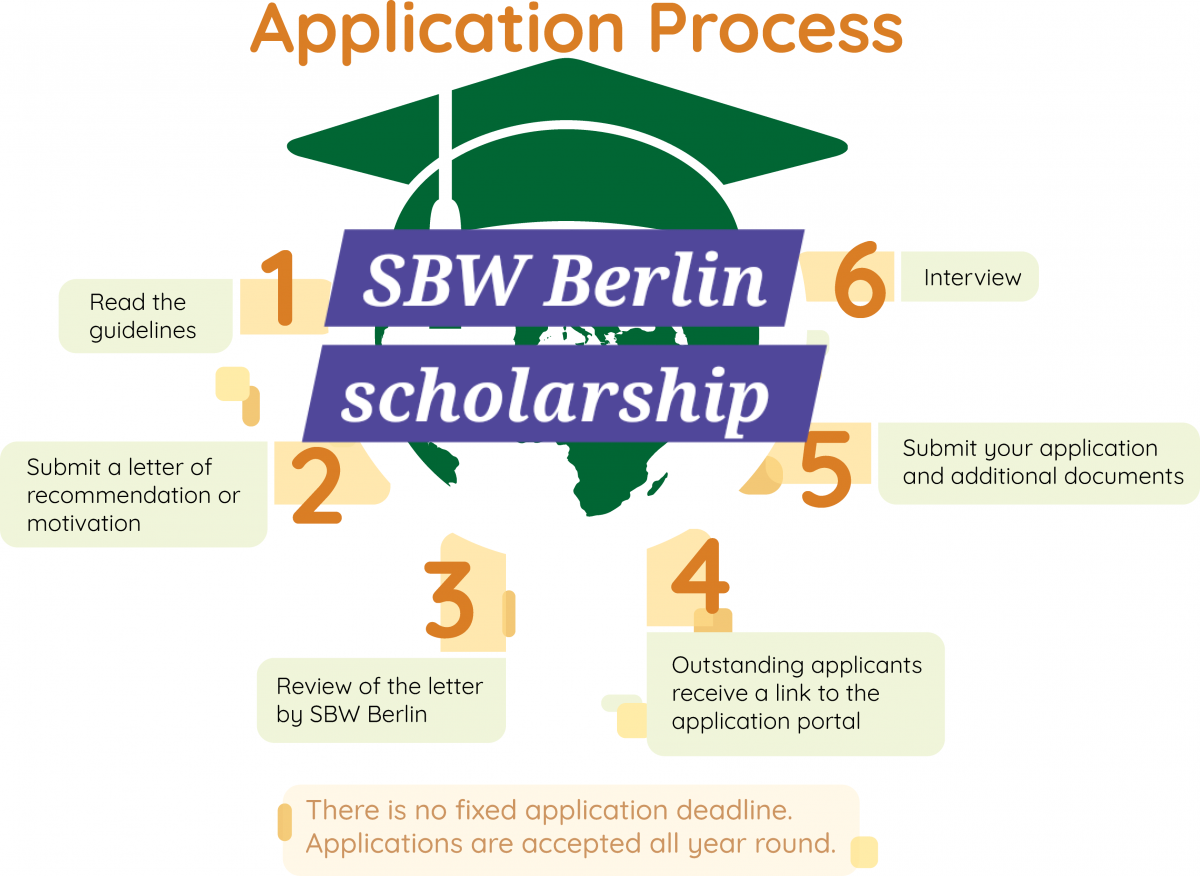
There is no fixed annual application deadline for the SBW Berlin Scholarship. According to SBW Berlin’s current information, applications are accepted throughout the year.
The first step is not simply opening a giant online application form and filling in dozens of boxes.
For the international-student scholarship, I would first need to demonstrate my social commitment through a recommendation letter from a non-profit organisation or social institution.
The organisation sends the recommendation letter to SBW Berlin by email. SBW Berlin then reviews the submission.
Only applicants whose initial submission is considered outstanding are given access to the online application form. That makes the first stage very important.
Step 1: Get the Recommendation Letter Right
If I were applying, I would not ask someone to write a vague letter saying:
“This student is hardworking and deserves a scholarship.” That would tell the selection team very little about my actual social involvement.
I would want the organisation to explain my responsibilities, the work I have done and my involvement with the community.
The official guidelines specifically require proof of social commitment through a recommendation from a non-profit organisation or social institution.
So I would choose someone who genuinely knows my work. If I volunteered for an organisation for several months, the person supervising that work would probably be in a better position to describe my contribution than someone who barely knows me.
Step 2: Wait for the Initial Review
This is where patience becomes part of the process. After the recommendation letter is submitted, SBW Berlin reviews it.
If the initial submission is considered outstanding, the applicant receives access to the online application form.
So I would not panic if I did not immediately receive a full application form. The first stage is designed as a screening step.
Step 3: Complete the Online Scholarship Application
Once I receive access to the application portal, I would take my time.
This is where I would expect to provide detailed information about my academic background, financial circumstances, social involvement, professional goals and proposed project.
I would make sure that everything I write matches the documents I submit.
If I say I worked with an organisation for two years, my supporting documents should not suggest that I was there for three months.
If I describe a project as already operating, I should be able to explain what has actually happened. Consistency matters.
Step 4: Prepare for Verification
I would also keep my original documents organised because SBW Berlin’s verification process can require evidence such as identification, residence or visa documentation, income information, academic records and study-specific work, training or internship certificates, depending on the applicant’s situation.
This is one reason I would create a digital folder before starting. I would name my files properly.
Instead of having files called: certificate-final-final2.pdf I would use something like: Bachelor_Transcript.pdf Volunteer_Recommendation.pdf
Passport.pdf
Income_Document.pdf
It sounds minor, but when an application requires several documents, organisation saves a surprising amount of stress.
What Studying With SBW Berlin Could Actually Feel Like
The part I find particularly interesting about the programme is that the scholarship connects academic learning with practical social work.
I would not just study a subject and then wait until graduation to think about how to use it. SBW Berlin describes its approach as combining education, talent development, networking and social project development.
That could mean taking something I learn in class and thinking:
Can I actually use this in my project back home?
For example, if I were studying management, I could apply project-management principles to a community initiative.
If I were studying technology, I could explore how digital tools could help an organisation reach more people.
If I were studying social sciences, I might use research methods to better understand the community problem my project addresses.
That connection between the degree and the social project is one of the strongest features of the programme.
I Would Also Have to Keep My Academic Performance Strong
Being socially active would not excuse poor academic performance. SBW Berlin expects scholarship recipients to maintain good academic performance during their supported semesters.
So I would have to find a balance. This is something I would take seriously before accepting the scholarship.
I would have classes, exams, assignments and presentations. Then there would be the project work.
There would also be meetings, workshops and reporting responsibilities. In other words, the scholarship would give me significant support, but it would also require me to be disciplined.
What Happens After Graduation?
This is perhaps the most important part of the SBW Berlin model. The relationship does not simply end when I receive my diploma.
For international scholarship recipients, SBW Berlin expects graduates to continue their social projects in their home countries and use the skills acquired during their studies to advance those projects. SBW Berlin says it continues to provide advisory support after graduation.
The international scholarship also requires an intention to work in the country of origin for at least 18 months after graduation, or to engage in qualifying charitable activities in Germany under the alternative arrangement described by SBW Berlin.
That is why I would not treat this as a scholarship for someone whose only goal is to get to Germany and remain there permanently. The programme has a clear social-development component.
What If I Decide to Stay in Germany?
This is another area where I would read the scholarship agreement carefully before accepting the award.
SBW Berlin explains that if a scholarship recipient discontinues the study or project or remains in Germany in circumstances covered by the repayment provisions, a repayment plan can come into effect. The current international scholarship information also refers to the alternative of engaging in non-profit work in Germany until the repayment plan has been fulfilled.
So I would never make assumptions about this. I would read the current guidelines and scholarship contract carefully. The consequences of changing plans after receiving substantial financial support are not something I would want to discover later.
What Makes a Strong SBW Berlin Applicant?
If I had to explain the strongest profile in simple terms, I would say it is someone whose story makes sense from beginning to end.
For example:
Past:
I have already been involved in a meaningful social or non-profit activity.
Present:
I have a clear reason for studying a particular programme in Berlin or Potsdam.
Project:
I have a realistic social project that connects my education with a real community need.
Future:
I know how I intend to use my education after graduation.
That is much stronger than simply saying: “I need a scholarship because I cannot afford university.”
Financial need matters, but SBW Berlin is clearly looking for something broader: academic ability, suitability, financial need and demonstrated social commitment.
A Realistic Example of How I Would Present My Story
Imagine I had spent several years working with a youth-focused organisation in my home country.
I noticed that students from low-income families were dropping out of school because they lacked academic support and guidance.
Instead of writing: “I want to study in Germany so that I can help young people,”
I would explain what I had actually seen. I would describe the work I had already done. Then I would explain what I had learned from that experience.
After that, I would explain why my proposed degree would give me skills I currently lack. Finally, I would describe how I would use those skills to strengthen the project after returning home.
That tells a much more convincing story. It also gives the scholarship committee something concrete to evaluate.
SBW Berlin Scholarship: A Few Things I Would Not Assume
There are several assumptions I would avoid making. I would not assume that applying to SBW Berlin automatically gives me university admission.
The university application is separate, and I am responsible for applying to the university or university of applied sciences myself.
I would not assume there is one annual deadline. SBW Berlin currently states that there is no fixed application deadline and applications can be submitted throughout the year.
I would not assume every applicant gets the online application form. For the international scholarship, the recommendation-letter stage comes first, and access to the application form is given to outstanding prospects after review.
I would not assume the scholarship is simply a financial award. Social project work, meetings, reports, presentations and academic performance are part of the expectations for recipients.
I would not invent social experience. If my only involvement with community work is something I did for two weeks, I would not turn it into a fictional three-year leadership story. Authenticity matters.
How I Would Prepare My SBW Berlin Application
If I were applying today, I would work through the process in this order:
First, I would check the current eligibility criteria.
Second, I would identify the degree programme I want to study in Berlin or Potsdam.
Third, I would begin the separate university admission process.
Fourth, I would identify the non-profit or social organisation that can genuinely confirm my social involvement.
Fifth, I would work with that organisation to prepare the required recommendation letter.
Sixth, I would develop a realistic social project idea rather than writing something generic.
Seventh, I would organise my academic, financial and identification documents.
Eighth, I would submit the initial recommendation documentation and wait for SBW Berlin’s review.
Ninth, if invited to continue, I would complete the online application carefully.
Finally, I would prepare myself for further selection and verification stages and make sure I could clearly explain my academic and social goals.
My Biggest Lesson From Looking at the SBW Berlin Scholarship
If I were sitting down to advise another applicant after going through the process, I would tell them not to start with the question:
“How do I convince SBW Berlin to give me money?” I would start with a different question: “What problem am I already trying to solve, and how would studying in Berlin help me solve it better?”
That is a much more useful way to think about the scholarship.
SBW Berlin has published examples of scholarship recipients working on projects involving environmental protection, education, music, peacebuilding, mentoring and school dropout prevention.
That tells me that social impact can take many forms. I do not need to copy somebody else’s project. I need to understand my own community, my own experience and the skills I need to make a meaningful contribution.
SBW Berlin Scholarship 2026/2027: Final Summary
The SBW Berlin Scholarship for International Students is an opportunity worth examining closely if I am a young international applicant with strong academic potential, limited financial resources and a genuine record of social or non-profit involvement.
But I would not approach it as an ordinary scholarship. The social commitment component is central to the programme.
I would need to show that I have already taken action, not merely that I like the idea of helping people.
I would also need to be prepared for the responsibilities that come with being a recipient: maintaining good academic performance, developing a social project, participating in meetings and workshops, preparing reports or presentations and thinking seriously about how my work will continue after graduation.
And I would read the latest official guidelines before submitting anything because scholarship rules, benefits and requirements can change.
For applicants from Africa and other eligible countries, the most important thing is to build an application around a genuine story:
the community problem I understand, the work I have already done, the education I want to pursue, the project I want to develop and the impact I want to create after my studies.
That is the story I would want my SBW Berlin application to tell.
Where to Check the Official SBW Berlin Information
Before applying, I would always check the latest information directly on the official SBW Berlin website, particularly the page for the SBW Berlin Scholarship for International Students and the current scholarship guidelines.
The official programme currently states that there is no fixed application deadline, so eligible applicants can apply throughout the year.
Most importantly, I would not wait until the last minute to prepare.
A strong application takes time because the social commitment evidence, university admission, project idea, academic records and financial documentation all need to fit together.
For me, that would be the real preparation not simply filling out a form, but making sure the entire story behind the application is genuine, consistent and connected to the kind of social impact I want to create.
Do you want to apply for this scholarship now, visit the official application portal here and start your journey
Explanations to Bonn International Graduate Scholarship, How to Apply, A step by step process.
Commonwealth PhD Scholarships 2027: My Experience Applying for a Fully Funded PhD in the UK
Eric Bleumink Fellowship 2027 in the Netherlands (Fully Funded Master’s Scholarship)
Discover more from Scholars Africa
Subscribe to get the latest posts sent to your email.

About Scholars Africa Editorial Team
Scholars Africa Editorial Team is dedicated to researching and publishing verified scholarships, jobs, and global opportunities. Our content is built on extensive analysis of application trends, eligibility criteria, and selection patterns to help applicants succeed at every stage. Our team has reviewed hundreds of scholarship programs and application processes across multiple countries.
In their site, they indicated that you must apply for admission in a University before the scholarship. So can you explain than and who to carry it out?
Some scholarship programs requires students to have admission before applying. This type of scholarships are usually offered by universities and they are usually competitive. Because of the competitive nature if the scholarship, the requirements for student to be in full admission is to make sure that the awards are given to students who merit the award.