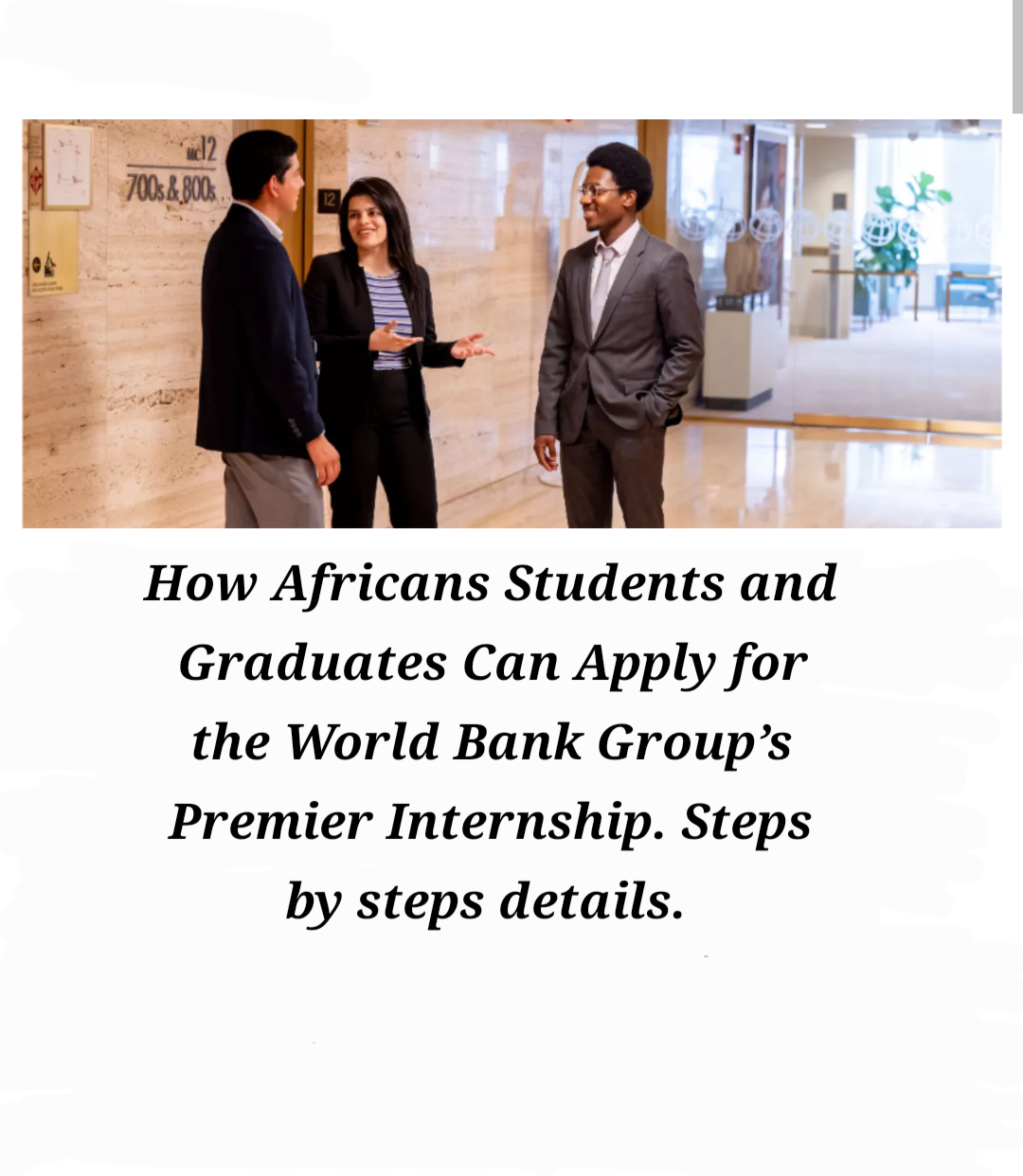
When I started looking for international opportunities that could genuinely strengthen my career, I realised that some of the most valuable programmes are not necessarily the ones that come with the loudest advertising.
The World Bank Group Internship Program is one of those opportunities.
For an African student or recent graduate interested in economics, development, public health, agriculture, environment, finance, technology, education or other areas connected to international development, an internship with the World Bank Group can provide something that is difficult to get from a classroom alone: exposure to how large-scale development work is actually designed, analysed and implemented.
What caught my attention about this opportunity is that it is not simply about spending a few months in a famous international organisation and adding the name “World Bank” to a CV.
The internship is structured around actual work.
As an intern, I would expect to work with colleagues, contribute to projects and gain exposure to the World Bank Group’s operations and mission. That practical experience is particularly valuable if I am still studying and trying to understand what kind of career I want after graduation.
But there is something I would want every applicant to understand before starting.
Being eligible is not the same as being competitive.
The World Bank Group attracts applicants from around the world, so I would approach the application as a serious professional recruitment process rather than as a routine student internship.
In this guide, I’ll walk through how I would approach the World Bank Group’s premier internship as an African applicant, including the eligibility requirements, documents, application process, selection timeline and the details I would check carefully before pressing the final submission button.
What Is the World Bank Group Internship Program?
The World Bank Group’s internship is a structured professional learning opportunity for students who want practical exposure to international development work.
It is designed to give participants the opportunity to contribute to projects and initiatives connected to the World Bank Group’s work while developing professional and technical skills.
For me, the biggest attraction would be the opportunity to see what happens behind the scenes.
At university, I might study development economics, public health, environmental policy, agriculture or finance from a theoretical perspective.
At the World Bank Group, I could potentially see how those ideas are used in real projects and policy work.
That difference matters.
It is one thing to write a university paper about poverty reduction.
It is another thing to contribute to research, analysis, project preparation, data work or other tasks connected to an actual development initiative.
Can African Students Apply for the World Bank Internship?
Yes. The World Bank Group’s internship opportunities are international, and qualified candidates from different countries and backgrounds are encouraged to apply.
There is no reason for me to assume that being from Africa automatically puts me at a disadvantage.
At the same time, I would not approach the application with the mindset that my nationality alone makes me competitive. The stronger question is:
What can I demonstrate that I can contribute?
If I am an economics student, for example, I would want my application to show evidence of quantitative ability, research experience or relevant academic work.
If I am studying public health, I would highlight relevant research, data analysis, fieldwork or coursework.
If I am interested in technology, I would make my technical skills visible rather than simply writing “computer literate” on my CV. That is how I would think about the application.
Why I Would Take This Internship Seriously
There are plenty of internships that are essentially about observing what everyone else is doing.
This opportunity is more interesting because interns can become involved in ongoing work.
The areas covered by the World Bank Group are extremely broad. Depending on the specific position and business needs, work can relate to areas such as:
Economics
Investment
Investment portfolio management
Public health
Education
Nutrition
Population
Agriculture
Environment
Engineering
Urban planning
Natural resources management
Private sector development
Finance
Accounting
Communications
Human resources
Information technology
That range is important because “World Bank internship” does not mean there is one single type of intern doing one specific job. The experience can be very different depending on the team, office and assignment.
What Could I Actually Work On?
If I were selected, I would expect my day-to-day work to depend heavily on the team I joined. The World Bank Group works across areas including:
Health
Education
Economics
Environment
Agriculture
Urban development
Transport
Digital development
Energy
Private sector development
Corporate support functions
So, I would not build my expectations around spending every day in high-level meetings.
Real internship work can involve research, data, documentation, analysis, communication, project support and other tasks that help a team move its work forward.
That is actually something I would welcome. The valuable part of an internship is often the less glamorous work because that is where I learn how professional teams actually operate.
The Professional Experience I Would Be Looking For
If I were selected for the World Bank internship, I would want to leave with more than a certificate. I would want evidence of what I actually worked on.
For example, I would like to be able to say that I contributed to a research assignment, supported a development project, analysed information, prepared materials or assisted a team with a specific piece of work.
Those details make a CV much stronger than simply writing: World Bank Group Intern 2026
A strong internship experience should eventually allow me to explain what I did, what tools I used, what I learned and what kind of contribution I made. That is why I would take even seemingly small assignments seriously.
Is the World Bank Internship Paid?
Yes, the internship is a paid opportunity. Interns receive an hourly salary.
That is an important advantage because an international internship can otherwise create a significant financial burden for students.
However, there is another detail that I would pay very close attention to.
Accommodation is my responsibility
The programme information makes clear that interns are responsible for arranging and paying for their own accommodation.
I would therefore not confuse “paid internship” with “fully funded internship.” Those are two different things.
If I were selected for an internship in Washington, D.C., for example, I would immediately start researching accommodation costs, transport and everyday living expenses.
Washington, D.C. can be expensive, so I would want to understand the practical financial side before making travel plans.
Where Does the World Bank Internship Take Place?
Internship opportunities may be based in Washington, D.C. or in World Bank Group country offices, depending on business needs and the available internship position.
This means I would not assume that every intern is automatically going to Washington. The location would depend on the specific opportunity.
For an African applicant, the possibility of working through a country office could also be particularly interesting because it may provide exposure to development work closer to the regional context I already understand.
Who Is Eligible for the World Bank Group Internship?
This is where I would carefully determine which track applies to me. The programme described in the source information has two main routes:
Undergraduate Track
For the undergraduate track, applicants must be final-year undergraduate students. This is important.
Simply being enrolled in a bachelor’s programme is not enough if the requirement is that I must be in my final year.
My transcript should therefore clearly demonstrate my current academic status.
Postgraduate Track
The postgraduate track is for students who are currently pursuing:
A master’s degree, or
A PhD
Again, I would make sure my academic documentation clearly proves my current status.
How Much Professional Experience Can I Have?
The eligibility information allows applicants with 0 to 6 years of professional experience. That is useful because it means the programme is not restricted exclusively to people who have never worked.
If I had completed internships, worked part-time, volunteered professionally or had several years of relevant experience, I would still check the experience requirement rather than assuming I was automatically disqualified.
At the same time, I would make sure my CV clearly distinguishes between education, professional experience, internships, volunteer work and other activities.
Technical Skills Matter More Than Many Applicants Realise
One detail that I would take seriously is the requirement for strong computing and technical skills. I would not simply write:
“Computer skills: Microsoft Office.”
That is too vague.
If I had experience with Excel, statistical software, programming, data analysis, research databases, GIS, financial modelling, data visualisation or other relevant tools, I would specify them.
For example, saying that I have experience analysing datasets in a particular software package tells the recruiter much more than saying I have “good computer skills.”
The exact technical skills that matter will depend on the role. An economics-related position may value quantitative and analytical tools.
A technology position may require programming or other technical expertise. A communications position may value digital communication and content tools.
The lesson I would take is simple: I would make my relevant skills visible instead of expecting the recruiter to infer them.
Step-by-Step: How I Would Apply for the World Bank Internship
Now we get to the part that matters most. If I were preparing my application, I would approach it in the following order.
Step 1: Determine Which Track Applies to Me
Before opening the application form, I would answer one question: Am I applying through the Undergraduate Track or Postgraduate Track?
If I am a final-year bachelor’s student, I would prepare for the undergraduate route. If I am currently pursuing a master’s or PhD, I would use the postgraduate route.
This sounds obvious, but it affects the evidence I need to provide. My transcript needs to demonstrate my current status.
Step 2: Prepare My CV
The CV is one of the most important documents in this application. I would not treat it like a generic university CV.
If I were applying for the World Bank Group internship, I would want the recruiter to understand my academic background, professional experience, research exposure, technical skills and relevant achievements quickly.
I would keep the information relevant. If I am applying for an economics-related opportunity, for example, I would give more attention to:
Economics coursework
Research projects
Quantitative analysis
Data experience
Relevant internships
Academic achievements
Research publications or papers, where applicable
If I am applying for an environment-related role, I would bring relevant environmental projects, fieldwork, research and technical experience closer to the top.
The CV should not simply describe everything I have ever done. It should help the recruiter understand why my background makes sense for the opportunity.
Step 3: Prepare a Strong Statement of Interest
The statement of interest is another document I would not rush.
I would avoid writing a generic paragraph like: “I have always admired the World Bank and would be honoured to work with such a prestigious organisation.”
That sentence could belong to thousands of applications. Instead, I would make the connection specific.
I would explain:
- What I am studying.
- What area of development interests me.
- What relevant experience I already have.
- Why the World Bank Group’s work fits my interests.
- What I hope to contribute.
- What I hope to learn from the internship.
For example, if my academic work focuses on agricultural development in Africa, I would explain how that interest developed and connect it to relevant World Bank work.
The strongest statement would make it easy to understand why this internship makes sense for me at this point in my academic journey.
Step 4: Get the Correct Transcript
This is one of the details I would check carefully before submitting. Applicants are required to provide proof of enrollment or an education transcript.
For undergraduate applicants, the transcript should clearly demonstrate that I am a final-year bachelor’s student.
For postgraduate applicants, it should demonstrate that I am currently pursuing a master’s degree or PhD. This is more important than it might initially appear.
If the document I upload does not clearly demonstrate my current academic status, I could create unnecessary uncertainty for the person reviewing my application.
I would therefore inspect the transcript before uploading it. I would ask: Does this document clearly show what programme I am currently enrolled in and where I am in that programme?
If the answer is unclear, I would find out what alternative official proof of enrollment is accepted.
Step 5: Check Every Document Before Submission
There is a particularly important warning attached to this application process: Once the application is submitted, applicants cannot make changes or updates.
That changes how I would handle the final submission. I would not treat the application button as something I can click casually. Before submitting, I would check:
My name
Email address
Education details
Programme
Dates
CV
Statement of interest
Transcript
Uploaded file versions
File readability
Contact information
Any other required application fields
I would also open the uploaded files and check them. Not just look at the filename. I would actually open them.
A file called Final_CV.pdf is useless if it is blank, corrupted or contains an old version.
Step 6: Have Someone Review the Application
The source specifically recommends due diligence before submission. I agree with that approach.
If I had someone I trusted who could review my application professionally, I would ask them to check it before I submitted it. But I would not ask them:
“Does this look good?” I would give them specific things to check. For example:
“Can you check whether my CV has any spelling errors?”
“Does my statement clearly explain why this internship fits my background?”
“Does my transcript prove that I am currently in the required academic track?”
“Do you notice any inconsistencies in my dates?”
Those questions produce more useful feedback.
Step 7: Submit the Application
Once everything was checked, I would submit the application. After successful submission, applicants receive an individual confirmation email containing an application number.
I would save that email. I would also save the application number somewhere secure.
If I needed to reference my application later, having that number immediately available would be much easier than searching through an inbox full of emails.
What Happens After I Submit?
This is where patience becomes important. I would not expect an immediate interview invitation. The selection process takes time.
According to the timeline in the source information, applicants are notified in March regarding selection and whether they will be invited for an interview.
That means March would be the month I would watch my email particularly closely.
When Are World Bank Internship Applicants Selected?
For the cycle described in the source material, selection notifications are expected in March. The notification will indicate whether an applicant is invited for an interview.
That means the first email is potentially very important. If I received an interview invitation, I would immediately begin preparing. I would revisit:
My CV
My statement of interest
The projects and experiences I mentioned
The technical skills I listed
The World Bank Group’s mission
The development area connected to the position
I would not prepare by memorising a speech. I would prepare by making sure I can comfortably discuss the experiences I already claimed in my application.
When Does the Internship Start?
The internship period described in the source runs from April to September.
So, if I were selected for the cycle described, I would expect the internship to take place during that period.
That is a substantial period of professional exposure. It is long enough to move beyond a quick introduction to the organisation and potentially become familiar with the work of a particular team.
What I Would Expect During the Internship
If I were selected, I would go in with realistic expectations. I would not expect to walk into the World Bank Group and immediately make major policy decisions.
Instead, I would expect to learn by contributing to the work of people who are already working on complex development issues. That could mean supporting research.
It could mean analysing information. It could involve preparing materials. It could involve working with data. It could involve helping with project-related activities.
The exact experience would depend on the team. But the valuable part would be getting an inside view of how a major international development institution operates.
Why This Could Be Valuable for an African Student
For me, the biggest advantage would be the combination of academic knowledge and international professional exposure. Suppose I am studying development economics in an African university.
I might already understand the theoretical side of development. An internship with the World Bank Group could expose me to how development professionals approach real projects, research and policy challenges.
The same applies to students in:
Public health
Agriculture
Environmental science
Engineering
Economics
Finance
Education
Information technology
Social sciences
Urban development
The experience could help me understand not only what I learned in university, but how those skills are used in a professional development environment.
What I Would Put on My CV After the Internship
One thing I would think about from the beginning is how to document what I actually accomplish. If I spent several months at the World Bank Group, I would keep a private record of:
Projects I contributed to
Research tasks
Technical tools I used
Reports or materials I helped prepare
Skills developed
Professional areas I was exposed to
Major responsibilities assigned to me
That makes it much easier to update my CV afterwards. Instead of writing: “Worked as an intern at the World Bank.”
I could potentially describe the actual work I performed. That is far more useful to a future employer, graduate programme or scholarship committee.
My Practical Application Strategy
If I were an African student applying for this internship, my approach would be straightforward.
First, I would establish eligibility.
I would confirm that I am either: A final-year bachelor’s student, or Currently pursuing a master’s degree or PhD.
I would also check the professional-experience limit and technical requirements.
Second, I would identify relevant opportunities.
I would not simply apply because the organisation is prestigious. I would look for positions that connect with my academic background and skills.
Third, I would customise my CV.
The most relevant education, experience and technical skills would be easy to find.
Fourth, I would write a specific statement of interest.
I would explain why my background connects with the work.
Fifth, I would verify my transcript.
I would make sure my academic status is clearly demonstrated.
Sixth, I would conduct a final application audit.
Because I cannot edit the application after submission, this step would be non-negotiable.
Seventh, I would save my confirmation email and application number.
Then I would monitor my email for the selection process.
Mistakes I Would Avoid
Mistake 1: Applying before checking the academic track
If I am not in my final undergraduate year or currently pursuing a master’s/PhD, I should not simply assume I qualify. I would check the applicable eligibility rules first.
Mistake 2: Uploading the wrong transcript
The transcript needs to demonstrate my academic status. I would check it before uploading.
Mistake 3: Writing a generic statement
The World Bank Group is not the only organisation receiving applications from ambitious students. A generic statement does little to explain why I belong in this particular opportunity.
Mistake 4: Listing technical skills without evidence
If I claim that I have strong analytical or computing skills, I would ideally have academic, professional or project experience that demonstrates them.
Mistake 5: Submitting without proofreading
Because the application cannot be changed after submission, I would proofread everything first.
Mistake 6: Ignoring the confirmation email
I would save the application number immediately.
Mistake 7: Forgetting about accommodation costs
The internship is paid, but accommodation is the intern’s responsibility. I would budget accordingly, particularly if the placement is in Washington, D.C.
World Bank Group Internship Application Checklist
Before I submit, I would want to be able to tick every box below:
Eligibility
I am a final-year undergraduate student, or
I am currently pursuing a master’s degree or PhD.
I fall within the stated professional-experience range.
I have the relevant technical/computing skills.
My academic background fits the internship opportunity.
Documents
Updated CV
Statement of Interest
Proof of enrollment/education transcript
Transcript clearly demonstrates my current academic status
All documents are readable
Correct versions have been uploaded
Final review
My personal information is correct.
My education dates are consistent.
My CV contains no obvious errors.
My statement is specific to the opportunity.
I have checked all uploaded files.
Someone I trust has reviewed the application if possible.
I understand that I cannot edit the application after submission.
After submission
I received the confirmation email.
I saved my application number.
I am monitoring my email.
I am prepared for a possible March selection notification.
I understand the internship period is April–September for the cycle described.
Is the World Bank Group Internship Worth Applying For?
For me, the answer would be yes provided that my academic and professional background genuinely fits the opportunity.
The biggest attraction is not simply the name of the organisation. It is the possibility of gaining practical experience in an institution working across some of the world’s most complicated development challenges.
For an African student, that experience can be particularly valuable. I could enter the programme with classroom knowledge and leave with a much better understanding of how international development work operates in practice.
And because the internship is paid, it can also provide some financial support during the placement, although I would still need to plan carefully for accommodation and other personal expenses.
Final Summary
If I were applying for the World Bank Group Internship, I would not think of it as just another internship application.
I would treat it like a professional recruitment process. I would start with eligibility. Then I would identify the track that applies to me. I would prepare a CV that shows what I can actually do.
I would write a statement of interest that connects my academic background to the World Bank Group’s work. I would make sure my transcript clearly proves my student status.
And before pressing submit, I would check everything twice because once the application is submitted, I cannot simply log back in and fix an embarrassing mistake.
For African students and graduates building careers in economics, public health, agriculture, environment, finance, technology, engineering, social sciences and development-related fields, this is an opportunity worth knowing about.
But I would approach it realistically. The World Bank name alone will not make an application competitive.
What matters is whether I can show that my academic background, technical skills, interests and experience make sense for the opportunity.
If I can demonstrate that clearly and submit a complete, carefully checked application I give myself a much better chance of making it through the first stage.
And if the March selection email eventually arrives inviting me to an interview, that is when the application moves from paper to conversation. The internship itself is then scheduled for the April–September period described in the source information.
That is the part I would ultimately be working toward: not just having “World Bank” on my CV, but leaving the internship with real experience I can explain, skills I can demonstrate and a much clearer understanding of where I want my career in global development to go.
Important: Internship eligibility, available positions, deadlines, locations, selection dates and other programme conditions can change between recruitment cycles. The April–September internship period and March notification timeline above reflect the cycle described in the source material. Applicants should verify the current World Bank Group Internship Program announcement and official application portal before submitting an application.
Official portal for Applications
Related opportunity for African Scholars
CERN Short-Term Internship 2026 in Switzerland: What I Would Know Before Applying
NVIDIA Internship Program 2027: Paid Opportunities for Students and Recent Graduates
CSIS Communications and Operations Internship 2026, Paid Full-Time Opportunity for Graduates
How to Apply for OECD Internship Program Open to Postgraduate and Undergraduate Students Only
Discover more from Scholars Africa
Subscribe to get the latest posts sent to your email.

About Scholars Africa Editorial Team
Scholars Africa Editorial Team is dedicated to researching and publishing verified scholarships, jobs, and global opportunities. Our content is built on extensive analysis of application trends, eligibility criteria, and selection patterns to help applicants succeed at every stage. Our team has reviewed hundreds of scholarship programs and application processes across multiple countries.
I’m looking forward in seeing your good response towards my email
Interested